
Loading, please wait...
LOT 0280
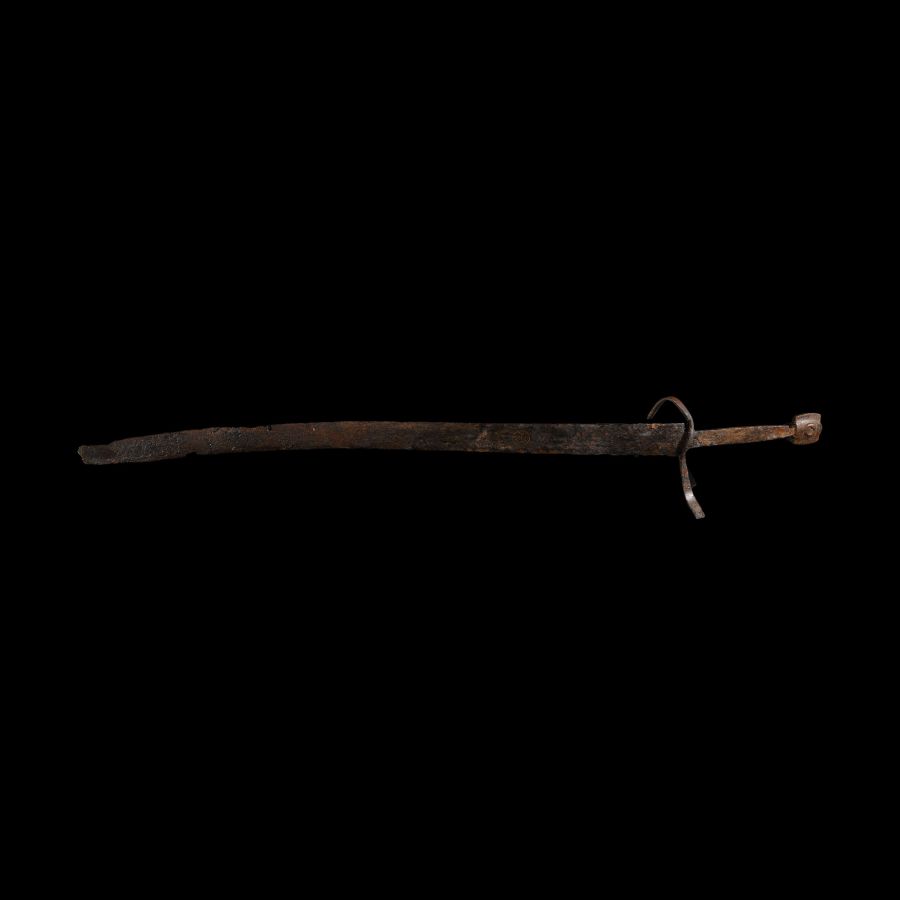
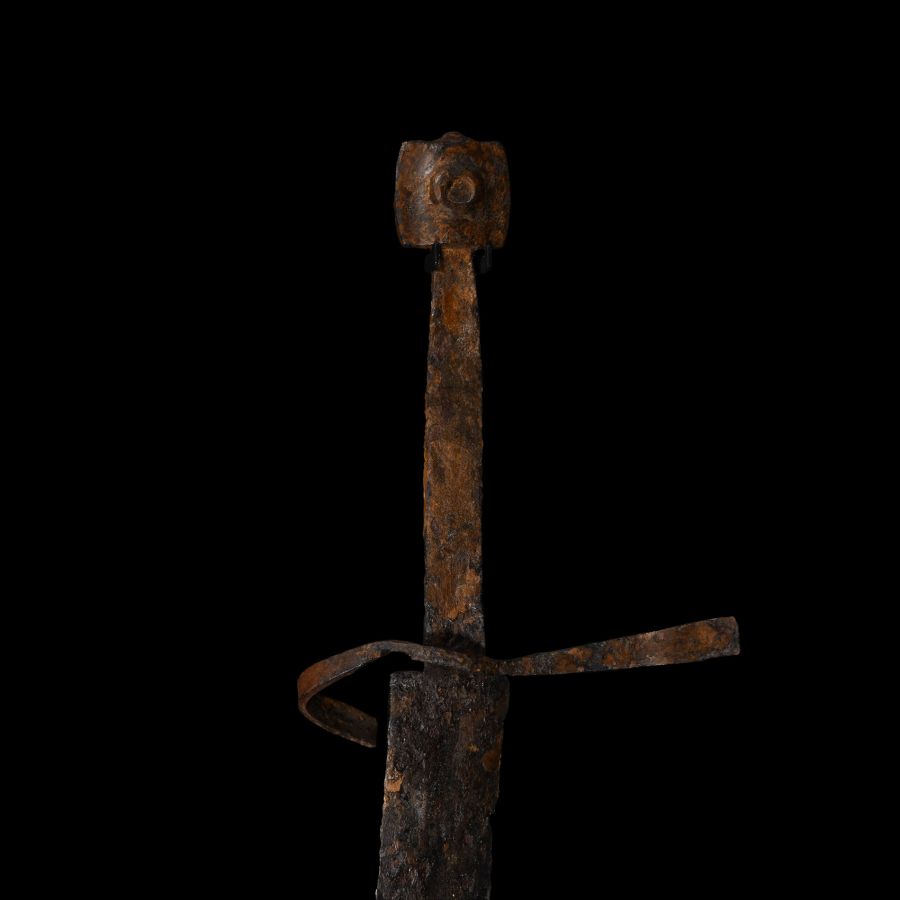
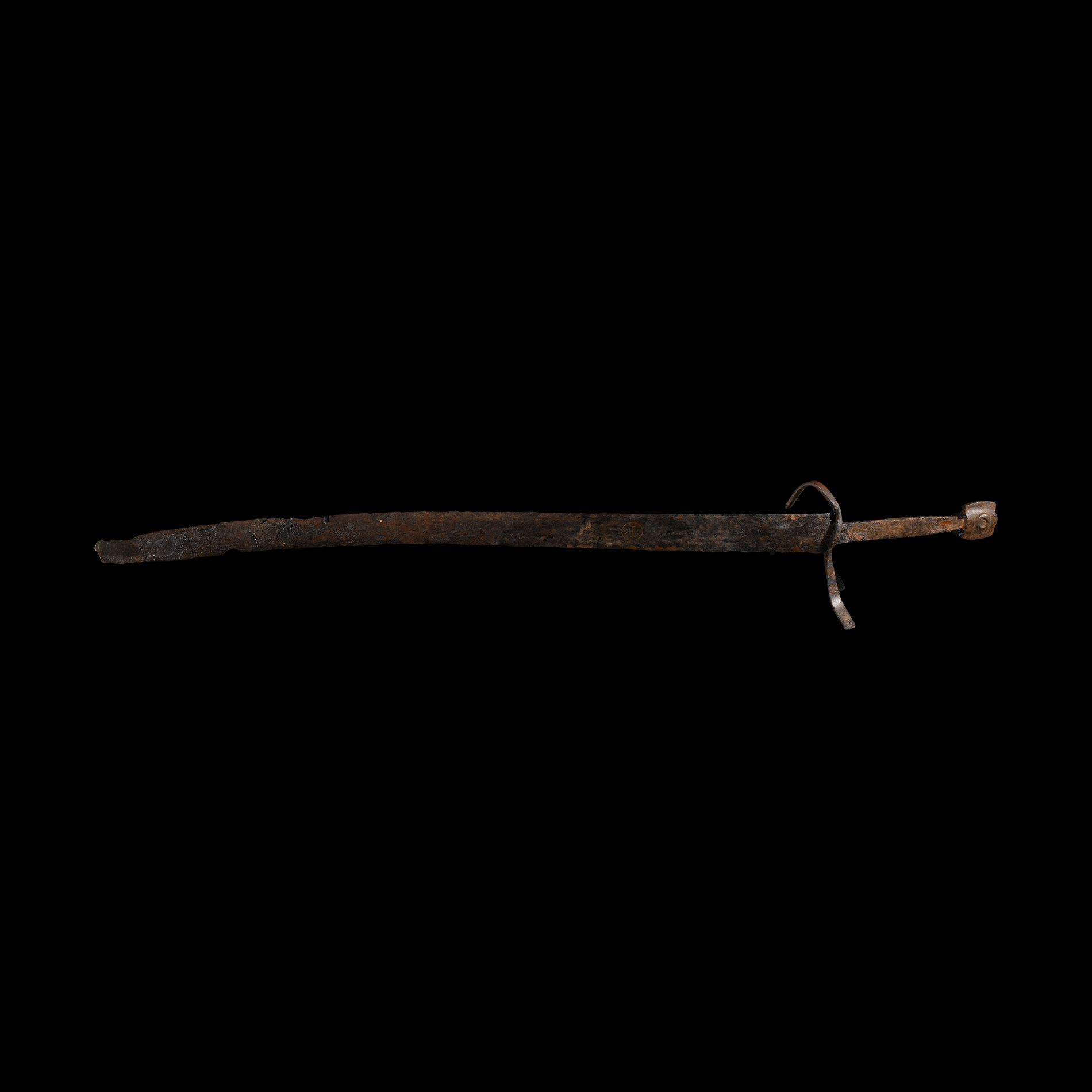
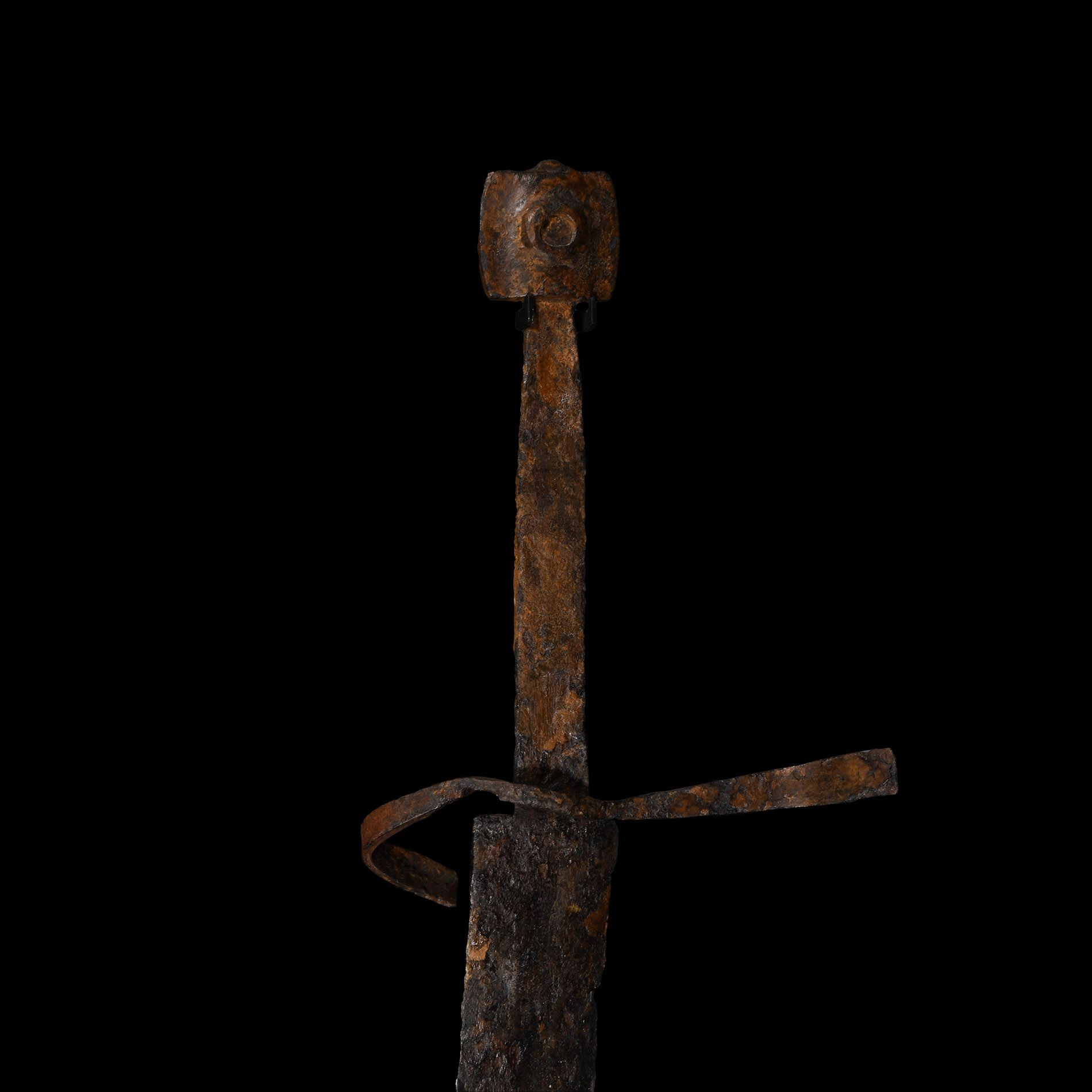
Medieval Iron Schiavonesca Type Sword with Latten Inlaid Crosses
CIRCA 15TH CENTURY A.D.
43 1/4 in. (1.7 kg total, 1.11 m).
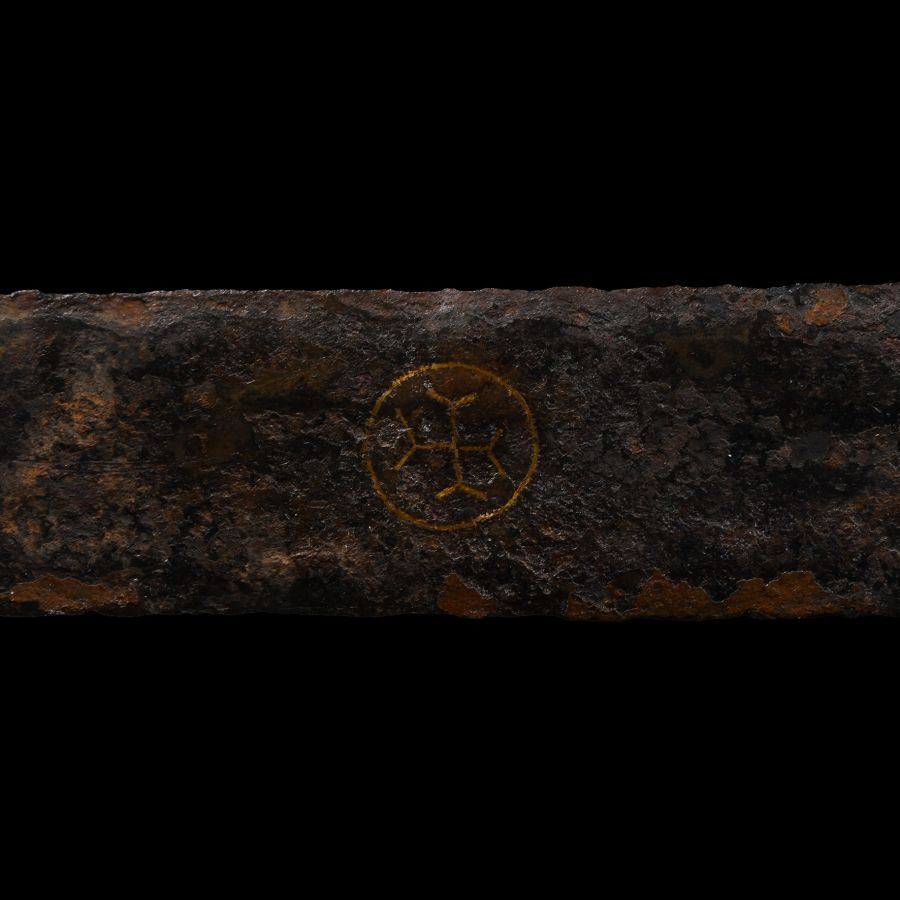
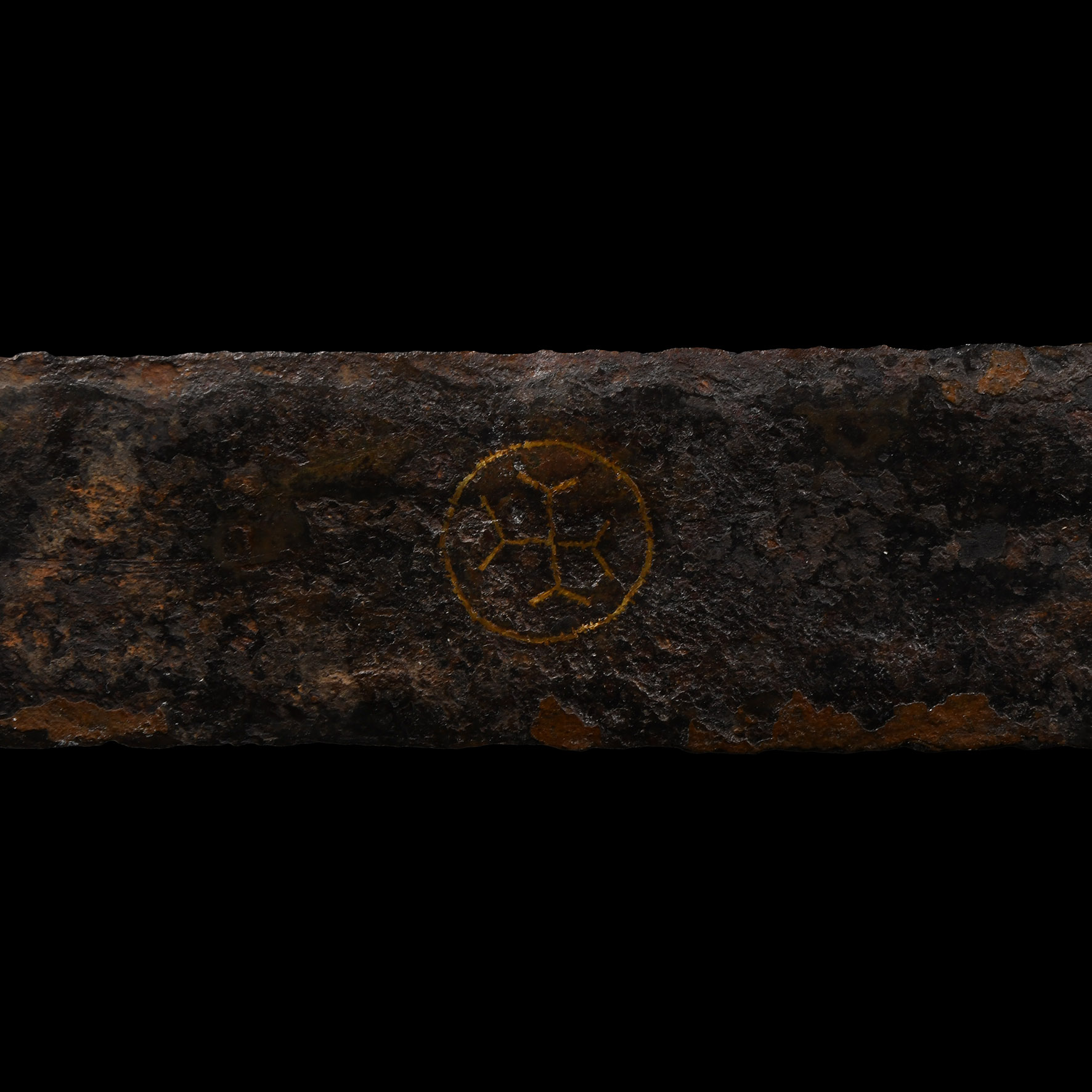
Comprising a broad double-edged parallel-sided blade, flat-section at the upper third with a very shallow central fuller, elliptical-section at the lower end; flat guard with scooped lower edge, D-section arms horizontally S-curved; 'cat's head' type pommel, rectangular with scrolled upper edge and integral central boss to both faces; on the upper part of the blade an engraved three-armed workshop mark and two possibly later added brass inlaid marks including a cross fourchee inside and the image of a sword to one side; mounted on a wall display mount.
ProvenancePrivate collection, Munich, Germany, 1970s.
Private collection, London, UK, 2014, acquired from the above.
See Aleksić, M., Mediaeval Swords from Southeastern Europe, material from 12th to 15th century AD, Beograd, 2007, especially cat. nos.273, pl.17, 2-3-4; similar swords at the armoury of the Ducal Palace in Venice, see Franzoi, U., L’Armeria del Palazzo Ducale a Venezia, Treviso, 1990, fig.41f., and in National Hungarian Museum, Budapest (inv. nr. 53.310, see Aleksić, 2007, cat.124).
FootnotesThe Schiavonesca sword was used by Dalmatian mercenaries serving in the Venetian state armies, and produced by the workshops of the Serenissima to which the marks probably belong. Many of these swords were produced in Dubrovnik, a Croatian city under the Venetian rule. Oakeshott classified all the pommels of square shape in his Type Z. Certain morphological differences between them were individuated by Dr Aleksić as a criteria for distinguishing the distinct subtypes, in this case the type Z3 for the upper crenelleted edge. The cross-guards of type 12b, like in this case, have symmetrically and horizontally sharply bent arms in the opposite directions. The 'cat's head' pommel is also found on surviving examples of cross-hilted swords of the 14th century which can be traced into the hands of Slavonic soldiers stationed in southern Europe, employed in the European armies of this period. The independent representation of the cross fourchee usually inscribed in a circle is rather frequent on the swords with type 12 cross guards and type Z pommel from Hungary, Northern Balkans and the neighbouring regions (Aleksić, 2007, p.122).
CONDITIONTimeLine Auctions follows a vetting process to ensure the authenticity and legality of all items, reinforcing our commitment to integrity and responsible trading. Each antiquity, antique, and coin lot undergoes thorough examination by a vetting committee of at least ten external specialists, professional trade association members, scientists, and archaeologists: Our Vetting Process
AUCTIONS:
TimeLine is a leading auction house specialising in antiquities, ancient art, collectables, natural history, coins, medals, and books. Our auctions offer museums, collectors, historians, and enthusiasts the opportunity to acquire unique and historically significant pieces.
LOT 0280
Medieval Iron Schiavonesca Type Sword with Latten Inlaid Crosses
Estimate £800 - 1,000€930 - 1,160 (for guidance only)$1,080 - 1,350 (for guidance only)
-
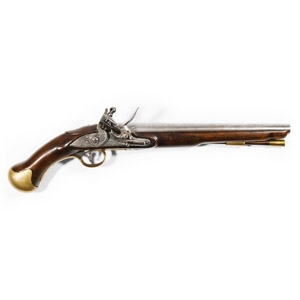
Tower Long Sea Service Flintlock Pistol
1800 A.D.Estimate: £3,000 - 4,000 (+bp*)
Opening Bid: £1,278
Napoleonic era with 30cm (12") round smooth bore barrel of .56" bore with London proof marks, the lock with 'TOWER', 'crown-over-GR' and 'crown-over-broad-arrow' marks fitted with brass-tipped wood ramrod and wood full stock and butt with brass butt cap, trigger guard, side plate and ferrule with steel belt hook; action working to half and full cock. 1.40 kg, 49 cm
Acquired from Andrew Bottomley, UK. The Kusmirek Collection, UK. Accompanied by a copy of the Bottomley listing. This lot has been checked against the Interpol Database of stolen works of art and is accompanied by search certificate no.204079.
Sold as an exempt item under Section 58 (2) of the Firearms Act, 1968, to be held as a curiosity or ornament. No license required but buyer must be over 18 years of age. Overseas bidders should note that, due to UK regulations governing export of all firearms, overseas buyers will need to make arrangements for shipping this lot out of the UK directly, by air freight, with a specialist company or agent. -
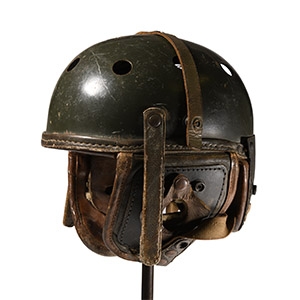
United States M38 Tank Crew Helmet
Circa 1940's A.D.Sold for (Inc. bp): £143
Rawling's pattern M38 composition tank crew helmet with neck protection plate and ear-flaps, fitted with leather lining with leather and fabric securing straps; finished dark green; with later inked 'CESARE' owner name and '1-5-79' date to liner. 613 grams, 27 cm high
Acquired from Czerny's Auction, lot 81515. The Kusmirek Collection, UK. Accompanied by copy of a previous invoice and lot description.
Possibly of Italian manufacture of the type used by US forces in WWII. -
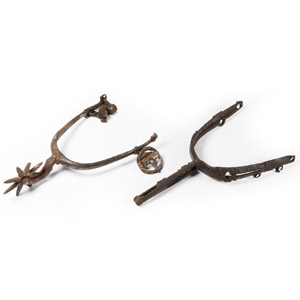
Medieval Iron Spur Group
13th-15th century A.D.Sold for (Inc. bp): £78
Comprising: one rowel spur with tapering D-section heelband, short shank and arched rowel box with articulated eight-armed rowel, attachment buckle with tongue suspended from integral loop on one arm, two lobed plaques with loops on reverse suspended from integral loops on the other; a spur with D-section heelband and lentoid-section shank, rectangular and quatrefoil openwork, sections of hatching and raised designs to the outer faces. 215 grams total, 16-18 cm
European collection, 1990s. Property of a Cambridgeshire, UK, gentleman.
