
Loading, please wait...
_900x900.jpg "Medieval Iron Rowel Spur Collection")
_200x200.jpg "Medieval Iron Rowel Spur Collection")
.jpg "Medieval Iron Rowel Spur Collection")
LOT 1779
Medieval Iron Rowel Spur Collection
CIRCA 14TH-16TH CENTURY A.D.
4 3/4 - 5 3/4 in. (257 grams total, 12.1-14.5 cm).
Comprising examples of various types, including some retaining the rowel, buckle and other fastening elements. [4, No Reserve]
ProvenanceAcquired 1990s-early 2000s.
East Anglian private collection.
Cf. for two of these spurs a similar specimen in the British Museum, inventory no.1915,1208.187, dated 1340-1400 A.D.
CONDITIONTimeLine Auctions follows a vetting process to ensure the authenticity and legality of all items, reinforcing our commitment to integrity and responsible trading. Each antiquity, antique, and coin lot undergoes thorough examination by a vetting committee of at least ten external specialists, professional trade association members, scientists, and archaeologists: Our Vetting Process
AUCTIONS:
TimeLine is a leading auction house specialising in antiquities, ancient art, collectables, natural history, coins, medals, and books. Our auctions offer museums, collectors, historians, and enthusiasts the opportunity to acquire unique and historically significant pieces.
-
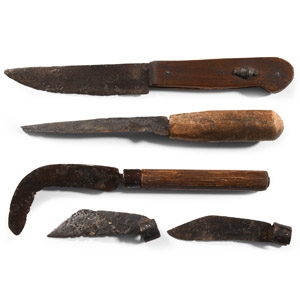
Medieval to Jacobean Period Iron Knife Collection
14th-17th century A.D.Sold for (Inc. bp): £13
Comprising: single-edged knife with swept edge, whittle-tang handle; single-edge knife with scale-tang handle, stamped with a crown in a pelleted cartouche; hawkbill knife with edge to the inner face of the curve; short broken-back blade with bolster; similar with punched 'f' maker's mark. 192 grams total, 8-21.5 cm
From the collection of the famous author, writer and speaker, Gordon Bailey, Essex, UK; formed since 1968. -
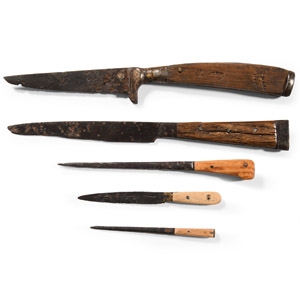
Medieval and Later Knife Collection
15th-17th century A.D.Sold for (Inc. bp): £85
Including a single-edged straight-bladed knife with scale-tang handle, one similar with hooked bolster and initials 'WR' in the handle, a tiny bone-handled pricket, and other items; many of these objects are published in the Detector Finds book series. 113 grams total, 8.7-20.5 cm
From the collection of the famous author, writer and speaker, Gordon Bailey, Essex, UK; formed since 1968. -
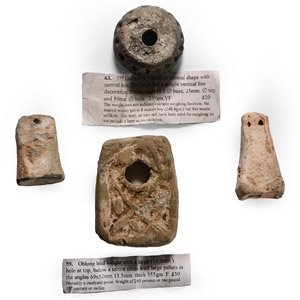
Medieval Lead Weight Group
12th-15th century A.D.Sold for (Inc. bp): £26
Including one a truncated cone with vertical ribbing, a square-section wedge with reserved 'T' to underside, and other types; two with typed collector's note. 976 grams total, 43-69 mm
Ex Simmons Gallery, 1990s. Accompanied by two typed information slips.
