
Loading, please wait...
_900x900.jpg "Medieval Iron Kidney Dagger")
_200x200.jpg "Medieval Iron Kidney Dagger")
.jpg "Medieval Iron Kidney Dagger")
LOT 0265
Medieval Iron Kidney Dagger
LATE 15TH CENTURY A.D.
18 1/8 in. (307 grams, 46 cm).
Featuring a wedge-shaped blade and a lobed handle; the hilt fitted with an iron plate bending down to form points on each side of the blade, pommel with a discoid brass plate decorated with an incised flower motif.
ProvenanceAcquired 1960s-1990s.
Late Alison Barker collection, a retired London barrister.
Cf. Tarassuk, L. & Blair, C., Complete Encyclopaedia of Arms & Weapons, London, 1982, p.156, item 5, for a late 15th century version of the type.
FootnotesThe term 'ballock dagger' was used in medieval times to describe a dagger with a grip bearing a considerable resemblance to a phallic symbol. It was also called 'kidney dagger' during the Victorian times. The constant characteristic is the presence of two roundish and symmetrical bulbs at the guard, with the grip itself emerging upward between them and flaring slightly towards the top, sometimes being surmounted by a cap.
CONDITIONTimeLine Auctions follows a vetting process to ensure the authenticity and legality of all items, reinforcing our commitment to integrity and responsible trading. Each antiquity, antique, and coin lot undergoes thorough examination by a vetting committee of at least ten external specialists, professional trade association members, scientists, and archaeologists: Our Vetting Process
AUCTIONS:
TimeLine is a leading auction house specialising in antiquities, ancient art, collectables, natural history, coins, medals, and books. Our auctions offer museums, collectors, historians, and enthusiasts the opportunity to acquire unique and historically significant pieces.
LOT 0265
Medieval Iron Kidney Dagger
Estimate £1,500 - 2,000€1,740 - 2,320 (for guidance only)$2,030 - 2,700 (for guidance only)
-
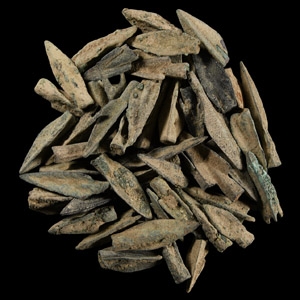
Greek Bronze Arrowhead Group
Circa 5th-3rd century B.C.Sold for (Inc. bp): £98
Primarily composed of socketted types, most triangular in section. 186 grams, 26-45 mm
Ex private collection, 1980s. Acquired on the UK art market in the 1990s. -
.jpg)
WWII 'RAF' Bomber (Mosquito) Helmet, Map and Whistle Group
1941 A.D. or laterSold for (Inc. bp): £1,170
Comprising: a type C leather open face helmet wired for type B communication, oxygen mask with hose and alloy-framed flying goggles with padded leather and rubber band, the frames stamped 'Stadium Made in England Patent Reg Design'; the helmet with webbing chin strap, buckles and stud fasteners, chamois leather lining bearing ink stamp and handwritten 'Adams Progressive' 'No.75-78', plug holder with paper label, tubular oxygen mask inlet marked 'MLD 18' 'MC253D', microphone plug and hose with brass connector stamped 'D/156'; together with an RAF flight map and an RAF 'ditching' whistle of classic snail type with Air Ministry's crown markings and reference numbers '23/230' and '293/14/L1795'; the helmet mounted on a wooden 'mannequin' head. 6.1 kg, 31 cm
Acquired from J C Militaria and Historic Flying Clothing Company. The Kusmirek Collection, UK. Accompanied by copies of listings for each item.
This type of helmet and system was introduced in 1941 A.D. -
.jpg)
Early Georgian Incendiary Iron Cannon Ball
Early 19th century A.D.Sold for (Inc. bp): £98
Featuring a circular opening to receive fuse and plug to one face; hollow-formed. 3.9 kg, 11 cm diameter
Fine condition.
Acquired after 2000. Property of a Buckinghamshire, UK, gentleman.
The shrapnel shell is named after Lieutenant-General Henry Shrapnel (1761-1842), a British officer who devised the hollow, gunpowder-filled ball that was fused to explode either in the air or on the ground with the resulting ball fragments proving to be an effective anti-personnel weapon; later types were filled with lead musket balls and powder to make the weapon even more effective against troops; such projectiles were used both with field artillery cannon and with mortars.
