
Loading, please wait...
LOT 0283
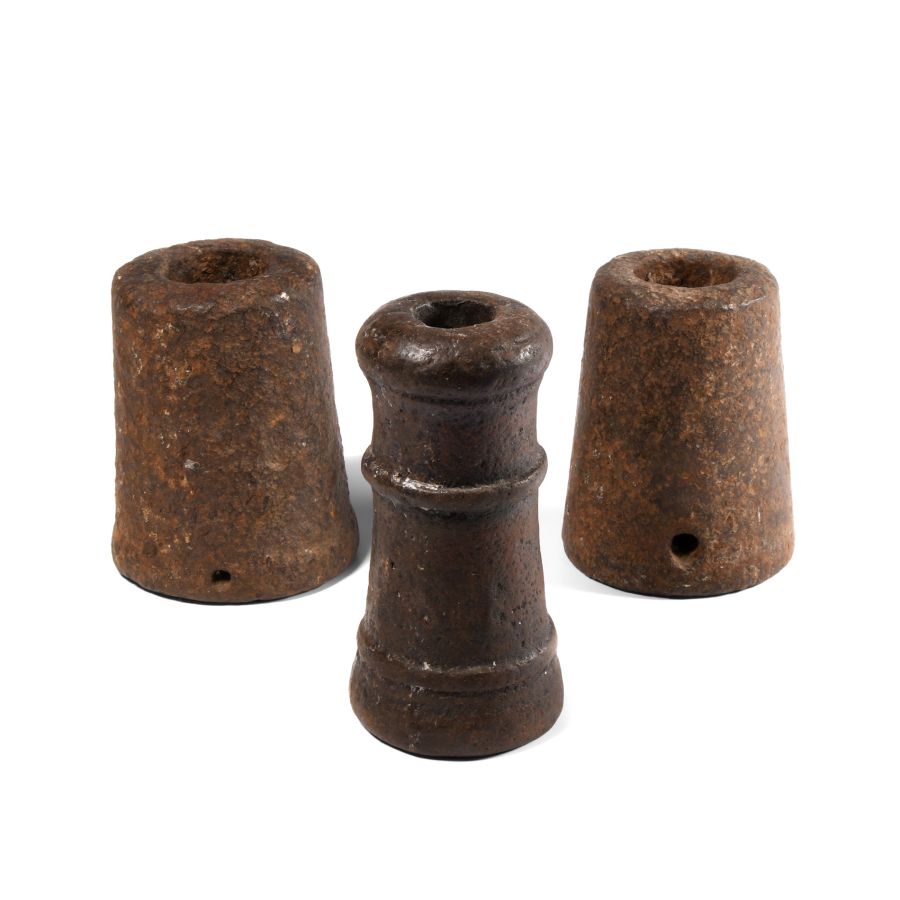
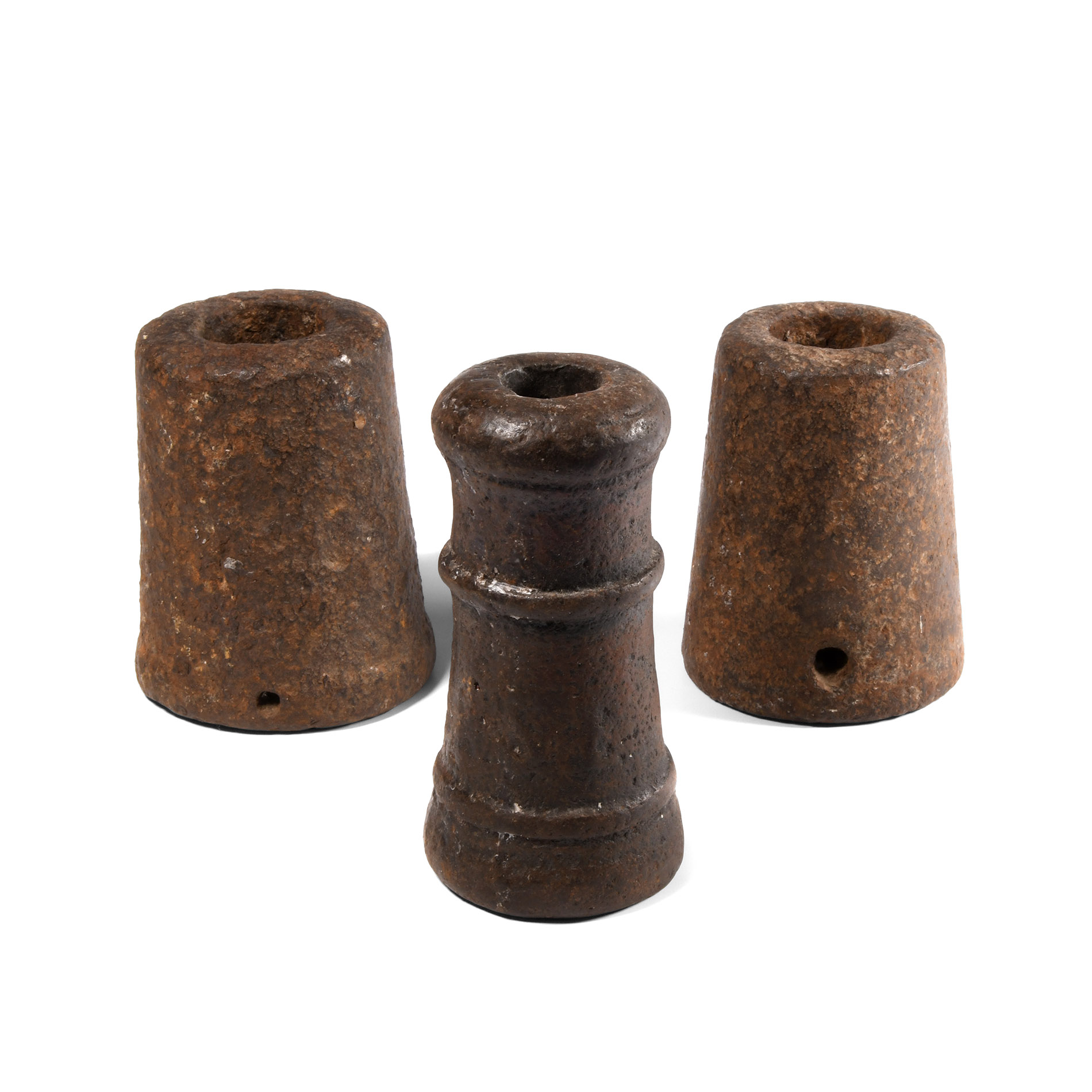
Medieval Iron Hand Cannon Collection
15TH CENTURY A.D.
3 3/4 - 4 3/4 in. (5.6 kg total. 9.5-12 cm).
Each comprising a touch hole to base. [3]
ProvenanceAcquired 1990s-early 2000s.
East Anglian private collection.
See Funcken, L. & Funcken F., Le costume, l'armure et les armes au temps de la chevalerie, de huitieme au quinzieme siecle, Tournai,1977, pp.66-69, for reconstruction of how such hand cannons were used.
FootnotesAt the beginning of the 14th century, among the infantry troops of the Western Middle Ages, developed the use of manual cannons (such as the Italian schioppetti, spingarde, and the German Fusstbusse). The new weapon had, compared to the bow and the crossbow, the advantage of not needing any particular care, of being manufactured more quickly and of being cheaper.
CONDITIONTimeLine Auctions follows a vetting process to ensure the authenticity and legality of all items, reinforcing our commitment to integrity and responsible trading. Each antiquity, antique, and coin lot undergoes thorough examination by a vetting committee of at least ten external specialists, professional trade association members, scientists, and archaeologists: Our Vetting Process
AUCTIONS:
TimeLine is a leading auction house specialising in antiquities, ancient art, collectables, natural history, coins, medals, and books. Our auctions offer museums, collectors, historians, and enthusiasts the opportunity to acquire unique and historically significant pieces.
-
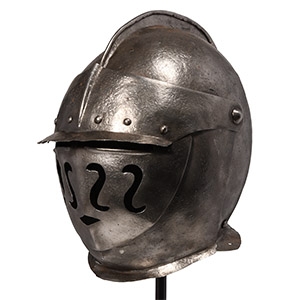
European Savoyard Burgonet
Circa 1620 A.D.Estimate: £3,500 - 4,500 (+bp*)
Opening Bid: £1,389
Comprising a full face shield with broad wavy bars and a small mouth opening, a wide hinged visor; the visor and the front section of the helmet secured by large hook-and-eye closures on the right-hand side; the crown with a tall ridge running from front to back, small collar for protecting the neck. 1.14 kg, 25 cm high
Acquired from Andrew Bennett in 2016. The Kusmirek Collection, UK. Accompanied by a copy of a payment confirmation from Andrew Bennett, dated 1st June 2016. Accompanied by an academic report by Dr Raffaele D'Amato. This lot has been checked against the Interpol Database of stolen works of art and is accompanied by search certificate number no. 11768-203986.
This variation of the burgonet helmet is thought to have originated in the Savoy region of southeast France, and was very popular with heavy cavalry (Reiters) serving with a variety of Continental armies of the period. The term Savoyard is a reference to a large number of these helmets that the Swiss captured from the troops of the Duke of Savoy during an unsuccessful assault on the city of Genoa in 1602. The undulated bars and the small mouth of the visor are all indicative of the Savoyard style. The hinges on the side allowed the front of the helmet as a whole to be lifted away from the rear, aiding the wearer to place it over his head. -
.jpg)
Byzantine 'Greek Fire' Fire Bomb or Hand Grenade
9th-11th century A.D.Sold for (Inc. bp): £182
Piriform in shape with raised lugs to the upper body with stamped concentric roundels between. 588 grams, 15.3 cm
Family collection, acquired 1980-2015. Ex property of a North London gentleman. Accompanied by an academic paper by military specialist Dr Raffaele D'Amato, dated 15 July 2019 and titled 'Eastern Roman Empire - Greek Fire Bomb or Hand Grenade (μεσαίον kακάβιον) 9th-11th century AD'.
Apart from the use of siphons or manual flame-throwers called cheirosiphona, special corps of Roman soldiers employed terracotta grenades, in the form of small jars, abundantly evidenced in archaeological excavations. Such were the γανωτα, vessels (sometimes also of bronze) used for Greek fire. They were called μεσαία kακαβιά or κυτροκακάβια where the former had a bulbous shape and the latter a more cylindrical form. -
.jpg)
Roman Bronze Armour Squama Scales Group
2nd-3rd century A.D.Sold for (Inc. bp): £715
Mixed group of semi-rigid bronze scales with scalloped lower edges, pierced for attachment; together with two small panels of articulated lamina scales. 30 grams total, 10-65 mm
Acquired in the late 1980s. The Kusmirek Collection, UK.
A new form of rigid scale-armour, typified by pieces found in Britannia (Corbridge, Carlisle), Pannonia (Musov), Moesia (Iron Gates) and in various other provinces of the empire, was introduced earlier in the Antonine Period, and continued for all of the 3rd and 4th centuries A.D. The new body protection was realised with scales attached by wire to each of their four neighbouring scales. These new scales tended to be not only very small, but also long and slender and needed to be carefully shaped around the neck.
