
Loading, please wait...


LOT 1376
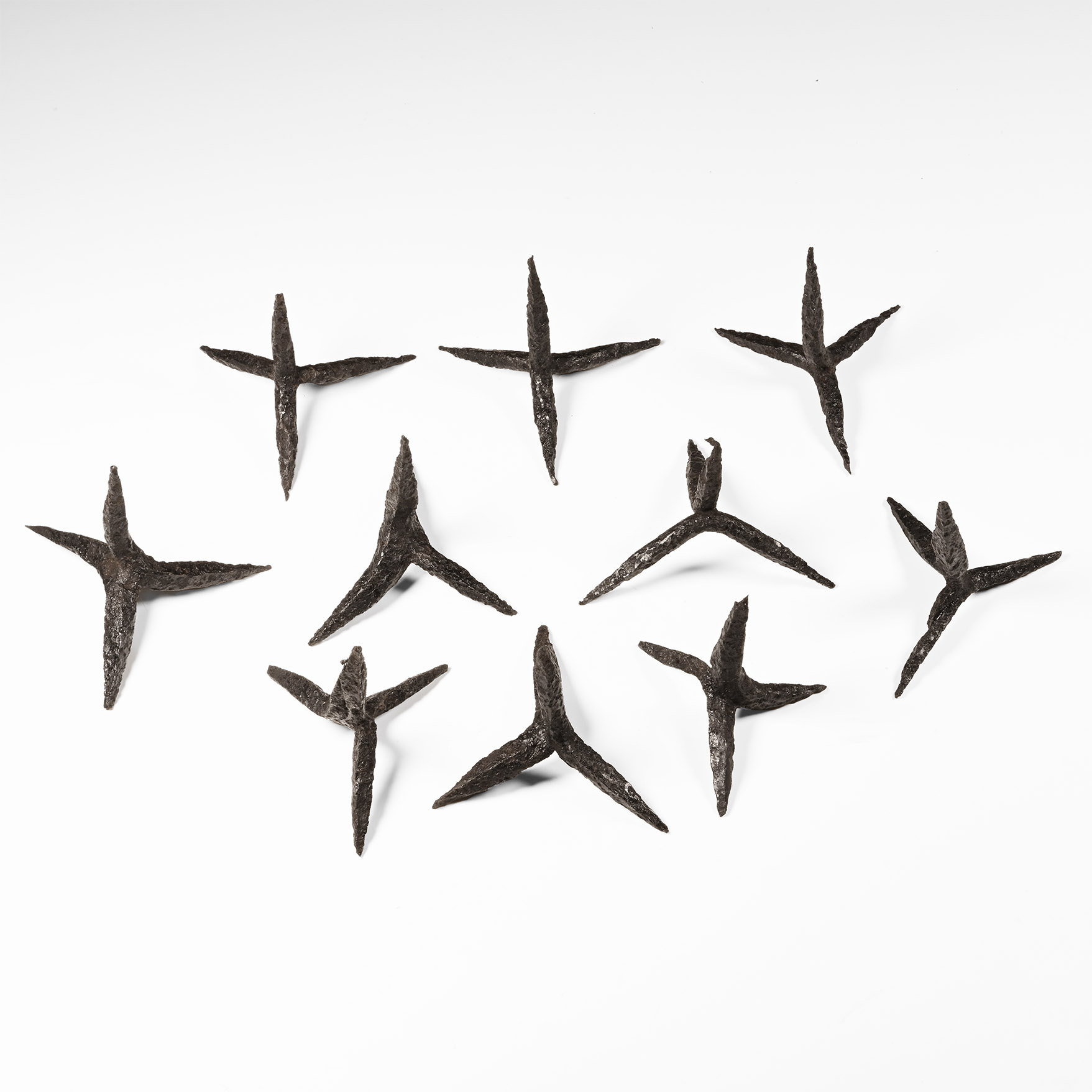
Medieval Iron Caltrop Anti-Cavalry Group
13TH-15TH CENTURY A.D.
3 - 3 3/4 in. (599 grams total, 77-96 mm).
A group of ten iron anti-cavalry caltrops, hand-forged with square-section spikes. [10, No Reserve]
ProvenanceFrom the private collection of a London gentleman, from his grandfather's collection formed before the early 1970s.
LiteratureCf. Žákovský, P., ‘Caltrop. Contribution to the knowledge of one neglected weapon’ in Studia Minora Facultatis Philosophicae Universitatis Brunensis, M 12-13, 2007-2008, pp.115-132, fig.9, nos.2,3,4,5 (type 3 of Žákovský classification).
FootnotesP. Žákovský has been able to classify medieval caltrops, mainly from the 13th to 15th century A.D., on the basis of their morphology, into four main typologies, each with different variants. Caltrops with single-pointed spikes, whose interpretation, however, is often ambiguous belong to type I. The other three types represent classic four-pointed caltrops, and individual types in this group differ from one another just in their cross-section.
CONDITIONTimeLine Auctions follows a vetting process to ensure the authenticity and legality of all items, reinforcing our commitment to integrity and responsible trading. Each antiquity, antique, and coin lot undergoes thorough examination by a vetting committee of at least ten external specialists, professional trade association members, scientists, and archaeologists: Our Vetting Process
AUCTIONS:
TimeLine is a leading auction house specialising in antiquities, ancient art, collectables, natural history, coins, medals, and books. Our auctions offer museums, collectors, historians, and enthusiasts the opportunity to acquire unique and historically significant pieces.
-
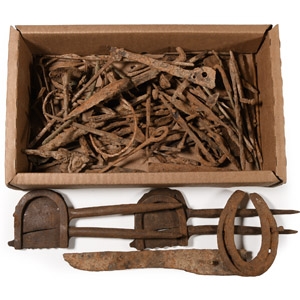
Roman Iron Arrowhead and Other Artefact Group
1st-4th century A.D.Sold for (Inc. bp): £117
Including horseshoes, arrowheads, surgical tools, architectural fittings and other items. 1.6 kg total, 4-19 cm
Ex Cambridge, UK, gentleman, 1990s. -
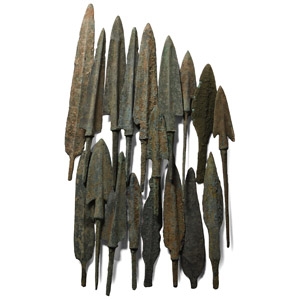
Luristan Bronze Arrowhead Collection
Circa 13th-9th century B.C.Sold for (Inc. bp): £312
Including triangular, leaf-shaped, barbed and other types. 446 grams total, 10-16.5 cm
Ex London, UK, collection, 1990s.
One series of arrowheads seem to belong to the category of lanceolate head and rounded shoulders from the category Type V, i.e. triangular arrowheads with rounded or angular midrib. Some other arrowheads seem to be a subcategory of subtype A of Khorasani but longer. -
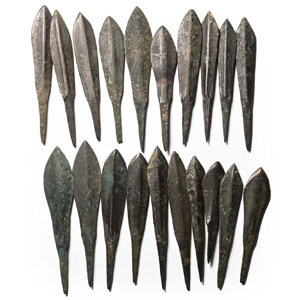
Old Babylonian Bronze Arrowhead Collection
1800-1500 B.C.Sold for (Inc. bp): £624
Comprising paddle-shaped arrowheads with a flat, comparatively wide mid-rib. 171 grams total, 53-78 mm
UK private collection before 2000. Acquired on the UK art market. Property of a London gentleman.
These kind of arrowheads were typical of the Old Babylonian Empire. The shoulders were pronounced and the arrowhead had a rectangular-section tapering tang. This simple form was popular throughout and show comparative common finds in the Bible Lands.
