
Loading, please wait...
LOT 1121
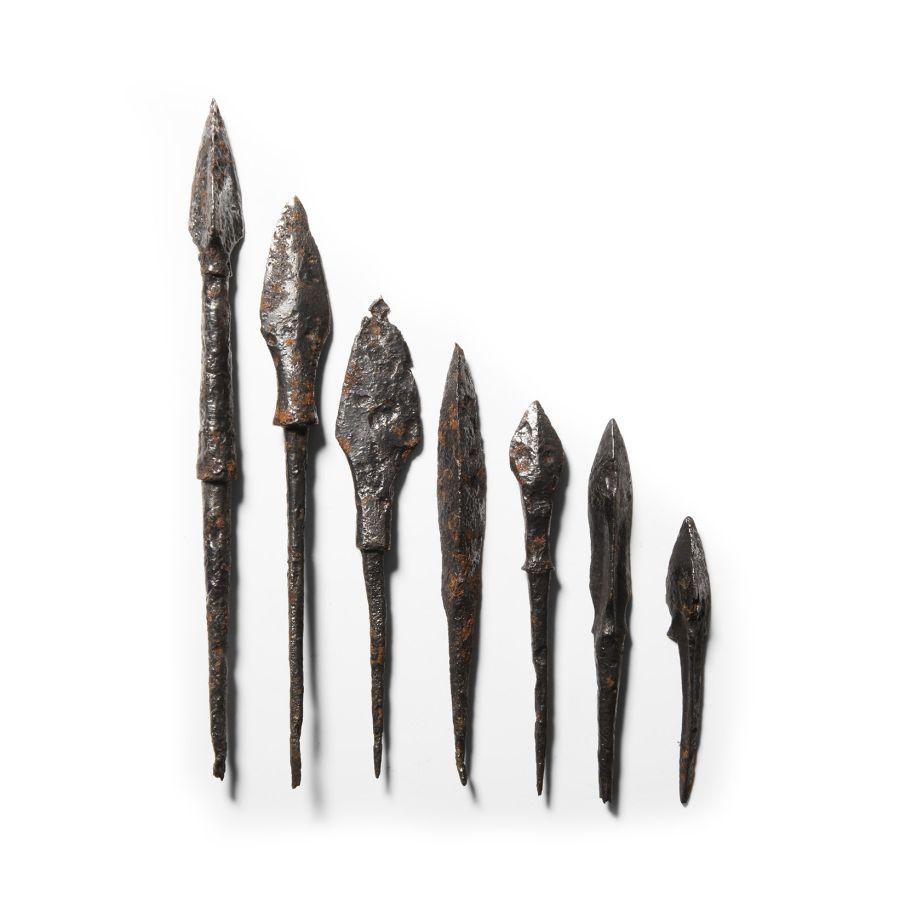
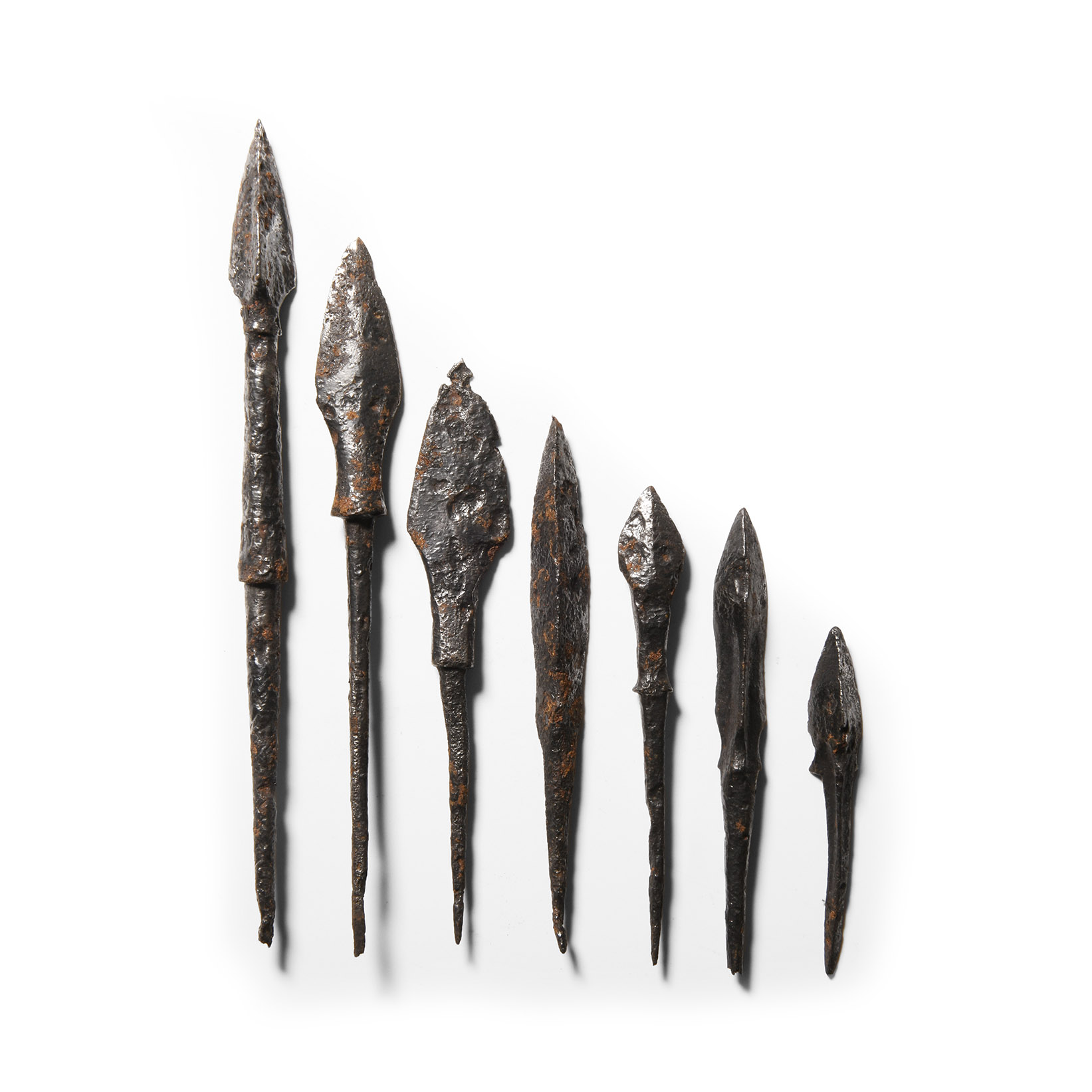
Medieval Iron Arrowhead Group
13TH-15TH CENTURY A.D.
2 - 4 1/2 in. (59 grams total, 5-11.6 cm).
Comprising tanged arrowheads of various types. [7]
ProvenanceAcquired before 1972.
The Kusmirek Collection, UK.
Cf. Michalak, A., Arma confinii, przemiany późnośredniowiecznej broni na rubieżach Śląska, Wielkopolski, Branderburgii i Łużyc (Arma confinii, transformations of late medieval weapons on the borders of Silesia, Wielkopolska, Brandenburg and Lusatia, in Polish), Zielona Gora, 2019, pls.92-128, for similar projectiles.
FootnotesThe projectiles belong to the type 1 of the A. Michalak classification. In Western Europe, especially from the 13th century onwards, arrows were made in various forms including: simple cone-shaped heads, rhomboid heads, hooked heads, heads with various curved barbs, willow-shaped heads, triangular and flat-bladed heads, crescent-shaped heads and sometimes as petal-shaped and battering heads.
CONDITIONTimeLine Auctions follows a vetting process to ensure the authenticity and legality of all items, reinforcing our commitment to integrity and responsible trading. Each antiquity, antique, and coin lot undergoes thorough examination by a vetting committee of at least ten external specialists, professional trade association members, scientists, and archaeologists: Our Vetting Process
AUCTIONS:
TimeLine is a leading auction house specialising in antiquities, ancient art, collectables, natural history, coins, medals, and books. Our auctions offer museums, collectors, historians, and enthusiasts the opportunity to acquire unique and historically significant pieces.
-
.jpg)
Evans Transitional 34-Shot Musket
1866-1867 A.D.Sold for (Inc. bp): £1,404
By Evans Repeating Co, with 71 cm (28") round barrel with 34 shot tubular magazine in butt and hinged back-sight, two-piece wood stock with steel butt plate, sling swivels, and collars; action working well and believed only 150 made. 3.85 kg, 117 cm
Acquired from M J Noble Ltd, UK, 2015. The Kusmirek Collection, UK. Accompanied by copies of the purchase invoice and listing.
Sold as an exempt item under Section 58 (2) of the Firearms Act, 1968, to be held as a curiosity or ornament. No license required but buyer must be over 18 years of age. Overseas bidders should note that, due to UK regulations governing export of all firearms, overseas buyers will need to make arrangements for shipping this lot out of the UK directly, by air freight, with a specialist company or agent. -
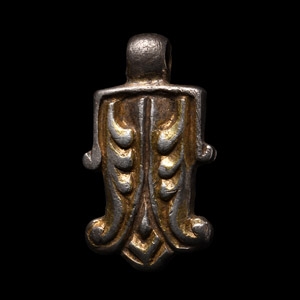
Khazar Silver-Gilt Sword Belt Hanger
7th-8th century A.D.Sold for (Inc. bp): £140
Formed as leaves or a flower bud with volutes emerging from a rectangular frame at the upper end, also with volutes, integral loop above; two mounting lugs to the reverse. 6.03 grams, 27 mm
Fine condition.
Acquired in the 1980s-1990s. Ex an important central London gallery, London W1.
In the development of the Seversky Donets basin, together with the Alans and other bearers of the cremation rite, archaeology confirms the presence of tribes who practiced inhumation funeral rite with the eastern orientation of the dead (Netailovsky ground burial). Elements of belt sets, typical for this period, were found in these graves. Elements of the belt set similar to those found in the burials of the Netailovsky burial ground mainly come from the so-called ‘under-barrow burials with ditches’ of the 7th - first half of the 8th centuries, identified with the Khazars proper. Floral decoration of the belt elements, like this one, can be regarded as evidence of intensive contacts between the Khazars and Byzantium. -
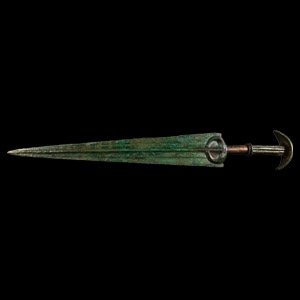
Marlik Bronze Short Sword with Crescentic Pommel
14th-10th century B.C.Sold for (Inc. bp): £1,300
Formed with a slender triangular blade, raised midrib with flat upper face, penannular guard and scooped shoulders, columnar grip with two gusseted hoops, the upper half of the grip is decorated with vertical lines, the lower part with horizontal grooves, crescent pommel; short sword or dagger. 430 grams, 44 cm
Ex Alexander Cotton collection, Hampshire, UK 1980s.
This short sword or dagger belongs to the category of blades with pennanular guard, with hilt and guard cast in one piece with the grip. This solid weapon has separate sets of encircling ribs on the grip. Negahban excavated similar weapons from the Marlik cemeteries, although sometimes the type combines grip and penannular guard with flanged hilts open to accept inlays.
