
Loading, please wait...
LOT 1646
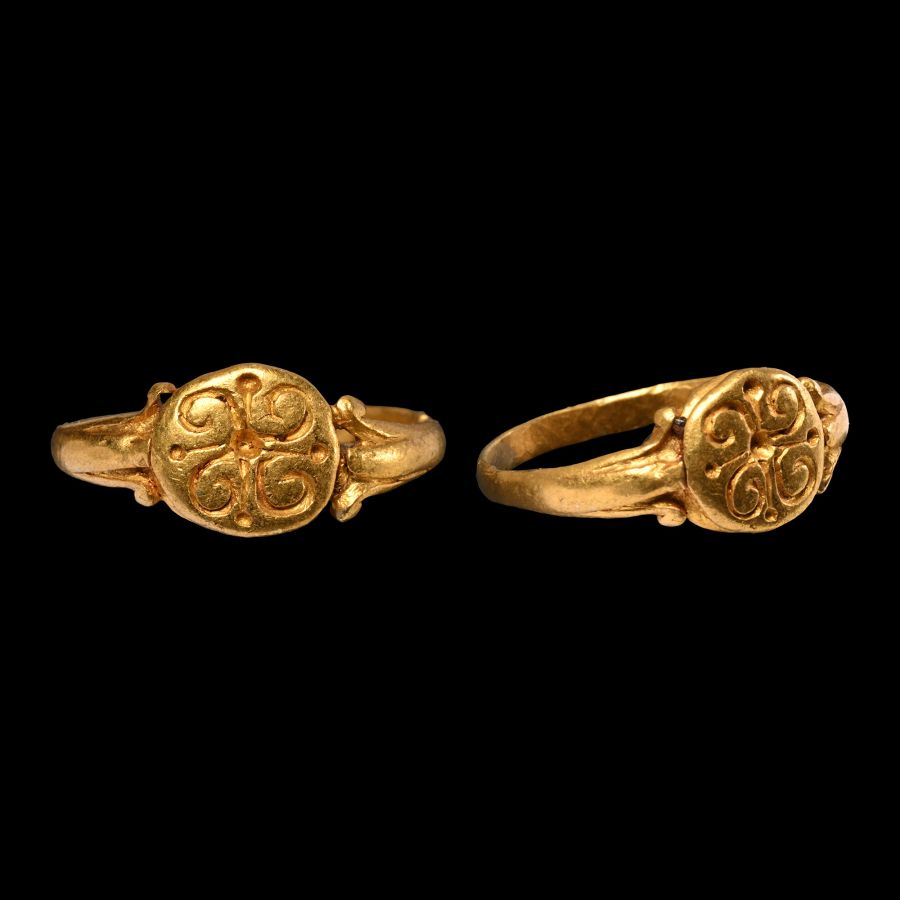
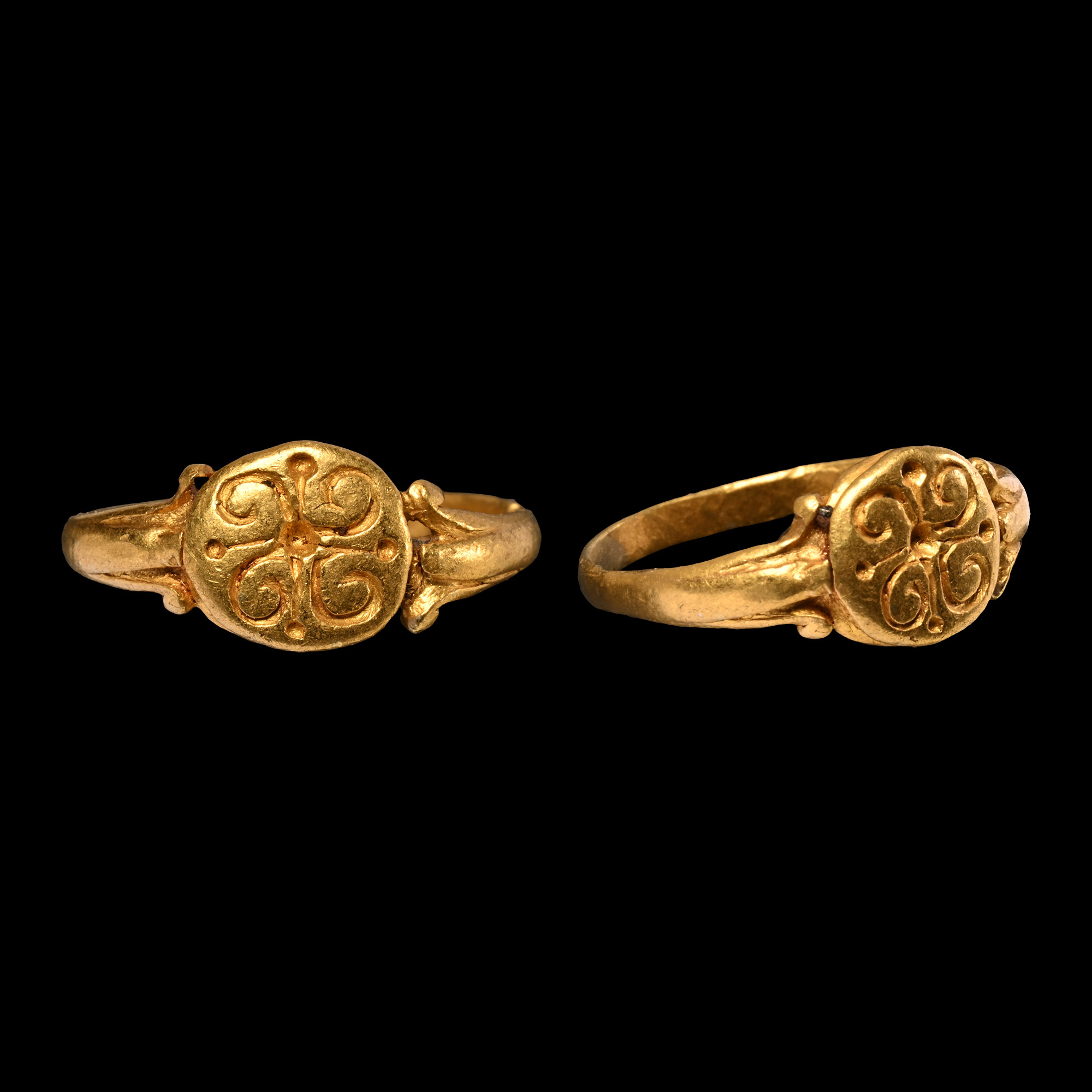
Medieval Gold Spiral Cross Ring
CIRCA 14TH-16TH CENTURY A.D.
5/8 in. (2.91 grams, 16.93 mm overall, 14.93 mm internal diameter (approximate size British F 1/2, USA 3, Europe 4.3, Japan 4)).
With flared volute shoulders, ellipsoid plaque with incuse motif of four spirals with interstitial pellets; repaired.
ProvenanceAcquired 1980-2015.
Ex Abelita family collection.
TimeLine Auctions follows a vetting process to ensure the authenticity and legality of all items, reinforcing our commitment to integrity and responsible trading. Each antiquity, antique, and coin lot undergoes thorough examination by a vetting committee of at least ten external specialists, professional trade association members, scientists, and archaeologists: Our Vetting Process
AUCTIONS:
TimeLine is a leading auction house specialising in antiquities, ancient art, collectables, natural history, coins, medals, and books. Our auctions offer museums, collectors, historians, and enthusiasts the opportunity to acquire unique and historically significant pieces.
-
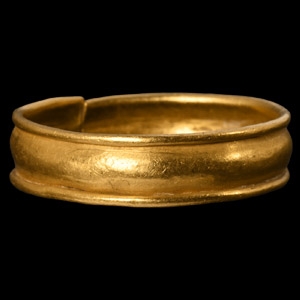
Medieval Banded Gold Ring
14th-16th century A.D.Sold for (Inc. bp): £260
With an annular hoop, domed central band and raised edges. 2.02 grams, 20.28 mm overall, 18.12 mm internal diameter (approximate size British L 1/2, USA 6, Europe 11.87, Japan 11)
Acquired 1980-2015. Ex Abelita family collection. -
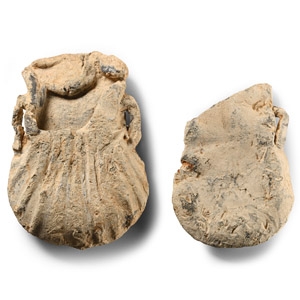
Medieval Lead Pilgrim's Holy Water Ampulla Group
1175-1400 A.D.Sold for (Inc. bp): £7
Comprising: ampulla with scallop detailing to the bulb, two lateral loop handles, upper portion of obverse removed; ampulla with hatched moulding to the bulb, 'AD' flanking a leek to obverse, crowned 'A' monogram to reverse, top edge cut away. 118 grams total, 45-54 mm
Found North Yorkshire, UK. Accompanied by a copy of the British Museum's Portable Antiquities Scheme (PAS) report no.SWYOR-0EAB85. Accompanied by the original British Museum's Portable Antiquities Scheme (PAS) receipt copy no.001936 dated 13 August 2016. -
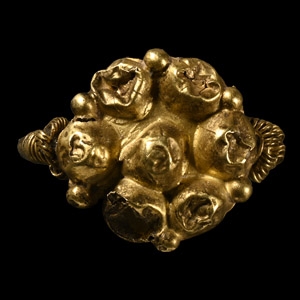
Medieval Gold Ring with Floral Bezel
Circa 15th-16th century A.D.Estimate: £400 - 600 (+bp*)
Opening Bid: £200
Comprising a round-section hoop with an applied floral bezel, small pellet between each petal; decorative wire wrapped around the hoop on each side of the bezel, probably modified from an earlier Hellenistic earring. 2.88 grams, 20.87 mm overall, 16.33 x 15.63 mm internal diameter (approximate size British H 1/2, USA 4, Europe 6.81, Japan 6)
From the property of the late Mr SM, London, UK, 1969-1999.
