
Loading, please wait...
LOT 0339
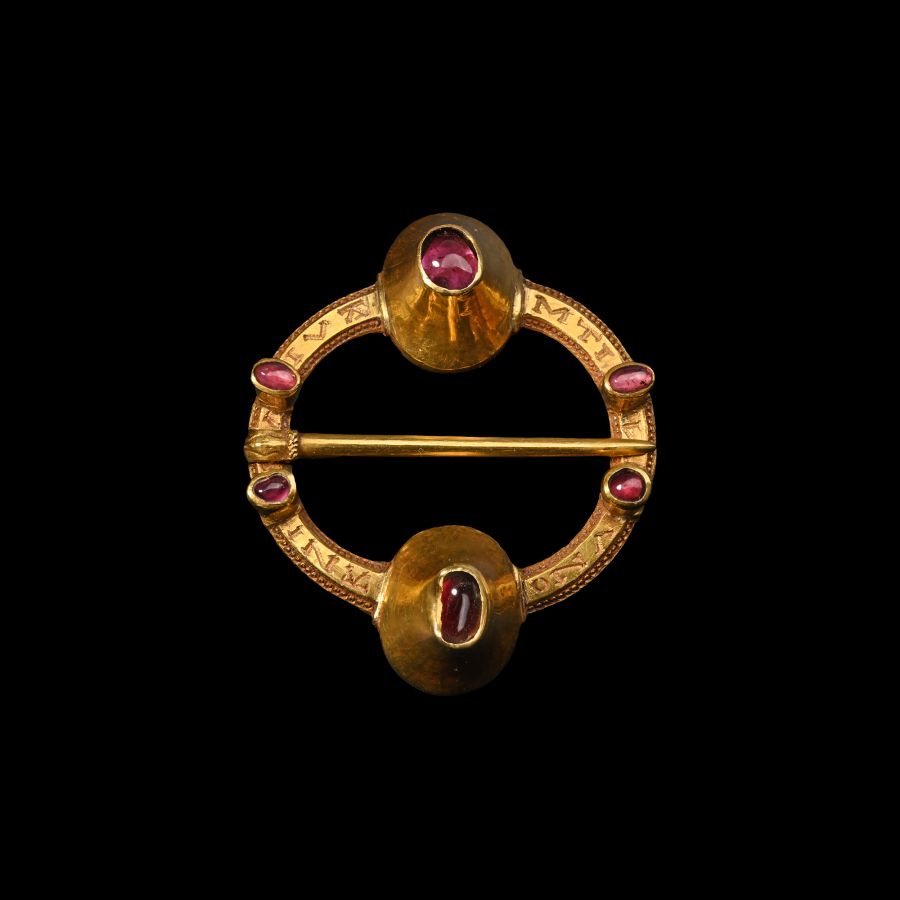
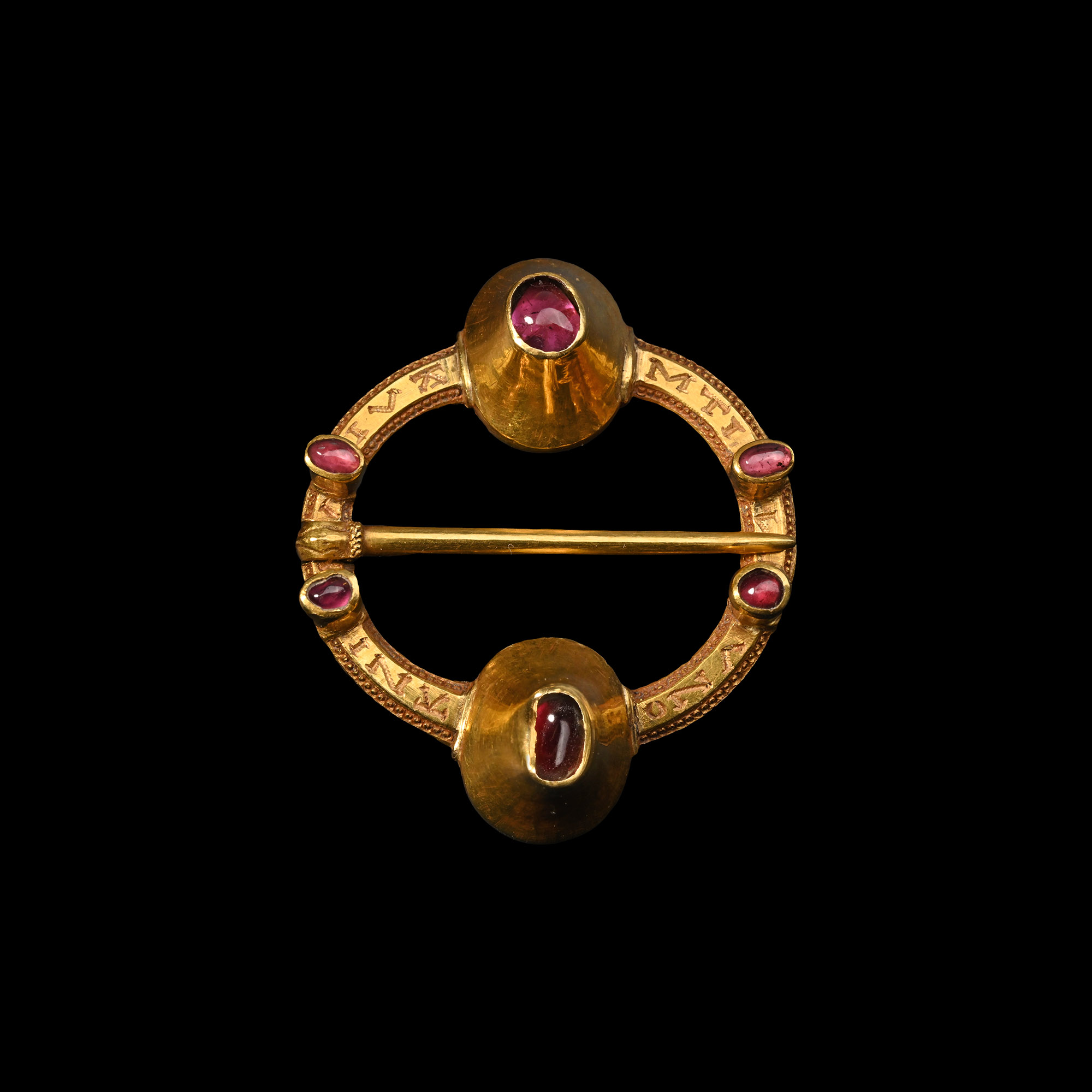
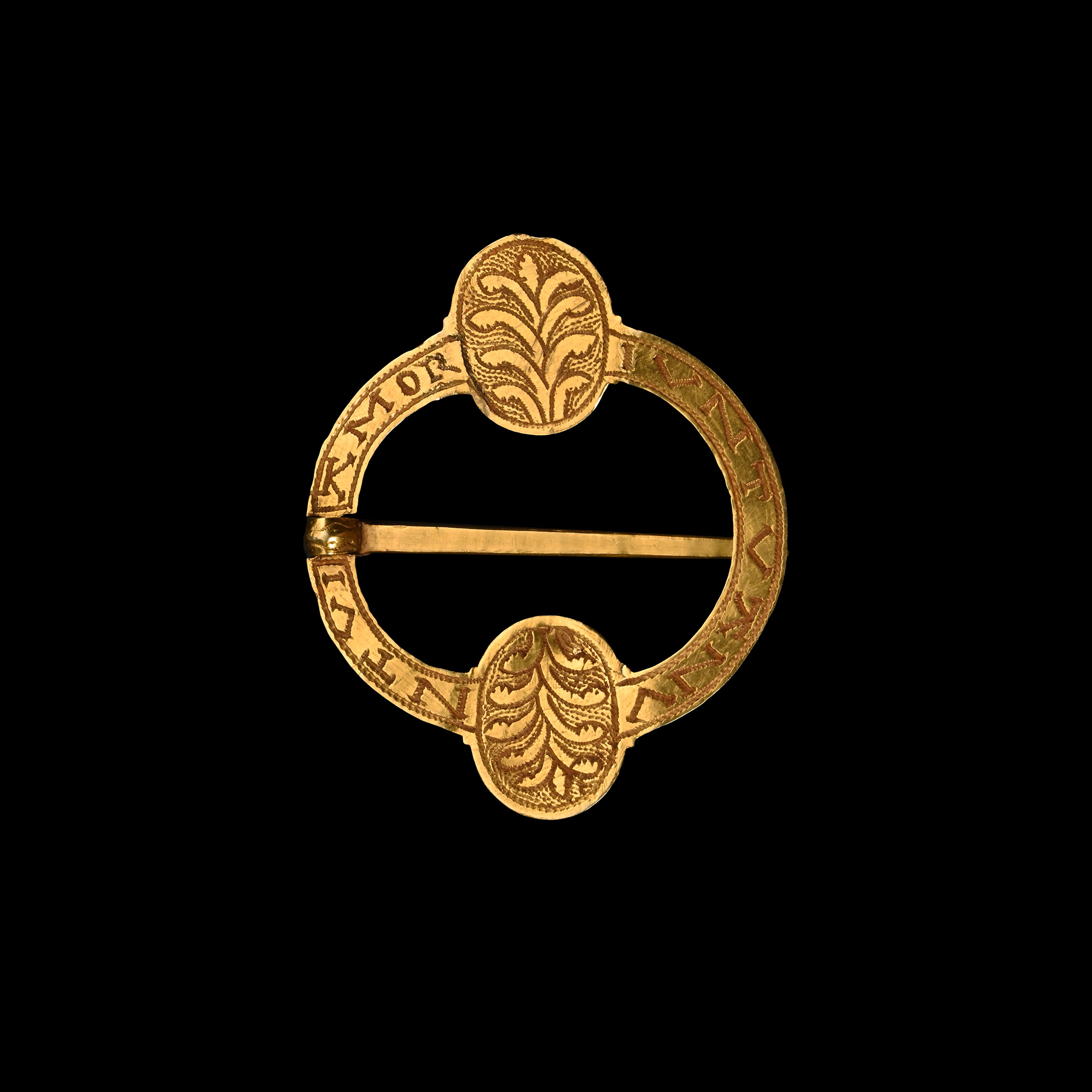
Medieval Gold Ring Brooch with Garnets and 'Let us Live as One Soul’ Posy Inscription
13TH-14TH CENTURY A.D.
1 1/2 in. (8.76 grams, 38 mm).
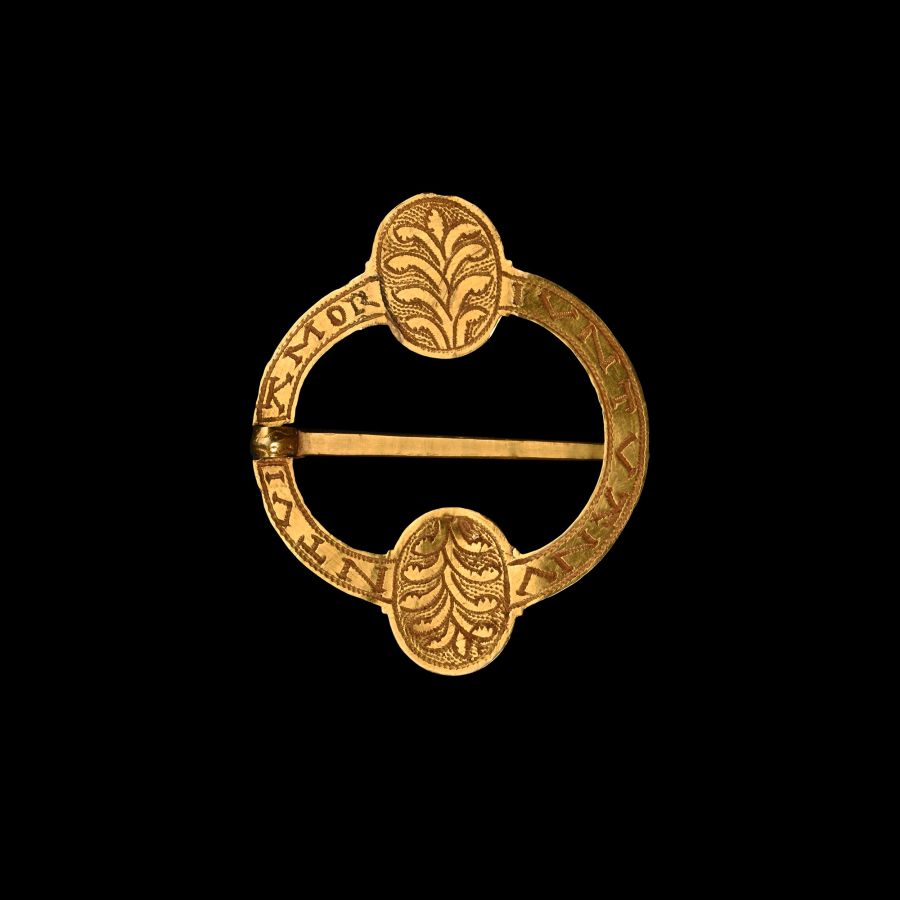
An annular brooch with pelletted edges, six garnet cabochons adorning the brooch, each in a tall closed setting; inscribed on the front 'VIVAMTINVNOANI', the reverse inscribed with 'AMORIVNTVANVNTVI' divided between two palmettes.
ProvenancePrivate English collection, formed between the late 1970s and early 1990s.
Private collection, UK.
This lot has been checked against the Interpol Database of stolen works of art and is accompanied by search certificate number no.12989-245987.
Cf. a similar, smaller ring brooch can be found in the collection of the Metropolitan Museum of Art, New York, accession no. 2018.355; see also The British Museum, London, museum nos. 1849,0301.32 and AF.2683, for comparison.
FootnotesBoth inscriptions can be interpreted differently according to the order of their reading; the front can be read ‘IN JUNO ANI VIVAM TI’, which roughly translates as ‘May I live for you in the fastening’, alternatively ‘VIVAM[vs] IN VNO ANI[mo]’ which roughly translates as ‘Let us live as one soul’. The back reads: 'AMORIVNTVANVNTVI' ‘AMOR[is] IVN[c]T[i] ANVNTIV[s]’ which roughly translates as ‘a message of joint love’.
The inscriptions on the brooch serve as metaphors, linking its function of fastening materials to the binding of lovers in medieval romance. Gift-giving was central to courtly love, and the brooch symbolised both affection and protection, reminding the wearer of the giver’s love while also warding off unwanted advances.
TimeLine Auctions follows a vetting process to ensure the authenticity and legality of all items, reinforcing our commitment to integrity and responsible trading. Each antiquity, antique, and coin lot undergoes thorough examination by a vetting committee of at least ten external specialists, professional trade association members, scientists, and archaeologists: Our Vetting Process
AUCTIONS:
TimeLine is a leading auction house specialising in antiquities, ancient art, collectables, natural history, coins, medals, and books. Our auctions offer museums, collectors, historians, and enthusiasts the opportunity to acquire unique and historically significant pieces.
LOT 0339
Medieval Gold Ring Brooch with Garnets and 'Let us Live as One Soul’ Posy Inscription
Sold for (Inc. bp): £7,020
-
Medieval and Later Thimble Group
Circa 15th-20th century A.D.Sold for (Inc. bp): £59
Including beehive, annular and other types. 225 grams total, 13-25 mm
Found Suffolk, UK. (UK buyers only, not for export) -
Medieval Knight's Enamelled Bronze Heraldic Horse Harness Pendant Group
14th-15th century A.D.Sold for (Inc. bp): £104
Including quatrefoil and octagonal types with heraldic motifs: lion passant and three lions passant gardant. 24 grams total, 33-36 mm
Found Gloucestershire, UK. Acquired from the early 1980s. From the private collection of a late Gloucestershire, UK, gentleman; thence by descent. -
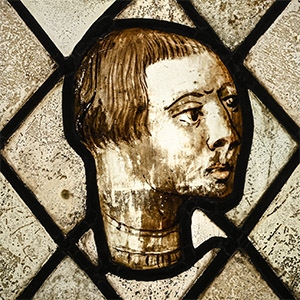
Medieval Stained Glass Head of a Man
Netherlands, Brabant, 1500-1520 A.D.Sold for (Inc. bp): £1,170
Square composite panel with brown-hued vitreous enamel and pink pigment, irregular profile bust set into the diamond quarries. 838 grams, 30.3 x 27 cm
Ancient Arms and Armour, Stained Glass, Coffrets and Furniture. Property from a New York Collection, American Art Association, New York, 23 November 1923, no.110 (as Flemish XV-XVI). The Monastery Stained Glass, 2004. Accompanied by a previous cataloguing document.
The loose, fluid brushwork and fine touches of pink sanguine pigment on this male head place him firmly in the first decades of the sixteenth century, a dating supported further by the visible hemline of the fashionable pleated shirt covering his neck. These are all characteristic features of Southern Netherlandish stained glass from this period, and parallels offered by programs such as the early sixteenth-century windows in Antwerp Cathedral, the c. 1500 glazing scheme at Sint Gummarus church in Lier just outside Antwerp, as well as at sites such as Notre Dame du Sablon in Brussels, suggest an artist working in Brabant in the early years of the century.
