
Loading, please wait...
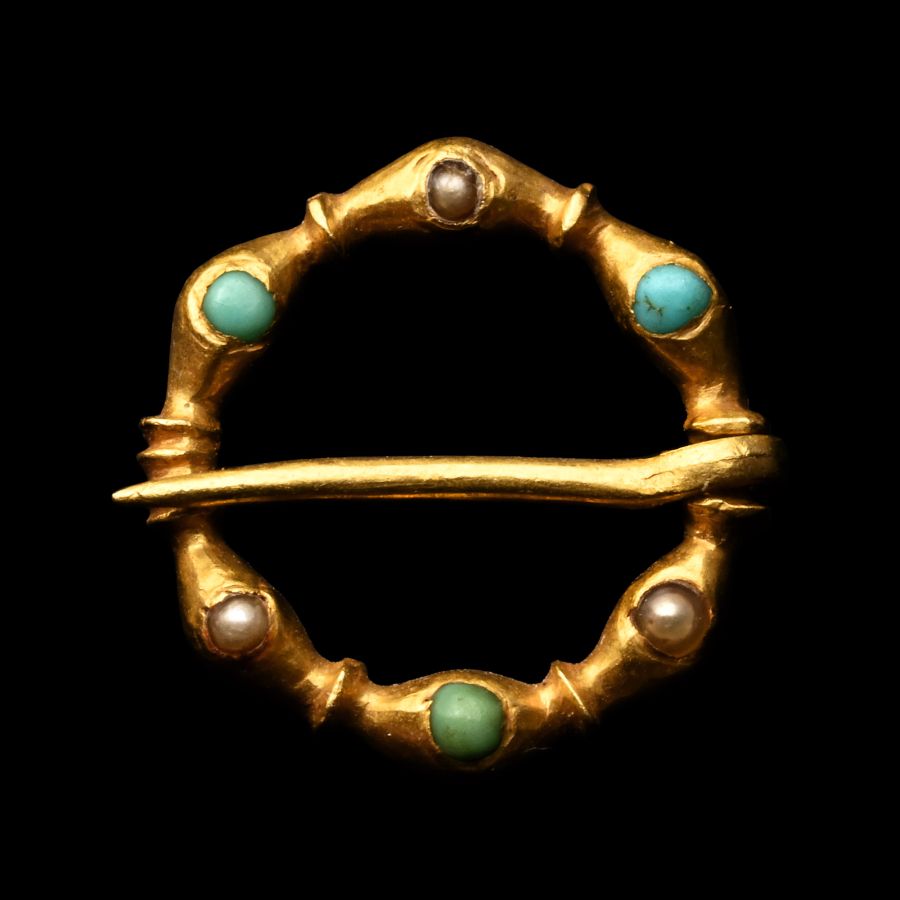


LOT 0343
Medieval Gold Brooch with Turquoise and Pearls
13TH-14TH CENTURY A.D.
1/2 in. (1.29 grams, 14 mm).
A delicate annular brooch set with three turquoise cabochons and three seed pearls, the space between the cells separated with a slender collar.
ProvenancePrivate collection, UK.
FootnotesAn annular brooch is a type of brooch that is circular in shape, forming a complete ring, they were worn by both men and women of all social classes. The word 'annular' comes from the Latin word 'annulus' meaning ring. These brooches were popular in medieval Europe, particularly from the 13th to 15th centuries, and were used to fasten clothing such as tunics and cloaks.
CONDITIONTimeLine Auctions follows a vetting process to ensure the authenticity and legality of all items, reinforcing our commitment to integrity and responsible trading. Each antiquity, antique, and coin lot undergoes thorough examination by a vetting committee of at least ten external specialists, professional trade association members, scientists, and archaeologists: Our Vetting Process
AUCTIONS:
TimeLine is a leading auction house specialising in antiquities, ancient art, collectables, natural history, coins, medals, and books. Our auctions offer museums, collectors, historians, and enthusiasts the opportunity to acquire unique and historically significant pieces.
-
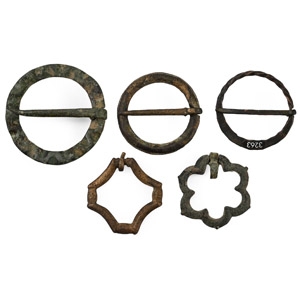
Medieval Bronze Ring Brooch Collection
13th-14th century A.D.Sold for (Inc. bp): £33
Including annular and voided cruciform types, one with collector's reference '3263' to reverse. 21 grams total, 25-36 mm
Found various sites in the UK. From the property of a late Lincolnshire, UK, gentleman. -
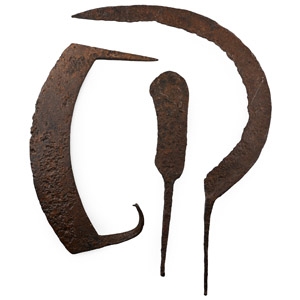
Medieval Iron Scythe Collection
13th-14th century A.D.Sold for (Inc. bp): £33
Including hooked iron blades, and a broad heavy blade with rounded end. 723 grams total, 26-39 cm
From a private European collection formed in the 1980s. From the property of a late Lincolnshire, UK, gentleman. -
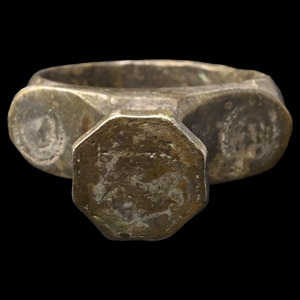
Medieval Silver Ring with Letter 'M'
Circa 15th-16th century A.D.Sold for (Inc. bp): £845
Substantial hoop with a raised plaque at the base, scooped shoulder extending to a tall octagonal bezel with 'M'. 19.76 grams, 38.67 mm overall, 19.77 mm internal diameter (approximate size British T 1/2, USA 9 3/4, Europe 21.89, Japan 21)
Ex German art market, 2000s. Acquired from an EU collector living in London. From the collection of a Surrey, UK, gentleman.
