Loading, please wait...
LOT 1819
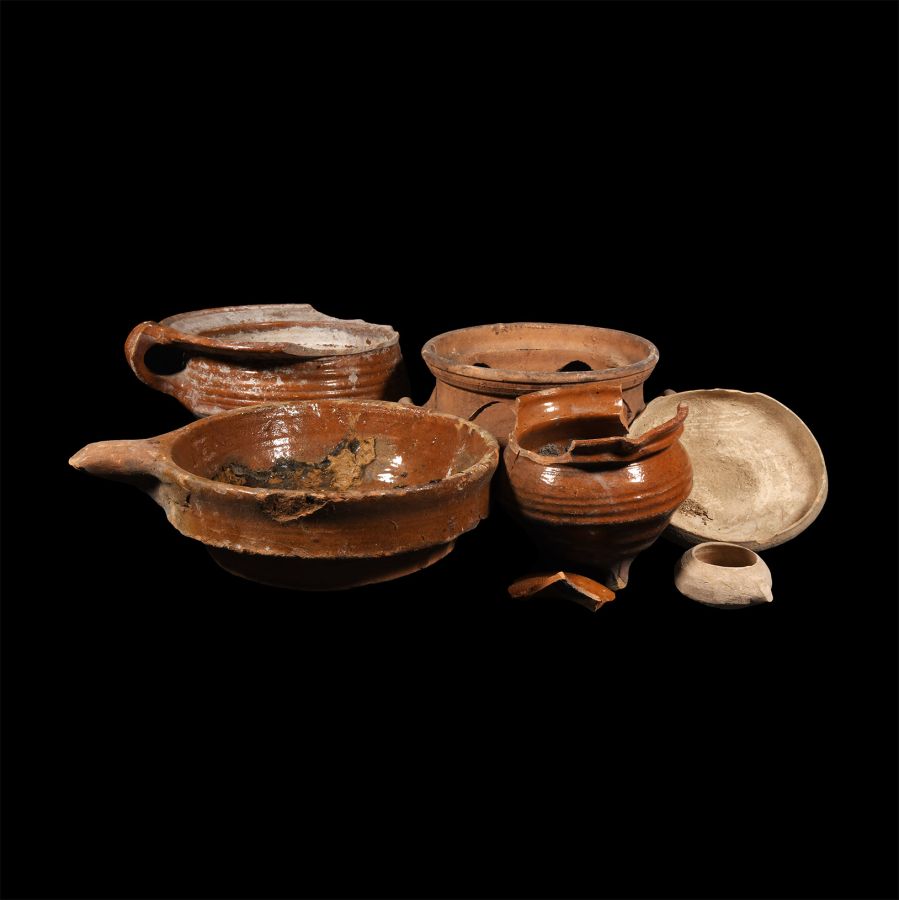
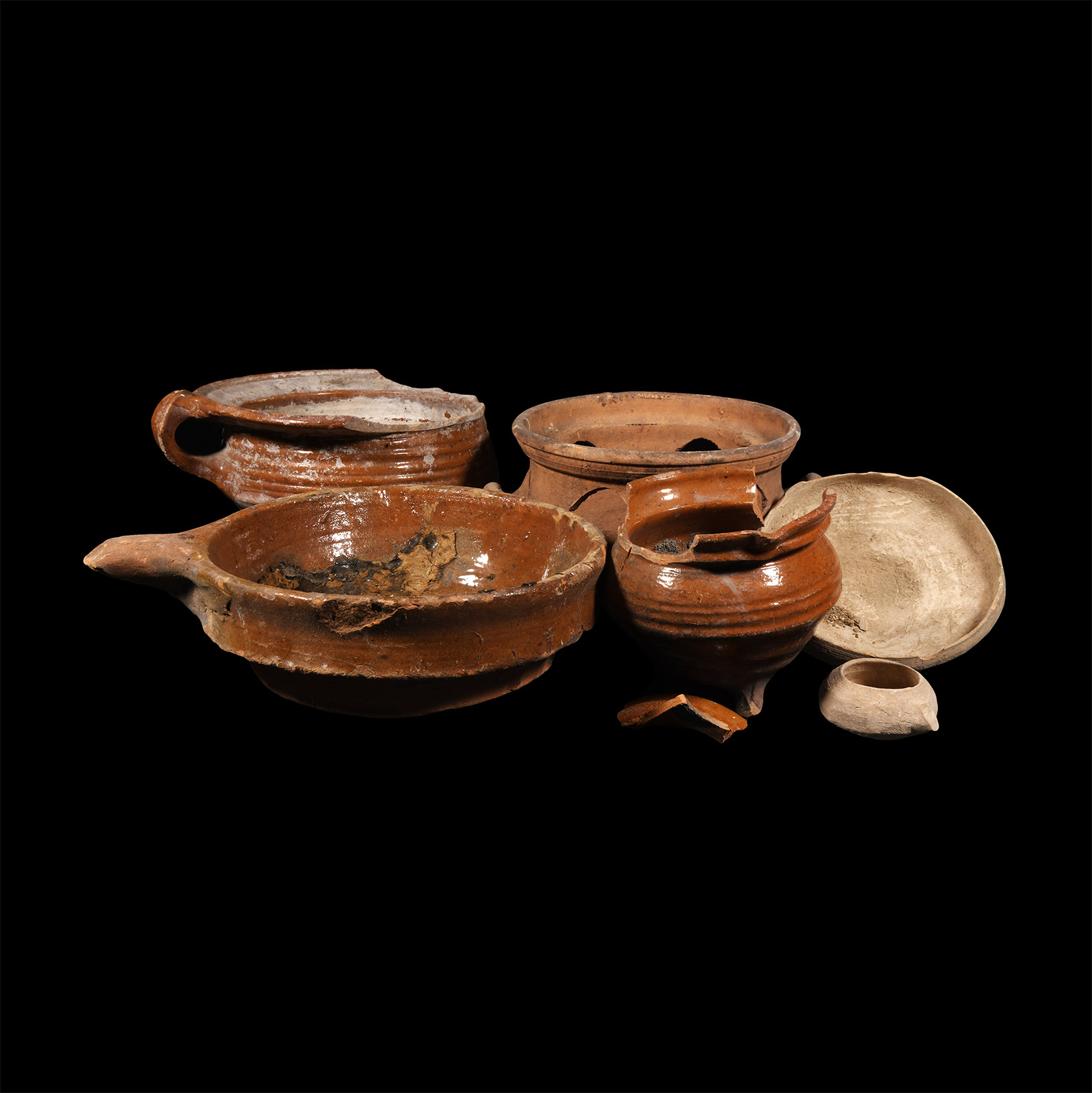
Medieval Glazed Pottery Group
15TH CENTURY A.D. AND LATER
3 - 11 in. (4.9 kg total, 7.5-30 cm).
Comprising glazed and unglazed ceramic vessels including jars, a skillet and handled pots; together with a Bronze Age bowl and jar. [6, No Reserve]
ProvenanceAcquired 1990s-early 2000s.
East Anglian private collection.
TimeLine Auctions follows a vetting process to ensure the authenticity and legality of all items, reinforcing our commitment to integrity and responsible trading. Each antiquity, antique, and coin lot undergoes thorough examination by a vetting committee of at least ten external specialists, professional trade association members, scientists, and archaeologists: Our Vetting Process
AUCTIONS:
TimeLine is a leading auction house specialising in antiquities, ancient art, collectables, natural history, coins, medals, and books. Our auctions offer museums, collectors, historians, and enthusiasts the opportunity to acquire unique and historically significant pieces.
-
'The Roxwell' Medieval Gold Signet Ring of 'King's Serjeant William Skrene'
14th-15th century A.D.Sold for (Inc. bp): £23,400
Gold hoop and discoid bezel with incuse ropework border; incuse image of a bird of prey perching with wings spread and head turned; blackletter incuse and reversed inscription in an arc above the bird's head and pinions '·al : for : ye : best ·' (all for the best); repair to hoop. 8.01 grams, 25.00 mm overall, 20.49 mm internal diameter (approximate size British V 1/2, USA 10 3/4, Europe 24.4, Japan 23)
Found while searching with a metal detector near Roxwell, Essex, UK, by Albert Robert Taylor on 4th September 2021. Accompanied by a copy of the British Museum's Portable Antiquities Scheme (PAS) report no.ESS-CD68AE. Accompanied by a copy of the report for H M Coroner on find of potential treasure with reference no.2022 T920. Accompanied by a copy of a letter from the British Museum disclaiming the Crown's interest in the find. Accompanied by a copy of the Treasure Act receipt. Accompanied by copies of the relevant pages on an article about finding this ring in Treasure Hunting Magazine, August 2022, p.13.
The ring's find location is close to an estate which was owned in the 14th century by the Skrene family and which included among their number a senior barrister and sergeant-at-law named William Skrene who was an Irish-born barrister and judge. The family name lives on to the present day at Roxwell with Skreens Park and for local road names nearby. Wiiliam spent his professional life in England, being appointed King's Serjeant and a judge of assize, as well as Chief Baron of the Irish Exchequer in 1395-7. In addition to the estate at Roxwell, he acquired various lands in Essex, including at Writtle, Great Finborough and Stanford Rivers. William died in 1419-20 and left sons and a daughter; his heir, also called William, married Alice Tyrrell, widow of Hamo Strange, and daughter of John Tyrrell, who was Speaker of the House of Commons of England for three terms. The exact combination of motto and crest or badge has eluded researches thus far. However, the ring was found near Roxwell, Essex, and evidently belonged to a person of some wealth and status given the quantity of gold used in its manufacture and the quality of the workmanship. The style of the ring is close in appearance to a number of early 15th century examples, which began to appear with the badge and motto rather than the full armorial bearings, so it is very possible that this is the personal signet ring of William Skrene, or possibly of his sons, William or Thomas. -
Medieval Sterling Jetton 'Coin Brooch'
13th-14th century A.D.Sold for (Inc. bp): £65
Edward I period jetton with pin fitting to display the cross moline emblem. 2.55 grams, 21 mm
From a Cambridgeshire, UK, collection.
Coins and jettons were frequently mounted thus used as pilgrim souvenirs. -
'The Kirkleavington' Medieval Bronze Inscribed Purse Frame
15th-16th century A.D.Sold for (Inc. bp): £3,640
The bar with central D-shaped block pierced vertically by a stud surmounted by the suspension loop, with four pierced flanges to the underside; the frame in two sections, the larger a U-shaped rod with pivot for the bar, the smaller pivoting within the inner face, both pierced on the inner face; the block inscribed to one face with capital S and to the other with intersecting Vs; the bar inscribed to one face in capitals 'A DOMINI TECVM' and to the other in coarsely incised capitals 'AVEMARIA G[R]ACIAPLE[NA]'; the smaller rod inscribed in capitals 'CREATOREN CELI ET TERRE ET IN [IES]VN'; the larger inscribed with a band of scrolled decoration and the text in Lombardic capitals 'SOLI DEO HONOR ET GLORIA'; the accompanying letter discusses the texts (1) Ave Maria G[r]acia ple[n]a Dominus Tecum 'Hail Mary full of grace, the Lord [is] with thee'; (2) Soli Deo Honor et Gloria 'Honour and glory to God alone'; (3) Creatorem celi et terrae et inferum 'creator of heaven and earth and in Jesus'. The intersecting Vs may form a monogram for A[ve] M[aria]; the 1847 letter describes the findspot as 'found at Kirkleavington near Yarm in the sill of a brook' in the North Riding of Yorkshire. 183 grams, 20.7 cm
Found at Kirkleavington near Yarm, North Riding of Yorkshire, UK, in 1847. Accompanying label describes it as ‘found in constructing the Leeds and Thirsk Railway, near Kirkleavington, Co. York. Communicated by John Bourne, Esq. Engineer to the Company, Leeds’. Accompanied by a manuscript letter of September 17th 1847 from Mr Histon Longstaffe discussing the text, with later amendments date 1854. This lot has been checked against the Interpol Database of stolen works of art and is accompanied by searcher certificate no. 200593.
Metal purse frames of this type were a luxury personal accessory of late Middle Ages and early Renaissance period (about 1450-1500). They were decorated with niello. In this technique the metalworker engraved a pattern or design onto highly polished metal and filled the incised lines with a hard black alloy. Religious inscriptions were incised to invoke the divine protection. A fragmentary purse-frame in the MOL [ID 4452] containing this same portion of the Apostles Creed enables us to correct the 19C reading INFERVN to IN IESVN ('in Jesus')