Loading, please wait...

Medieval Enamelled Gilt Bronze Heraldic Stud with Lion Medieval Enamelled Gilt Bronze Heraldic Stud with Lion Medieval Enamelled Gilt Bronze Heraldic Stud with Lion
Use mousewheel to zoom in and out, click to enlarge
Details

LOT 1647

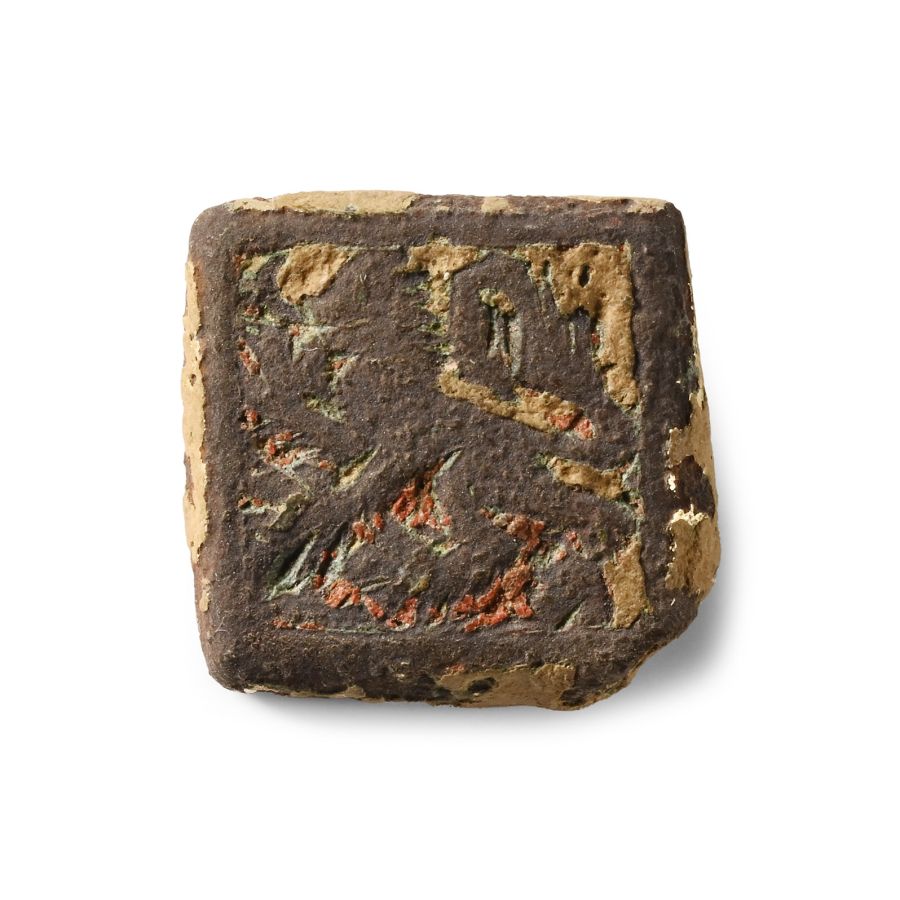
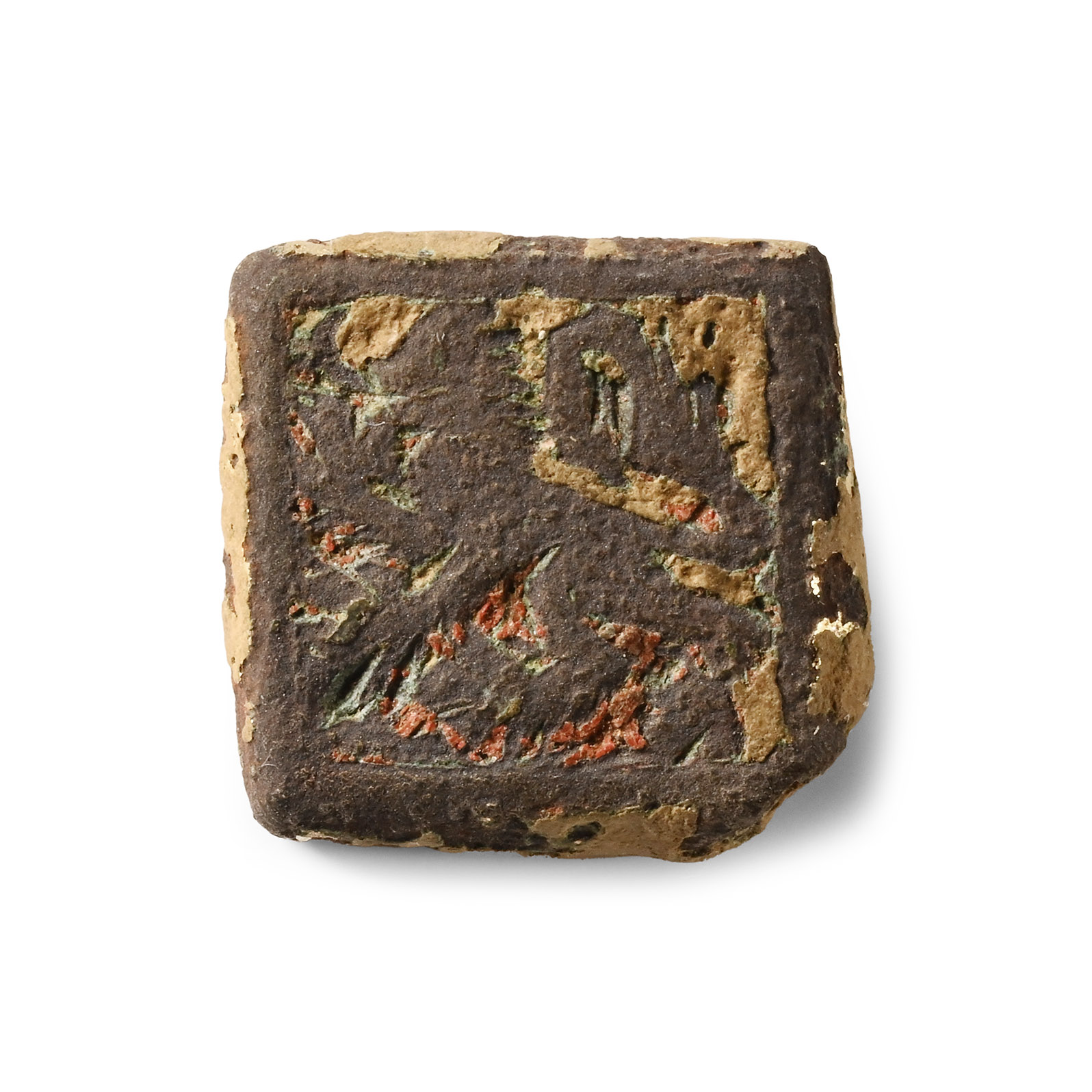
Medieval Enamelled Gilt Bronze Heraldic Stud with Lion

14TH-15TH CENTURY A.D.

5/8 in. (5.73 grams, 16 mm).

Lozengiform with reserved lion rampant on an enamelled field within a plain border; stud to reverse. [No Reserve]

Provenance

Found Cambridgeshire, UK.

CONDITION
VETTING:

TimeLine Auctions follows a vetting process to ensure the authenticity and legality of all items, reinforcing our commitment to integrity and responsible trading. Each antiquity, antique, and coin lot undergoes thorough examination by a vetting committee of at least ten external specialists, professional trade association members, scientists, and archaeologists: Our Vetting Process


AUCTIONS:

TimeLine is a leading auction house specialising in antiquities, ancient art, collectables, natural history, coins, medals, and books. Our auctions offer museums, collectors, historians, and enthusiasts the opportunity to acquire unique and historically significant pieces.

LOT 1647

Medieval Enamelled Gilt Bronze Heraldic Stud with Lion

Sold for (Inc. bp): £39

Print page

RELATED LOTS
  • Medieval Bronze Limoges Saint
    Medieval Bronze Limoges Saint
    13th century A.D.

    Sold for (Inc. bp): £169

    Comprising a tongue-shaped curved-section body pierced in two places for attachment and forked lower end, with rounded shoulders and bowed head with soft features and short hair. 20 grams, 86 mm


    From a collection acquired on the UK art market from various auction houses and collections mostly before 2000. From an important Cambridgeshire estate; thence by descent.

    From the 12th to 14th century, there was a large industry producing metal objects decorated in enamel using the champlevé technique, of which most of the survivals and probably most of the original production, are religious objects such as reliquaries, crosses and statues of saints.

    Lot Details

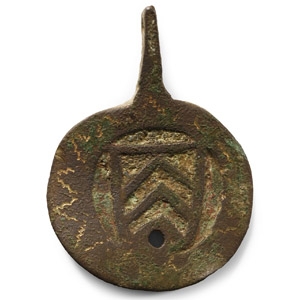
  • Medieval Bronze Knights Heraldic Horse Harness Pendant
    Medieval Bronze Knight's Heraldic Horse Harness Pendant
    14th-15th century A.D.

    Sold for (Inc. bp): £78

    Discoid plaque with integral pierced lug, gilt border with stepped radiating triangles, central heater shield with chevron motifs. 12.5 grams, 45 mm


    Acquired on the UK art market. Property of an Essex, UK, gentleman.

    Lot Details

  • The Drayton Medieval Gold Ring with Magical Inscription
    'The Drayton' Medieval Gold Ring with Magical Inscription
    1200-1300 A.D.

    Sold for (Inc. bp): £7,150

    The bezel developing to a low pyramid with lateral facets, surmounted by an inset cabochon sapphire set within an irregular cell; a quatrefoil plaque to each shoulder, and three more regularly placed around the shank; carinated hoop with magical Lombardic script '+NI ONAN NRIO ONIC / NIAI AINO ANIOI NAN'. 3.95 grams, 25.72 mm overall, 19.75 x 18.44 mm internal diameter (approximate size British R, USA 8 1/2, Europe 18 3/4, Japan 18)


    Found whilst searching with a metal detector near Drayton, Vale of the White Horse, Oxfordshire, UK, on Sunday 16th September 2018 by Chris Weir. Declared as treasure under the Treasure Act with reference no.2018T853, subsequently disclaimed and returned to the finder. Accompanied by a copy of the British Museum's Portable Antiquities Scheme (PAS) report no.GLO-0BFB91. Accompanied by a letter from the finder describing the circumstances of finding. This lot has been checked against the Interpol Database of stolen works of art and is accompanied by search certificate no.12118-214086.

    Many late medieval rings and brooches bear similarly meaningless inscriptions, perhaps due to the illiteracy of the engraver who nevertheless was aware that customers required an inscription, so provided one. Alternatively, since the text is composed from repeated sequences 'NI', 'AI', etc. based on an open syllabic structure, the words may be intended as a chant or magical charm. For discussion of such inscriptions see Evans, J., Magical Jewels of the Middle Ages and the Renaissance, Oxford, 1922, pp.121-132, for inscribed jewels.

    Lot Details

Stay up-to-date with the latest from TimeLine Auctions by joining our mailing list