
Loading, please wait...
LOT 0379
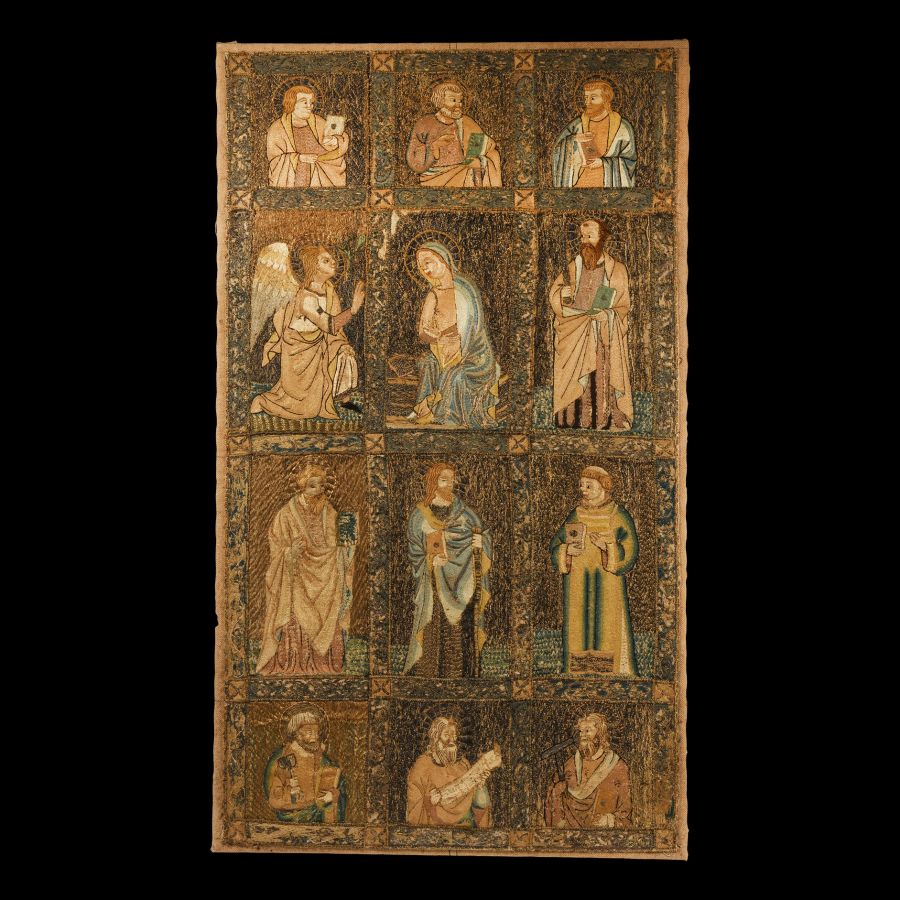
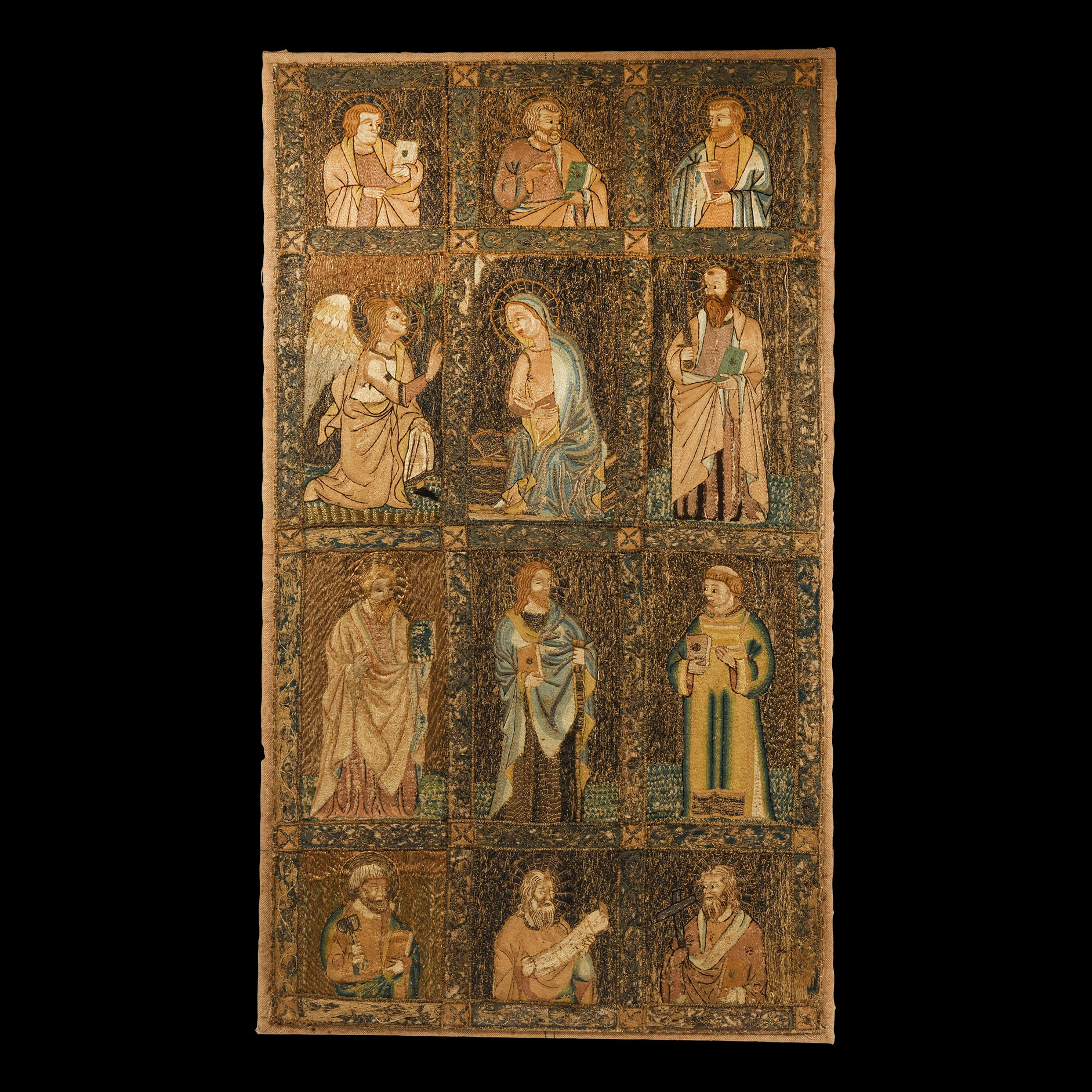
Medieval Embroidered Panel Composed of Sections of Dalmatic Garment
FLORENCE, ITALY, CIRCA 1440-1460 A.D.
33 1/4 in. (1.55 kg, 84.5 cm).
Comprising twelve sections, the top row with three Evangelists, each holding a gospel; the next row with the Annunciation scene with Archangel Gabriel, Mary and Saint Paul holding a raised sword and a book; Saint Augustine and Saint Thomas Aquinas flanking the standing figure of Jesus; the bottom row with Saint Peter holding keys and a book, Moses and probably Saint Andrew; each figure framed with embroidered foliage; sewn to a linen background stretched over a wooden frame. [No Reserve]
ProvenanceFrench private collection.
with Jean-Charles D'Ornano, 16 January 2022, lot 233.
Ex central London gallery.
Accompanied by an academic report by Dr Raffaele D’Amato.
This lot has been checked against the Interpol Database of stolen works of art and is accompanied by search certificate no.11749-202077.
Cf. an embroidered panel, part of a dalmatic in the Metropolitan Museum of Art, accession no. 64.101.1381, in Hartt, F., The Metropolitan Museum of Art. Vol. 4, The Renaissance in Italy and Spain,New York, 1988, pp.67-69, for comparison.
FootnotesThe dalmatic (liturgical vestment derived from the Late Roman garment with the same name) was worn by the deacons in Latin Catholic Church. This dress, mainly used in the Holy Liturgy, was often decorated in silk and gold embroidery, and splendid specimens were realised by the Italian workshops of the Florentine Republic, one of the richest Italian states of the Renaissance.
CONDITIONTimeLine Auctions follows a vetting process to ensure the authenticity and legality of all items, reinforcing our commitment to integrity and responsible trading. Each antiquity, antique, and coin lot undergoes thorough examination by a vetting committee of at least ten external specialists, professional trade association members, scientists, and archaeologists: Our Vetting Process
AUCTIONS:
TimeLine is a leading auction house specialising in antiquities, ancient art, collectables, natural history, coins, medals, and books. Our auctions offer museums, collectors, historians, and enthusiasts the opportunity to acquire unique and historically significant pieces.
LOT 0379
Medieval Embroidered Panel Composed of Sections of Dalmatic Garment
Sold for (Inc. bp): £2,470
-
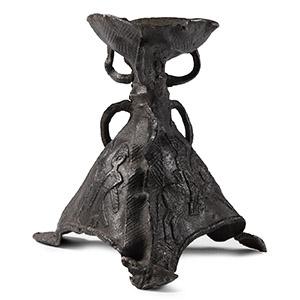
Medieval Pewter Tripod Candlestick with Relief Decoration
Flanders, 13th-14th century A.D.Sold for (Inc. bp): £2,470
Hemispherical cup to top, six semi-circular loops to neck and shoulder, decoration to each of three faces in relief comprising: a rider on horseback; a lion; a male and female figure embracing, each corner with a D-shaped flange with zoomorphic or foliate ornament. 165 grams, 8 cm
Ex Pierre-Richard Royer, 2010. Ex central London gallery. This lot has been checked against the Interpol Database of stolen works of art and is accompanied by search certificate no.202060. -
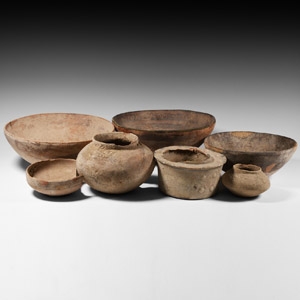
Medieval Glazed Pottery Group
15th century A.D. and laterSold for (Inc. bp): £117
Comprising mainly jars and bowls, including examples with painted geometric and fish decoration; chipped and cracked. 4.4 kg total, 10.5-27 cm wide
Acquired 1990s-early 2000s. East Anglian private collection. -
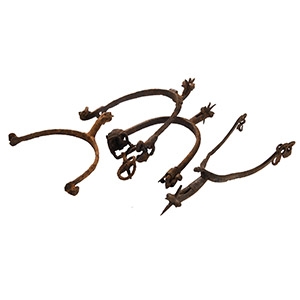
Medieval Iron Rowel Spur Collection
Circa 13th-16th century A.D.Estimate: £100 - 140 (+bp*)
Opening Bid: £40
Comprising examples of various types, including some retaining the rowel, buckle and other fitting elements. 249 grams total, 11.5-15 cm
Acquired 1990s-early 2000s. East Anglian private collection.
The early rowel spurs had short necks and small four-six or seven point star rowels, while four rowels were uncommon. After c.1350 the multipoint rowel became voguish though the former shapes continued.
