
Loading, please wait...
LOT 1132
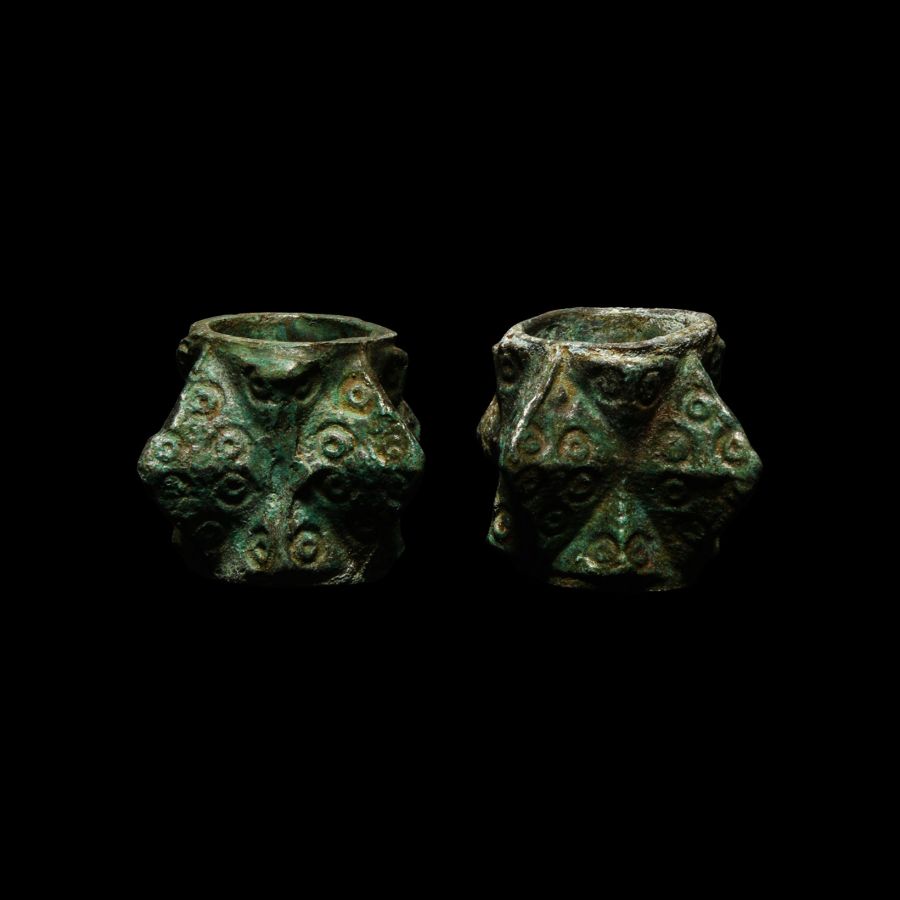
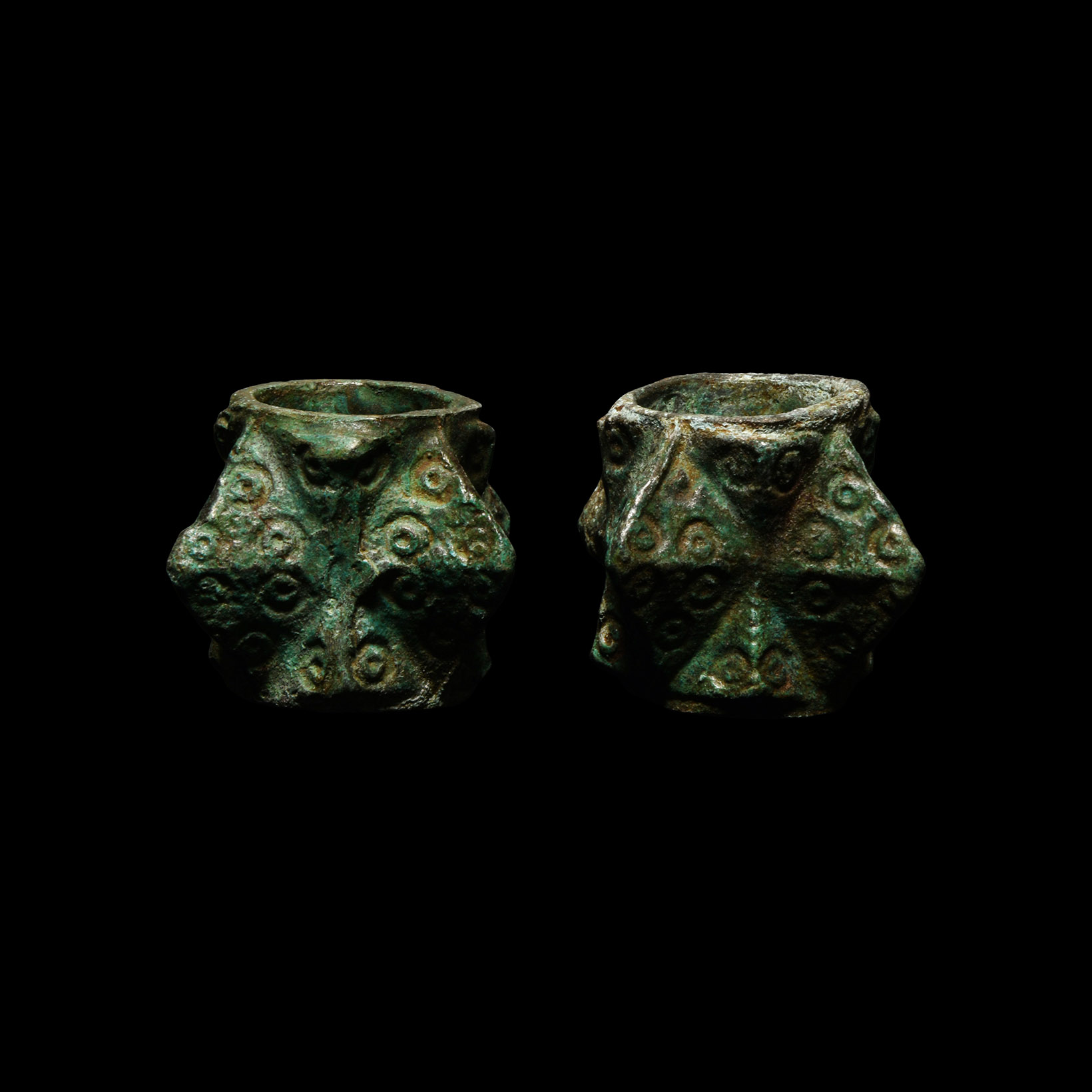
Medieval Decorated Bronze Macehead Group
14TH CENTURY A.D.
1 3/4 in. (155 grams total, 46 mm each).
Each with four large triangular-shaped projections flanked by smaller projections; decorated with groups of ring-and-dot ornaments. [2]
ProvenancePrivate collection, UK, formed in the 1980s.
The Kusmirek Collection, UK.
Cf.Gilliot, C., Weapons and Armours, Bayeux, 2008, pp.160-161, for similar maceheads.
FootnotesThe polygonal mace evolved into the hexagonal winged mace. Originating in the East, this weapon spread across Eastern Europe during the 13th century A.D., and from there to the West. The winged mace, used by the western Europeans, was almost certainly based upon Eastern Roman or Islamic prototypes. It is relevant to note that the polygonal mace was widely used by the eastern cavalrymen (like Turkish and Mongols), during the 14th century A.D.
CONDITIONTimeLine Auctions follows a vetting process to ensure the authenticity and legality of all items, reinforcing our commitment to integrity and responsible trading. Each antiquity, antique, and coin lot undergoes thorough examination by a vetting committee of at least ten external specialists, professional trade association members, scientists, and archaeologists: Our Vetting Process
AUCTIONS:
TimeLine is a leading auction house specialising in antiquities, ancient art, collectables, natural history, coins, medals, and books. Our auctions offer museums, collectors, historians, and enthusiasts the opportunity to acquire unique and historically significant pieces.
-
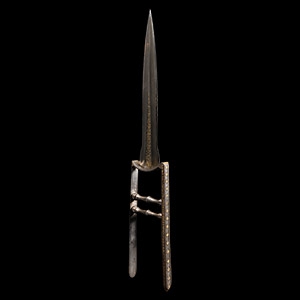
Indian Quatar Iron Dagger
18th-19th century A.D.Estimate: £1,000 - 1,400 (+bp*)
Opening Bid: £500
Comprising a broad blade tapering to an armour-piercing point, the steel side bars and balustered grips decorated with copper Koftgari work flowers and scrolls. 488 grams, 48 cm
General condition very good.
Property of a London gallery.
Unique to South Asia, the quatar or katar was a dagger that held at the crossbars with a clenched fist. The weapon was meant to be thrust into the opponent or prey from a close range. Rajput and Mughal royalty used this weapon to hunt tigers and even crocodiles to demonstrate their bravery and martial skill. -
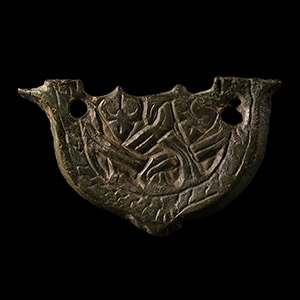
Viking Age Bronze Jellinge Sword Scabbard Chape
10th century A.D.Sold for (Inc. bp): £130
Plate with lip to the outer curved edges, knop to the centre of the bow and spurs to the angles; low-relief design of interlaced foliage within a braided band; lateral mounting holes, three studs to the reverse. 14.7 grams, 52 mm
From the collection of a North American gentleman, formed in the 1990s. -
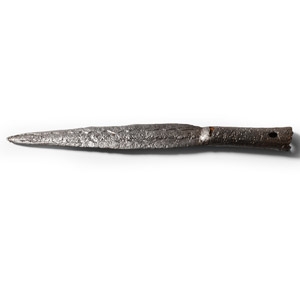
Viking Socketted Spearhead
10th-14th century A.D.Sold for (Inc. bp): £91
The leaf-shaped head with full-length midrib to both faces, tapering round-section socket with piercing for attachment to an organic shaft. 70 grams, 22 cm
Ex Surrey collection, formed 1990-2000. Acquired from TimeLine Auctions 2016, lot 162 (part). The Kusmirek Collection, UK.
