
Loading, please wait...
_900x900.jpg "Medieval Bronze Vesica-Shaped Seal Matrix with Agnus Dei")
_200x200.jpg "Medieval Bronze Vesica-Shaped Seal Matrix with Agnus Dei")
.jpg "Medieval Bronze Vesica-Shaped Seal Matrix with Agnus Dei")
LOT 1735
Medieval Bronze Vesica-Shaped Seal Matrix with Agnus Dei
CIRCA 1200-1400 A.D.
1 in. (5.31 grams, 26 mm).
With drop-shaped suspension lug at the top; showing a lamb with a cross above and below, a pelican in its piety, inscription around the edge reading: '+[...]M[...]H[...]H[...]NI I E(/C)I'. [No Reserve]
ProvenanceFound Colne Engaine, Braintree, Essex, UK.
Accompanied by a copy of the British Museum's Portable Antiquities Scheme (PAS) report no.ESS-6DEFEF.
This lot is accompanied by an illustrated lot declaration signed by the Head of the Antiquities Department, Dr Raffaele D'Amato.
TimeLine Auctions follows a vetting process to ensure the authenticity and legality of all items, reinforcing our commitment to integrity and responsible trading. Each antiquity, antique, and coin lot undergoes thorough examination by a vetting committee of at least ten external specialists, professional trade association members, scientists, and archaeologists: Our Vetting Process
AUCTIONS:
TimeLine is a leading auction house specialising in antiquities, ancient art, collectables, natural history, coins, medals, and books. Our auctions offer museums, collectors, historians, and enthusiasts the opportunity to acquire unique and historically significant pieces.
LOT 1735
Medieval Bronze Vesica-Shaped Seal Matrix with Agnus Dei
Sold for (Inc. bp): £20
-
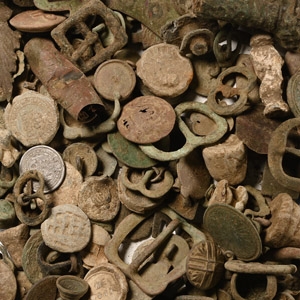
Medieval and Later Artefact Collection
14th-20th century AD.Sold for (Inc. bp): £72
A mixed group of items including buttons, buckles, lead seals and weights, mounts, and other items. 1.22 kg, 9-71 mm
Found Suffolk, UK. This lot is accompanied by an illustrated lot declaration signed by the Head of the Antiquities Department, Dr Raffaele D'Amato.
N.B. This lot is for UK buyers only, not for export. -
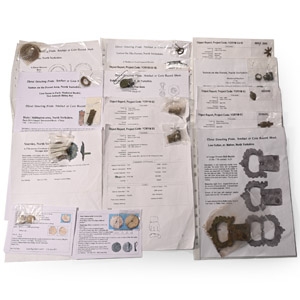
Medieval and Other Bronze Artefact Collection
12th-17th century A.D.Sold for (Inc. bp): £20
Comprising: a seal matrix with trilobed handle with initials 'PEE' or 'PFE'; a spur rowel fragment; thee buckle frames; an oval belt mount; a clothing fastener with swirling foliage; a large buckle frame and plate; an oval buckle with forked spacer; a fragment of a buckle frame with hatched decoration; two cooking vessel legs; lead bag seal inscribed 'SPILL...ERS' and 'NEWCAS' to one side, the other side with 'PATE'; a pierced lead disc; a buckle loop formed as two animals biting the crossbar; a book clasp with fleur-de-lis; a furniture fitting with a facing head with sun burst behind; a lead-alloy harness boss with a twelve-petalled flower. 426 grams total including document, 16-95 mm
Found Yorkshire, UK. From the private collection of Robin Sykes, Yorkshire, UK, formed since the late 1990s. Eighteen objects with record sheets by Jim Halliday. This lot is accompanied by an illustrated lot declaration signed by the Head of the Antiquities Department, Dr Raffaele D'Amato.
N.B. This lot is for UK purchase only. -
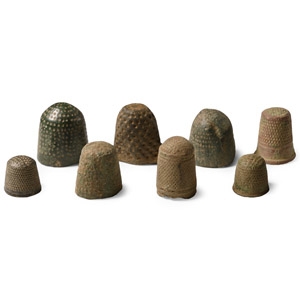
Medieval and Later Thimble Collection
14th-19th century A.D.Sold for (Inc. bp): £52
Comprising eight thimbles of beehive and other types. 36.5 grams total, 13-23 mm
Found Suffolk, UK. This lot is accompanied by an illustrated lot declaration signed by the Head of the Antiquities Department, Dr Raffaele D'Amato.
