
Loading, please wait...
_900x900.jpg "Medieval Bronze Ring with Double-Headed Eagle")
_200x200.jpg "Medieval Bronze Ring with Double-Headed Eagle")
.jpg "Medieval Bronze Ring with Double-Headed Eagle")
LOT 1796
Medieval Bronze Ring with Double-Headed Eagle
CIRCA 15TH-17TH CENTURY A.D.
3/4 in. (3.31 grams, 21.44 mm overall, 19.05 mm internal diameter (approximate size British N 1/2, USA 6 3/4, Europe 14.35, Japan 13)).
Flat-section annular hoop with overlapping finials, discoid bezel with incuse image of a two-headed spread eagle. [No Reserve]
ProvenanceEx German art market, 2000s.
Acquired from an EU collector living in London.
From the collection of a Surrey, UK, gentleman.
TimeLine Auctions follows a vetting process to ensure the authenticity and legality of all items, reinforcing our commitment to integrity and responsible trading. Each antiquity, antique, and coin lot undergoes thorough examination by a vetting committee of at least ten external specialists, professional trade association members, scientists, and archaeologists: Our Vetting Process
AUCTIONS:
TimeLine is a leading auction house specialising in antiquities, ancient art, collectables, natural history, coins, medals, and books. Our auctions offer museums, collectors, historians, and enthusiasts the opportunity to acquire unique and historically significant pieces.
-
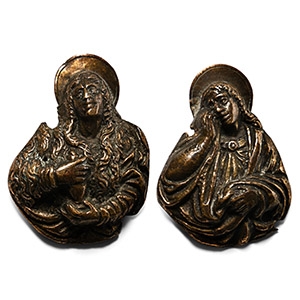
Medieval Gilt Copper Mounts of Mary Magdalene and Saint John the Evangelist
Italy, 16th century A.D.Estimate: £300 - 400 (+bp*)
Opening Bid: £150
Both saints shown nimbate and dressed in voluminous robes, Mary's long hair cascading down her shoulders and holding an ointment jar in her hands. 74.9 grams total, 57-58 mm
Private collection, UK. -
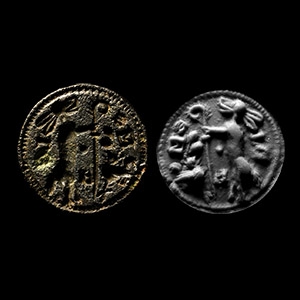
Medieval Bronze Chess Piece Personal Seal Matrix with Fox-Bishop
14th century A.D.Sold for (Inc. bp): £143
With a beaded border, a long-eared fox with a bishop’s crozier preaches to a congregation of birds; this hugely popular satirical motif in which the pastor becomes the predator, preying on his flock, was originally directed against the mendicant friars but soon came to criticise the regular clergy too; the two pairs of letters, either side of the ‘preacher’, appear to read 'IE ME', perhaps Anglo-Norman for ‘I love’. 7.09 grams, 18.65 mm high
Found Gloucestershire, UK. Acquired from the early 1980s. From the private collection of a late Gloucestershire, UK, gentleman; thence by descent. -
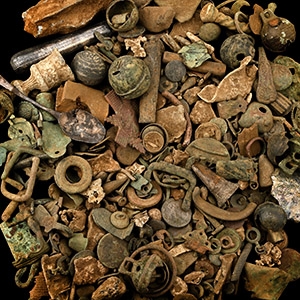
Medieval and Later Artefact Group
14th-21st century A.D.Sold for (Inc. bp): £59
Including crotal bells, lead shot, badges, furniture fittings and other items. 2.35 kg total, 12-94 mm
Found Suffolk, UK. (UK buyers only, not for export)
