
Loading, please wait...
LOT 1740
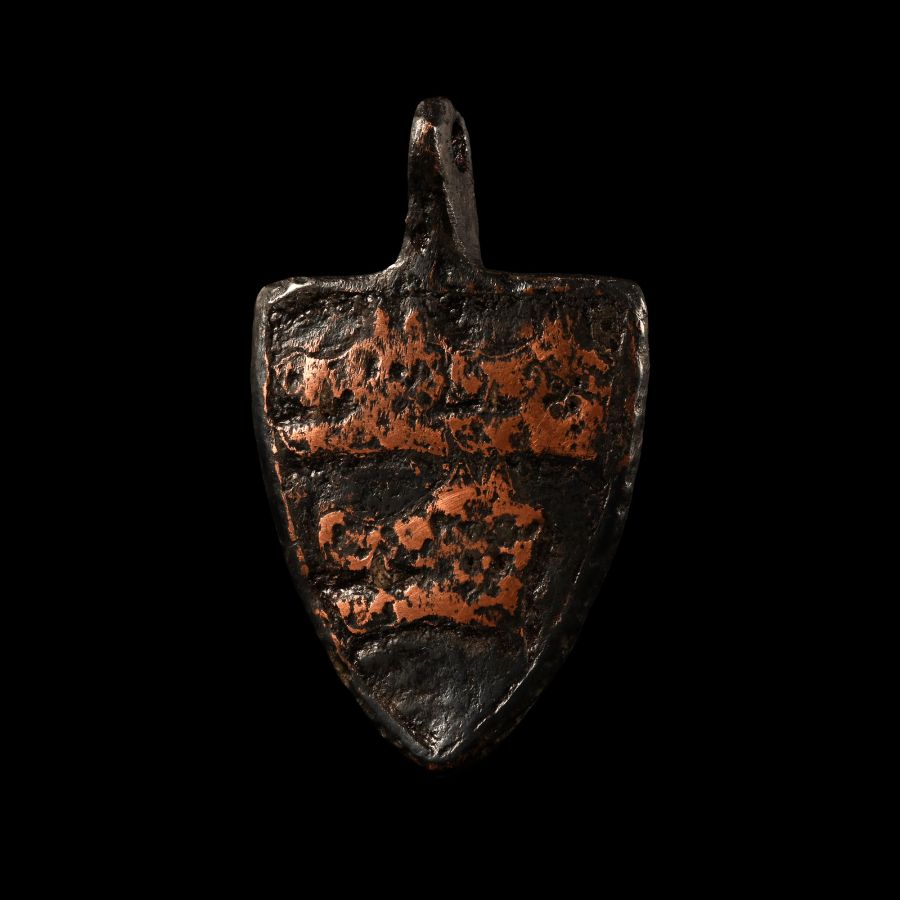
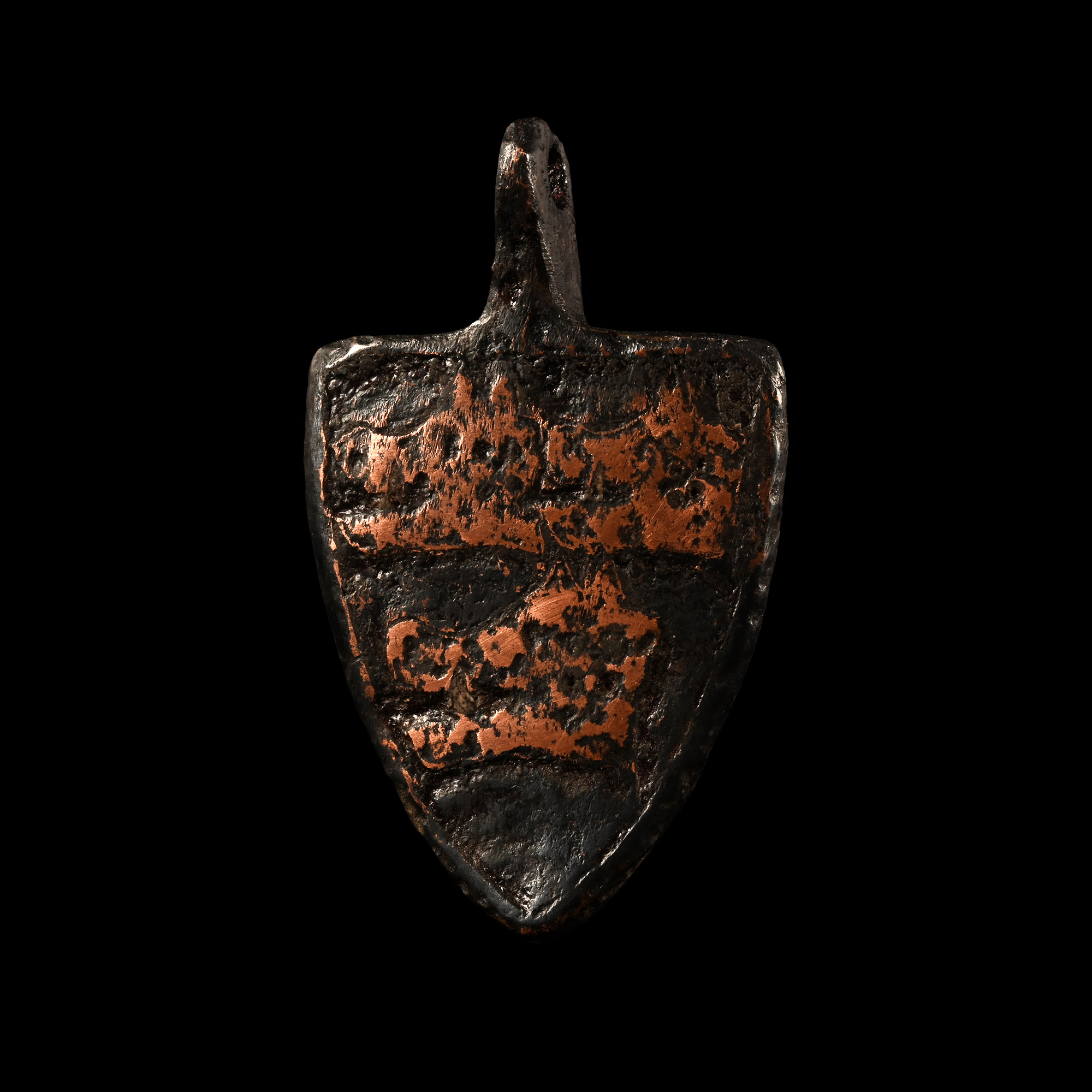
Medieval Bronze Knight's 'Swinburn Family' Heraldic Horse Harness Pendant with Three Boar's Heads
13TH-14TH CENTURY A.D.
1 3/4 in. (16.2 grams, 45 mm).
Heater shield-shaped with integral suspension loop to the upper edge; one face displaying a heraldic device composed of three boars' heads left with remaining traces of red enamel in the field.
ProvenanceFound near Snargate, Kent, UK.
Property of a Kent gentleman.
Accompanied by a copy of the British Museum's Portable Antiquities Scheme (PAS) report no.KENT-56AC78, dating it to c.1280-1350 A.D.
See Woodcock & Flower, Dictionary of British Arms 4, 2014, pp.150-151.
FootnotesThe triple boar's head arms is associated with several members of the Swinburne (sometimes Swynbourne) family in the late 13th to early 14th century period.
CONDITIONTimeLine Auctions follows a vetting process to ensure the authenticity and legality of all items, reinforcing our commitment to integrity and responsible trading. Each antiquity, antique, and coin lot undergoes thorough examination by a vetting committee of at least ten external specialists, professional trade association members, scientists, and archaeologists: Our Vetting Process
AUCTIONS:
TimeLine is a leading auction house specialising in antiquities, ancient art, collectables, natural history, coins, medals, and books. Our auctions offer museums, collectors, historians, and enthusiasts the opportunity to acquire unique and historically significant pieces.
LOT 1740
Medieval Bronze Knight's 'Swinburn Family' Heraldic Horse Harness Pendant with Three Boar's Heads
Sold for (Inc. bp): £208
-
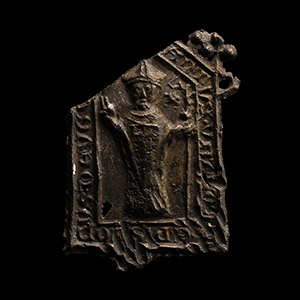
Medieval Pewter Pilgrim's Badge of St. Ubaldus
14th-15th century A.D.Sold for (Inc. bp): £208
Formed as a pentagonal plate showing a bishop in relief to the centre, wearing a mitre and floor length cope and surplice, holding attributes of his office, surrounding Latin legend: '[S]ANTVS VBALDVS EPISCOPVS DEV GV[BIO]' (St. Ubaldus, bishop, of Gubbio); one remaining attachment loop. 7.7 grams, 43 mm
European collection, 1990s. Property of a Cambridgeshire, UK, gentleman.
Commemorating a pilgrimage to the shrine of St. Ubaldus (1085-1160) in Gubbio. -
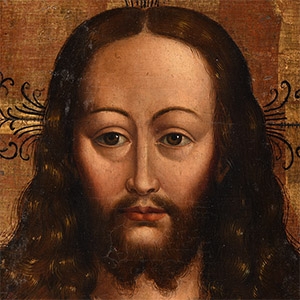
Medieval Wooden 'True Face of Christ' Icon
Castile, circa 1500-1520 A.D.Sold for (Inc. bp): £1,560
Depicting an idealised image of Christ on a gilt background, stylised cross behind; wide eyebrows and double-pointed beard; the hair falling on the shoulders in neat locks; wearing a red tunic with gold embroidery reading 'REX + REGUM' for 'king of kings', pearled edge. 1.28 kg, 28.5 cm
Excellent condition
with Ansorena, 10 November 2014, lot 456. Ex central London gallery. Accompanied by an academic report by Dr Raffaele D’Amato. This lot has been checked against the Interpol Database of stolen works of art and is accompanied by search certificate number no.11742-202064.
The crimson tunic of our painting is clearly derived from the Van Eyck model, where crimson is associated with the Majesty of Christ. Christ is in fact shown here as the Saviour of the World (Salvator Mundi), a popular image in 15th century paintings. -
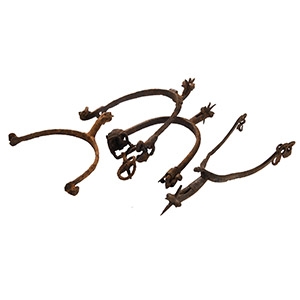
Medieval Iron Rowel Spur Collection
Circa 13th-16th century A.D.Estimate: £100 - 140 (+bp*)
Opening Bid: £40
Comprising examples of various types, including some retaining the rowel, buckle and other fitting elements. 249 grams total, 11.5-15 cm
Acquired 1990s-early 2000s. East Anglian private collection.
The early rowel spurs had short necks and small four-six or seven point star rowels, while four rowels were uncommon. After c.1350 the multipoint rowel became voguish though the former shapes continued.
