Loading, please wait...

Medieval Bronze Knight's Heraldic Horse Harness Pendant Group Medieval Bronze Knight's Heraldic Horse Harness Pendant Group Medieval Bronze Knight's Heraldic Horse Harness Pendant Group
Use mousewheel to zoom in and out, click to enlarge
Details

LOT 1589

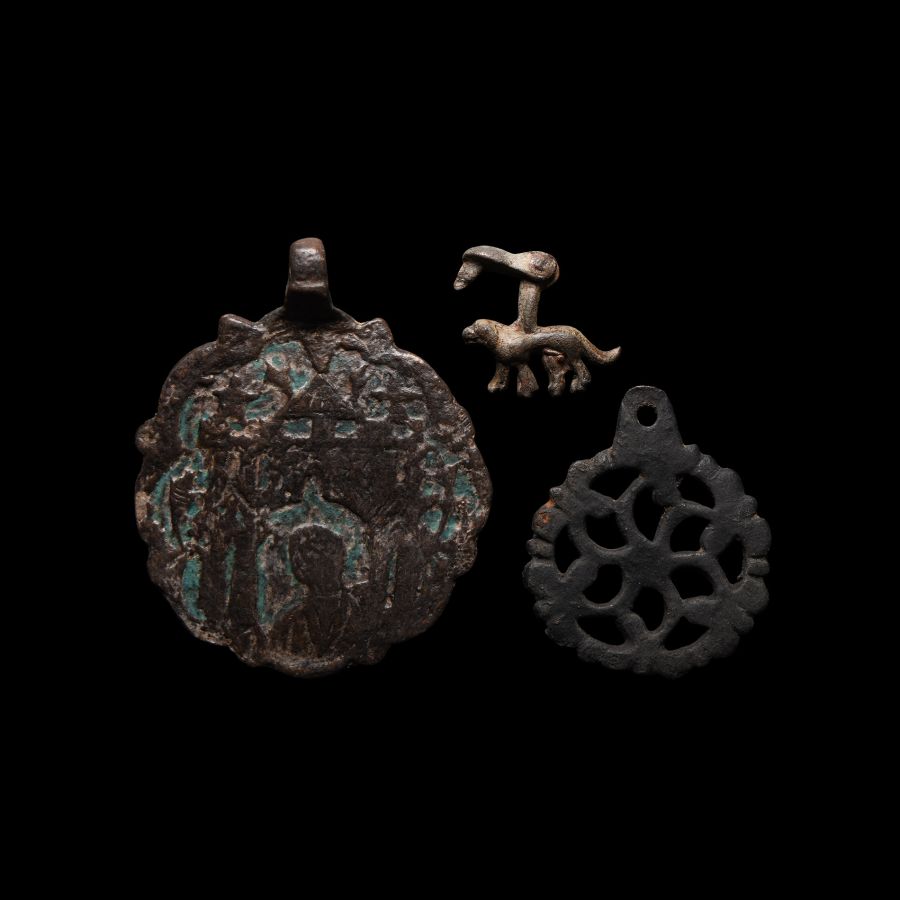
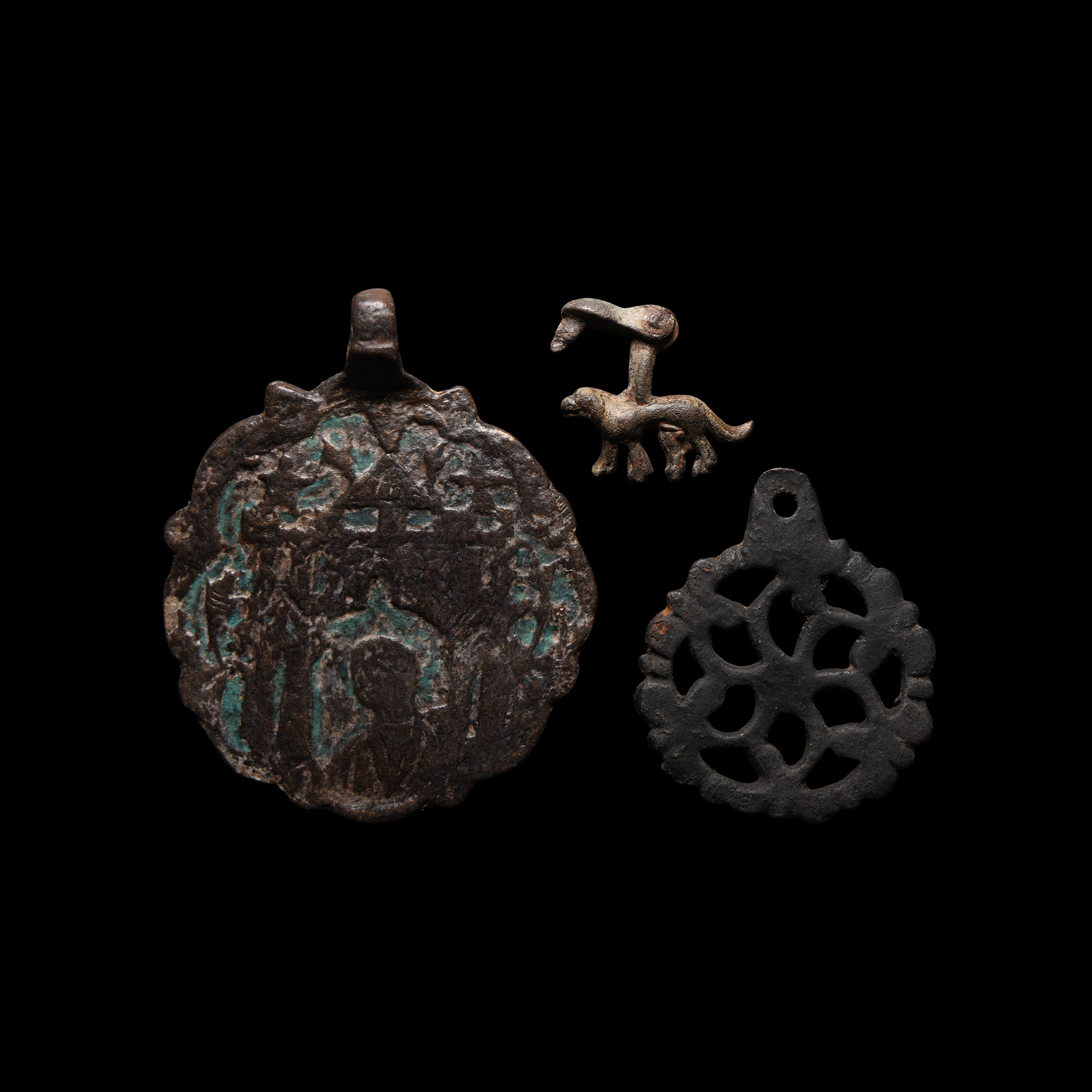
Medieval Bronze Knight's Heraldic Horse Harness Pendant Group

13TH-15TH CENTURY A.D.

1 3/8 - 2 5/8 in. (50.4 grams total, 34-66 mm).

Comprising: a talbot on a hinged attachment stud; an openwork rosette; an enamelled plaque with scene of a figure beneath an arch. [3, No Reserve]

Provenance

Found UK.
Acquired on the UK art market after 2000.
Ex Stratford collection, Suffolk, UK.

CONDITION
VETTING:

TimeLine Auctions follows a vetting process to ensure the authenticity and legality of all items, reinforcing our commitment to integrity and responsible trading. Each antiquity, antique, and coin lot undergoes thorough examination by a vetting committee of at least ten external specialists, professional trade association members, scientists, and archaeologists: Our Vetting Process


AUCTIONS:

TimeLine is a leading auction house specialising in antiquities, ancient art, collectables, natural history, coins, medals, and books. Our auctions offer museums, collectors, historians, and enthusiasts the opportunity to acquire unique and historically significant pieces.

Live Bidding

LOT 1589

Medieval Bronze Knight's Heraldic Horse Harness Pendant Group

Estimate £150 - 200€170 - 230 (for guidance only)$200 - 270 (for guidance only)

Print page

RELATED LOTS
  • Medieval Thames Pewter Pilgrims and Other Badge Fragments
    Medieval 'Thames' Pewter Pilgrim's and Other Badge Fragments
    15th-16th century A.D.

    Sold for (Inc. bp): £130

    Mixed group including tracery fragments, an openwork dome, spandrel, rosettes and other items. 50.2 grams total, 8-52 mm


    Found Thames foreshore spoil, 1980s.

    Lot Details

  • Medieval Embroidered Panel Composed of Sections of Dalmatic Garment
    Medieval Embroidered Panel Composed of Sections of Dalmatic Garment
    Florence, Italy, circa 1440-1460 A.D.

    Sold for (Inc. bp): £2,470

    Comprising twelve sections, the top row with three Evangelists, each holding a gospel; the next row with the Annunciation scene with Archangel Gabriel, Mary and Saint Paul holding a raised sword and a book; Saint Augustine and Saint Thomas Aquinas flanking the standing figure of Jesus; the bottom row with Saint Peter holding keys and a book, Moses and probably Saint Andrew; each figure framed with embroidered foliage; sewn to a linen background stretched over a wooden frame. 1.55 kg, 84.5 cm


    French private collection. with Jean-Charles D'Ornano, 16 January 2022, lot 233. Ex central London gallery. Accompanied by an academic report by Dr Raffaele D’Amato. This lot has been checked against the Interpol Database of stolen works of art and is accompanied by search certificate no.11749-202077.

    The dalmatic (liturgical vestment derived from the Late Roman garment with the same name) was worn by the deacons in Latin Catholic Church. This dress, mainly used in the Holy Liturgy, was often decorated in silk and gold embroidery, and splendid specimens were realised by the Italian workshops of the Florentine Republic, one of the richest Italian states of the Renaissance.

    Lot Details

  • The Kirkleavington Medieval Bronze Inscribed Purse Frame
    'The Kirkleavington' Medieval Bronze Inscribed Purse Frame
    15th-16th century A.D.

    Sold for (Inc. bp): £3,640

    The bar with central D-shaped block pierced vertically by a stud surmounted by the suspension loop, with four pierced flanges to the underside; the frame in two sections, the larger a U-shaped rod with pivot for the bar, the smaller pivoting within the inner face, both pierced on the inner face; the block inscribed to one face with capital S and to the other with intersecting Vs; the bar inscribed to one face in capitals 'A DOMINI TECVM' and to the other in coarsely incised capitals 'AVEMARIA G[R]ACIAPLE[NA]'; the smaller rod inscribed in capitals 'CREATOREN CELI ET TERRE ET IN [IES]VN'; the larger inscribed with a band of scrolled decoration and the text in Lombardic capitals 'SOLI DEO HONOR ET GLORIA'; the accompanying letter discusses the texts (1) Ave Maria G[r]acia ple[n]a Dominus Tecum 'Hail Mary full of grace, the Lord [is] with thee'; (2) Soli Deo Honor et Gloria 'Honour and glory to God alone'; (3) Creatorem celi et terrae et inferum 'creator of heaven and earth and in Jesus'. The intersecting Vs may form a monogram for A[ve] M[aria]; the 1847 letter describes the findspot as 'found at Kirkleavington near Yarm in the sill of a brook' in the North Riding of Yorkshire. 183 grams, 20.7 cm


    Found at Kirkleavington near Yarm, North Riding of Yorkshire, UK, in 1847. Accompanying label describes it as ‘found in constructing the Leeds and Thirsk Railway, near Kirkleavington, Co. York. Communicated by John Bourne, Esq. Engineer to the Company, Leeds’. Accompanied by a manuscript letter of September 17th 1847 from Mr Histon Longstaffe discussing the text, with later amendments date 1854. This lot has been checked against the Interpol Database of stolen works of art and is accompanied by searcher certificate no. 200593.

    Metal purse frames of this type were a luxury personal accessory of late Middle Ages and early Renaissance period (about 1450-1500). They were decorated with niello. In this technique the metalworker engraved a pattern or design onto highly polished metal and filled the incised lines with a hard black alloy. Religious inscriptions were incised to invoke the divine protection. A fragmentary purse-frame in the MOL [ID 4452] containing this same portion of the Apostles Creed enables us to correct the 19C reading INFERVN to IN IESVN ('in Jesus')

    Lot Details

Stay up-to-date with the latest from TimeLine Auctions by joining our mailing list