
Loading, please wait...
LOT 1864
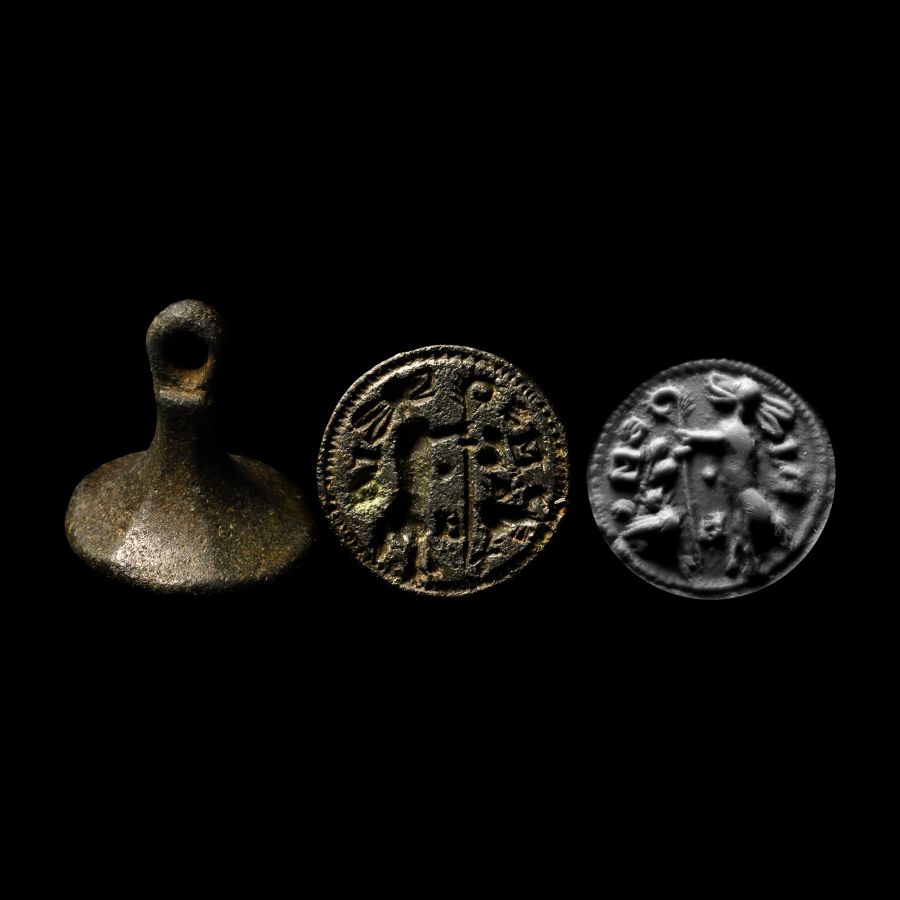
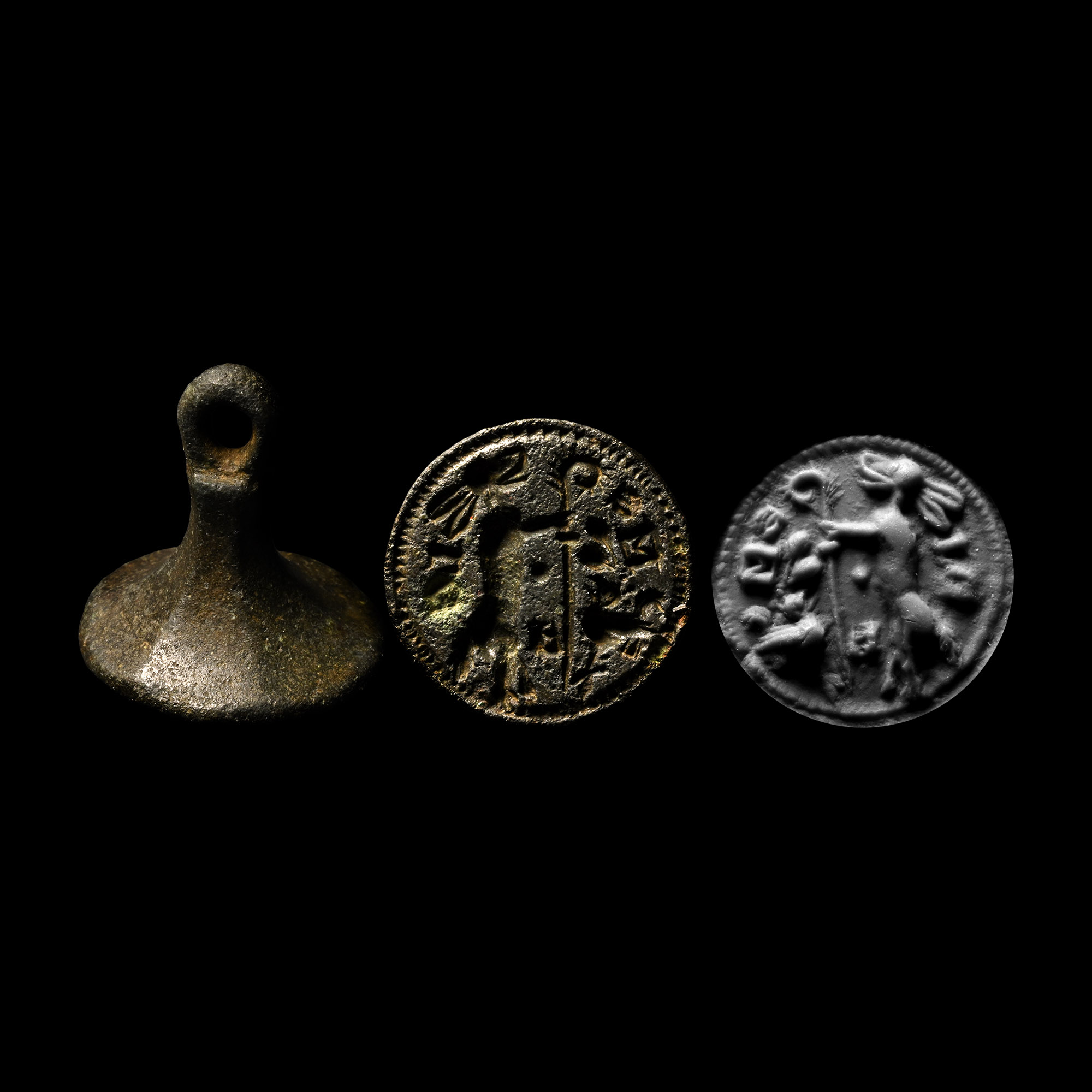
Medieval Bronze Chess Piece Personal Seal Matrix with Fox-Bishop
14TH CENTURY A.D.
3/4 in. (7.09 grams, 18.65 mm high).
With a beaded border, a long-eared fox with a bishop’s crozier preaches to a congregation of birds; this hugely popular satirical motif in which the pastor becomes the predator, preying on his flock, was originally directed against the mendicant friars but soon came to criticise the regular
clergy too; the two pairs of letters, either side of the ‘preacher’, appear to read 'IE ME', perhaps Anglo-Norman for ‘I love’. [No Reserve]
Found Gloucestershire, UK.
Acquired from the early 1980s.
From the private collection of a late Gloucestershire, UK, gentleman; thence by descent.
See Jones, M., The Secret Middle Ages, Cheltenham, 2025, pp.276-7, 282-3.
CONDITIONTimeLine Auctions follows a vetting process to ensure the authenticity and legality of all items, reinforcing our commitment to integrity and responsible trading. Each antiquity, antique, and coin lot undergoes thorough examination by a vetting committee of at least ten external specialists, professional trade association members, scientists, and archaeologists: Our Vetting Process
AUCTIONS:
TimeLine is a leading auction house specialising in antiquities, ancient art, collectables, natural history, coins, medals, and books. Our auctions offer museums, collectors, historians, and enthusiasts the opportunity to acquire unique and historically significant pieces.
LOT 1864
Medieval Bronze Chess Piece Personal Seal Matrix with Fox-Bishop
Sold for (Inc. bp): £143
-
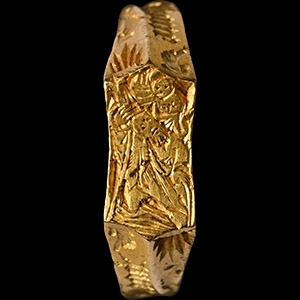
'The Otterington Hall' Medieval Inscribed Iconographic Gold Ring with Saint Christopher
1450-1550 A.D.Sold for (Inc. bp): £7,150
With a flat rectangular bezel engraved with an image of Saint Christopher carrying the Christ child on his back, the hoop extending on either side of the bezel and having a twisted design creating facetted shoulders with transverse ridges extending from each side of the bezel; each smaller shoulder facet engraved with six projecting rays, each larger side with engraved blackletter texts 'pur' and 'bone' meaning 'for good (fortune)’/ ‘for the best'; a foliate design present between the bezel and text, and each word followed by an engraved flower, the remainder of the hoop with a twisted ropework design; heavily worn by its original owner creating a desirable natural finger shape connecting the wearer with the original owner. 3.26 grams, 18.91 mm overall, 16.51 mm internal diameter (approximate size British I 1/2, USA 4 1/2, Europe 8.07, Japan 7)
Found whilst searching with a metal detector in South Otterington, Hambleton, North Yorkshire, UK, on 28 November 2024, by James Sweeney; declared as a Treasure under the Treasure Act with reference no.2024 T1402, and subsequently disclaimed by the Crown. Accompanied by a copy of the British Museum's Portable Antiquities Scheme (PAS) report no.YORYM-AED39E. Accompanied by a copy of a letter from the Office of the Senior Coroner for North Yorkshire and York, explaining that the Crown's interest in this find has been disclaimed. This lot has been checked against the Interpol Database of stolen works of art and is accompanied by search certificate number no.12990-244092.
Saint Christopher, the patron of travellers, was one of the most popular saints in the Middle Ages. As a supposed early Christian martyr, he was thought to give protection against death from the plague. -
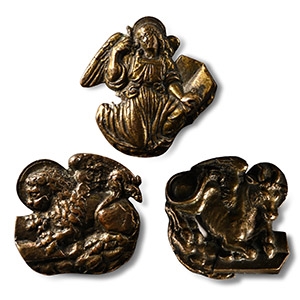
Medieval Gilt Plaques of the Evangelist
Italy, 16th century A.D.Sold for (Inc. bp): £390
Comprising three plaques depicting the symbols of the Evangelists Matthew (angel), Luke (ox) and Mark (lion). 92.3 grams total, 45-46 mm
Private collection, UK. -
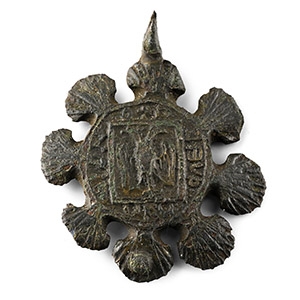
Medieval Knight's Bronze Eight-Lobed Heraldic Horse Harness Pendant with Double-Headed Eagle
Circa 14th-15th century A.D.Sold for (Inc. bp): £33
Comprising a central disc with eight radiating scallops to the rim, the upper with loop, the lower with later rivet; central square escutcheon with two-headed eagle; retrograde legend surrounding: '+ O/NG[?]/OFO/GVEL/O' . 22 grams, 51 mm
Acquired on the UK art market in the 1980s. From an East Anglian private collection.
