
Loading, please wait...


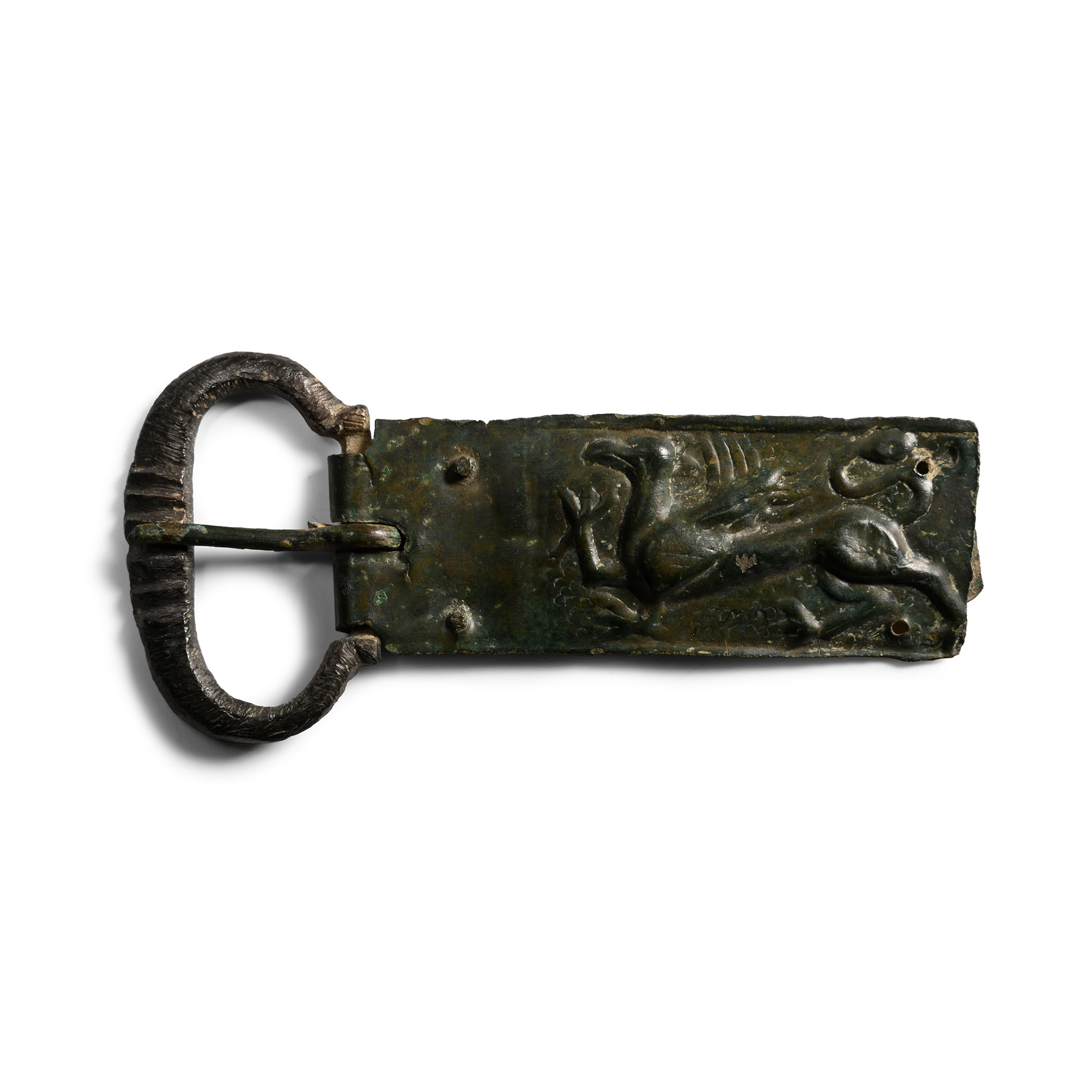
LOT 0383
Medieval Bronze Buckle with Repoussé Griffin
FRANCE, 13TH CENTURY A.D.
3 in. (11.4 grams, 78 mm).
Rectangular buckle-plate with repoussé advancing griffin and plain backplate with fixing pins; broad loop with bulbs to the forward edge; narrow tongue. [No Reserve]
ProvenanceFrom the Sir Alistair McAlpine collection.
London trade, 2001.
TimeLine Auctions follows a vetting process to ensure the authenticity and legality of all items, reinforcing our commitment to integrity and responsible trading. Each antiquity, antique, and coin lot undergoes thorough examination by a vetting committee of at least ten external specialists, professional trade association members, scientists, and archaeologists: Our Vetting Process
AUCTIONS:
TimeLine is a leading auction house specialising in antiquities, ancient art, collectables, natural history, coins, medals, and books. Our auctions offer museums, collectors, historians, and enthusiasts the opportunity to acquire unique and historically significant pieces.
-
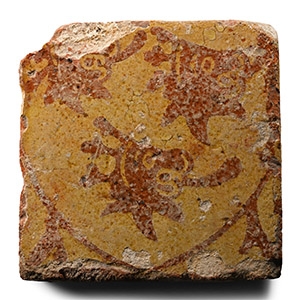
Medieval Glazed Floor Tile with Three Lions
England, 15th century A.D.Sold for (Inc. bp): £312
Decorated with three crowned lion heads with long tongues and large circular eyes, framed by the bottom half of a shield-shaped background. 930 grams, 13.5 x 13.5 cm
Benjamin Proust, 2015. Ex central London gallery. -
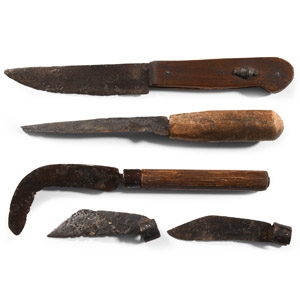
Medieval to Jacobean Period Iron Knife Collection
14th-17th century A.D.Sold for (Inc. bp): £13
Comprising: single-edged knife with swept edge, whittle-tang handle; single-edge knife with scale-tang handle, stamped with a crown in a pelleted cartouche; hawkbill knife with edge to the inner face of the curve; short broken-back blade with bolster; similar with punched 'f' maker's mark. 192 grams total, 8-21.5 cm
From the collection of the famous author, writer and speaker, Gordon Bailey, Essex, UK; formed since 1968. -
.jpg)
Medieval Bronze Knight's Holy Sepulchre Badge
Circa 13th-14th century A.D.Sold for (Inc. bp): £169
Formed as a cross-crosslet, the symbol of the Knights of the Holy Sepulchre, with punched-point border. 1.51 grams, 25 mm
Found near Bottisham, Cambridgeshire, UK.
The 'Equestrian Order of the Holy Sepulchre of Jerusalem' was an order of knighthood under the protection of the Pope, formed around 1099 A.D. by Duke Godfrey of Bouillon, the leader of the First Crusade. It was established for the protection of pilgrims travelling to the Holy Land and was recognised by a Papal Bull in about 1113 A.D.
