
Loading, please wait...
_900x900.jpg "Medieval Bronze Archer's Thumb Ring")
_200x200.jpg "Medieval Bronze Archer's Thumb Ring")
.jpg "Medieval Bronze Archer's Thumb Ring")
LOT 1394
Medieval Bronze Archer's Thumb Ring
13TH-15TH CENTURY A.D.
1 in. (7.31 grams, 26.60 mm overall, 22.48 mm internal diameter (approximate size British X 1/2 , USA 11 3/4, Europe 26.92, Japan 25)).
With geometric design on a hatched background and discoid pad to rear. [No Reserve]
ProvenanceAcquired in the 1990s.
Ex Private collection, Suffolk, UK.
Property of a Kent lady collector.
Cf. Bikic, V., Beyond the Jewellery: Archer’s Rings in the Medieval Balkans (14th-15th centuries) in Bosselmann-Ruickbie, A. (ed.), New Research on Late Byzantine Goldsmiths’ Works (13th-15th Centuries), Mainz, 2019, figs.5, 6, 7.
CONDITIONTimeLine Auctions follows a vetting process to ensure the authenticity and legality of all items, reinforcing our commitment to integrity and responsible trading. Each antiquity, antique, and coin lot undergoes thorough examination by a vetting committee of at least ten external specialists, professional trade association members, scientists, and archaeologists: Our Vetting Process
AUCTIONS:
TimeLine is a leading auction house specialising in antiquities, ancient art, collectables, natural history, coins, medals, and books. Our auctions offer museums, collectors, historians, and enthusiasts the opportunity to acquire unique and historically significant pieces.
-
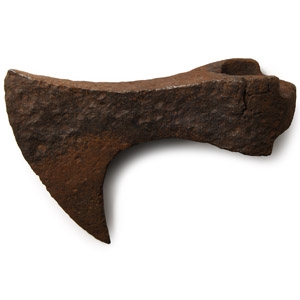
Viking Age Bearded Iron Axehead
11th-13th century A.D.Sold for (Inc. bp): £182
With broad curved blade and pointed chin, broad neck, deep socket with lateral flanges. 698 grams, 15.5 cm
From the collection of a Californian, USA, gentleman, dating back to the late 1960s.
During the mid 13th century, the axes were favourite weapons among Baltic people. For instance the Curonian army included lightly armed soldiers who fought with spears, shields, fighting knives and axes. A heavily armed soldier could also carry a sword, a helmet, a shield and a wide-bladed axe. -
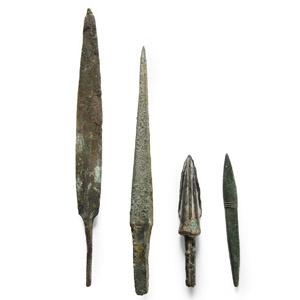
Western Asiatic Bronze Arrowhead Collection
1st millennium B.C.Sold for (Inc. bp): £33
Including a slender leaf-shaped type, square-section tanged type and others. 67.1 grams total, 5.8-12.3 cm
From a collection acquired on the UK art market from various auction houses and collections mostly before 2000. From an important Cambridgeshire estate; thence by descent. -
.jpg)
Medieval Bronze Archer's Thumb Ring
13th-15th century A.D.Sold for (Inc. bp): £72
With geometric design on a hatched background and discoid pad to rear. 7.31 grams, 26.60 mm overall, 22.48 mm internal diameter (approximate size British X 1/2 , USA 11 3/4, Europe 26.92, Japan 25)
Acquired in the 1990s. Ex Private collection, Suffolk, UK. Property of a Kent lady collector.
