
Loading, please wait...
_900x900.jpg "Medieval and Post Medieval Iron Knife Blade Group")
_200x200.jpg "Medieval and Post Medieval Iron Knife Blade Group")
.jpg "Medieval and Post Medieval Iron Knife Blade Group")
LOT 1887
Medieval and Post Medieval Iron Knife Blade Group
CIRCA 15TH-17TH CENTURY A.D.
3/4 - 10 in. (3.65 kg total, 2-25.5 cm).
Mainly comprising folding knives and other knife blades. [140, No Reserve]
ProvenanceAcquired 1990s-early 2000s.
Ex East Anglian private collection.
Cf. Marquardt, K., Eight Centuries of European Knives, Forks and Spoons: an Art Collection, Europe, 1997, pp.29-31, for similar examples from 15th century A.D.
FootnotesAmongst the considerable variations in Medieval knife blade shapes, the two most obvious are the blades with angled backs (like some examples here presented) and those with stepped backs.
CONDITIONTimeLine Auctions follows a vetting process to ensure the authenticity and legality of all items, reinforcing our commitment to integrity and responsible trading. Each antiquity, antique, and coin lot undergoes thorough examination by a vetting committee of at least ten external specialists, professional trade association members, scientists, and archaeologists: Our Vetting Process
AUCTIONS:
TimeLine is a leading auction house specialising in antiquities, ancient art, collectables, natural history, coins, medals, and books. Our auctions offer museums, collectors, historians, and enthusiasts the opportunity to acquire unique and historically significant pieces.
-
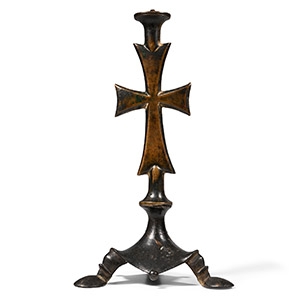
Medieval Bronze Cross on Base
10th-11th century A.D.Estimate: £5,000 - 7,000 (‡+bp*)
Opening Bid: £2,500
Comprising an expanding-arm cross supporting a short neck with disc finial above; below, a short shank with trumpet-shaped baluster and triangular base, scooped in profile with segmented radiating legs and domed feet; a knop placed between each pair of legs. 669 grams, 23 cm
With Juliette Noujaim, Arqueologie, Islamic Art, Le Louvre des Antiquaires, Paris. Acquired by the present owner from the above in 2005. This lot has been checked against the Interpol Database of stolen works of art and is accompanied by a search certificate number no.12290-222317. -
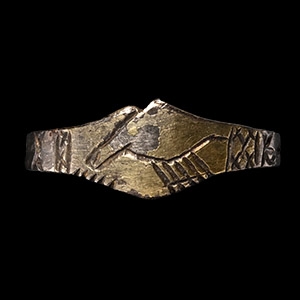
Large Medieval Silver Gilt Fede Ring with Magical Symbols
15th-16th century A.D.Sold for (Inc. bp): £364
Comprising a square-section shank and bezel formed as two clasped hands; hatched band to each cuff; punched markings to the outer face, pseudo-script or amuletic in purpose. 2.97 grams, 23.51 mm overall, 20.58 mm internal diameter (approximate size British U, USA 10, Europe 22.52, Japan 21)
From the collection of the famous author, writer and speaker, Gordon Bailey, Essex, UK; formed since 1968. -
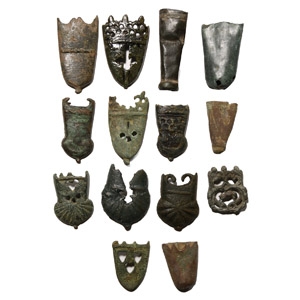
Medieval and Later Bronze Dagger Chape Collection
14th-19th century A.D.Sold for (Inc. bp): £105
Including enclosed bell-shaped, openwork single-face and other types; many of these objects are published in the Detector Finds book series. 125 grams total, 31-53 mm
From the collection of the famous author, writer and speaker, Gordon Bailey, Essex, UK; formed since 1968.
