
Loading, please wait...
_900x900.jpg "Medieval and Later Lead Artefact Group")
_200x200.jpg "Medieval and Later Lead Artefact Group")
.jpg "Medieval and Later Lead Artefact Group")
LOT 1921
Medieval and Later Lead Artefact Group
CIRCA 14TH-20TH CENTURY A.D.
1/2 - 5 1/4 in. (5.13 kg total, 13-132 mm).
Mixed group including a model horse, a model ecclesiastical throne, musket and pistol balls, and other items. [95, No Reserve]
ProvenanceFound Hertfordshire, UK.
CONDITIONTimeLine Auctions follows a vetting process to ensure the authenticity and legality of all items, reinforcing our commitment to integrity and responsible trading. Each antiquity, antique, and coin lot undergoes thorough examination by a vetting committee of at least ten external specialists, professional trade association members, scientists, and archaeologists: Our Vetting Process
AUCTIONS:
TimeLine is a leading auction house specialising in antiquities, ancient art, collectables, natural history, coins, medals, and books. Our auctions offer museums, collectors, historians, and enthusiasts the opportunity to acquire unique and historically significant pieces.
-
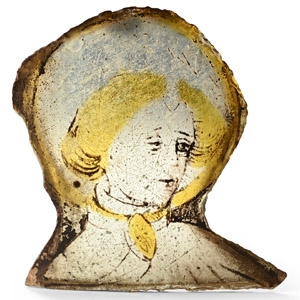
Medieval Stained Glass Head of a Saint
Western France, 15th century A.D.Sold for (Inc. bp): £494
Portrait bust of John the Evangelist with vesica-shaped brooch at the chest, nimbus behind the head. 62.3 grams, 10.7 cm
Ex central London gallery. -
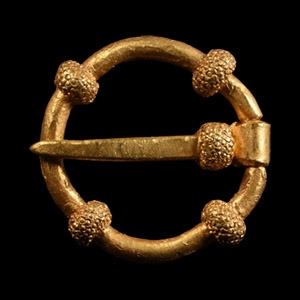
'The Boxted' Medieval Gold Annular Brooch with Granulated Knops
13th century A.D.Sold for (Inc. bp): £1,820
Annular in form with four granulated bulbs; straightened and with replicant pin. 11.00 grams, 25 mm
Found whilst searching with a metal detector near Boxted, Colchester, Essex, UK, by Kevin Stimpson in September 2019. Accompanied by a copy of the British Museum's Portable Antiquities Scheme report no.ESS-585B22. Disclaimed as treasure under the Treasure Act with reference no.2019T1066. -
.jpg)
Medieval Gilt Bronze Ostensorium with Semi-Precious Gemstones
Germany, Cologne, circa 1430 A.D.Sold for (Inc. bp): £6,760
Comprising a tubular shank with lower plain collar and median ribbed and fluted collar, teardrop-shaped head with transverse tubular 'monstrance' or viewing aperture, knop to the apex of the teardrop on each face; obverse with ellipsoid and circular cells enclosing precious and semi-precious stones in a variety of shapes and colours; reverse with ring of domed studs and two hinged fastenings; mounted on a custom-made stand. 902 grams total, 32.4 cm high including stand
Mercier & Cie, 16 April 2023, no.214. This lot has been checked against the Interpol Database of stolen works of art and is accompanied by a search certificate number no.12292-221721.
