
Loading, please wait...

LOT 1800
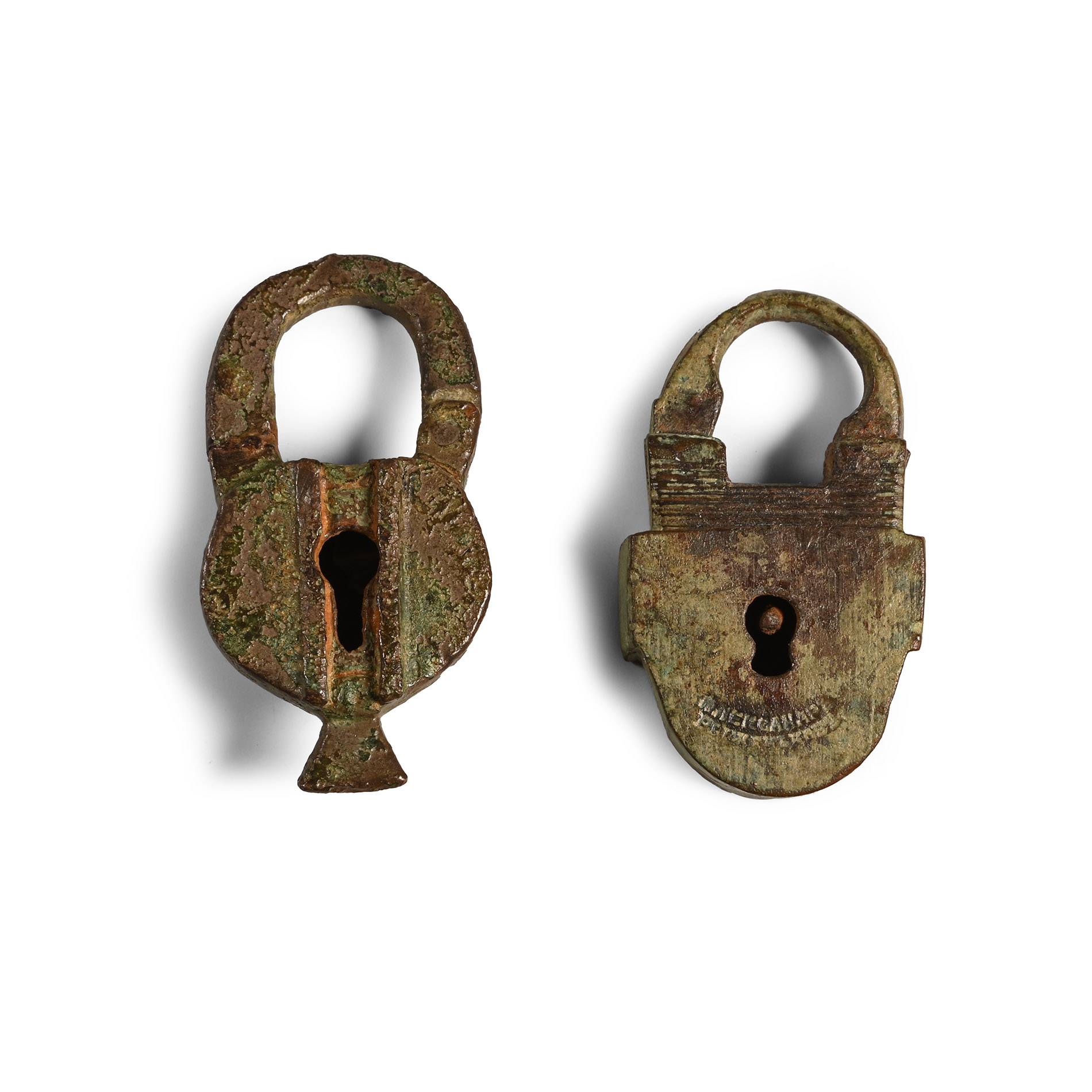
Medieval and Later Bronze Padlock Group
15TH-19TH CENTURY A.D.
1 3/4 - 2 in. (55.6 grams total, 46-50 mm).
One with thick C-shaped locking arm, keyhole with slot, wedge-shaped tab below; the other D-shaped with hinged arm, keyhole with turning pin, stamped maker's name '...CAHAP' beneath the hole. [2]
ProvenanceEx German art market, 2000s.
Acquired from an EU collector living in London.
From the collection of Surrey, UK, gentleman.
TimeLine Auctions follows a vetting process to ensure the authenticity and legality of all items, reinforcing our commitment to integrity and responsible trading. Each antiquity, antique, and coin lot undergoes thorough examination by a vetting committee of at least ten external specialists, professional trade association members, scientists, and archaeologists: Our Vetting Process
AUCTIONS:
TimeLine is a leading auction house specialising in antiquities, ancient art, collectables, natural history, coins, medals, and books. Our auctions offer museums, collectors, historians, and enthusiasts the opportunity to acquire unique and historically significant pieces.
LOT 1800
Medieval and Later Bronze Padlock Group
Estimate £120 - 170€140 - 200 (for guidance only)$160 - 230 (for guidance only)
-
Medieval Iron Rowel Spur Collection
Circa 14th-16th century A.D.Sold for (Inc. bp): £143
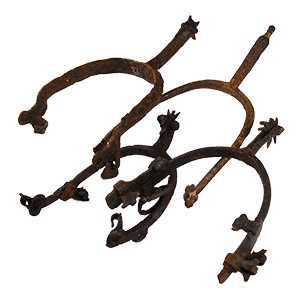
Comprising spurs of various sizes; including examples retaining rowels and buckles. 313 grams total, 13.3-15.3 cm
Acquired 1990s-early 2000s. East Anglian private collection.
Early in 16th century, fashion of spurs changed and the spur were fitted with a much shorter, dropped neck, their rowels ranging from medium seven-point to large short seven points. -

Medieval 'Westminster' Bronze Buckle and Plate and Lead Pilgrim's Ampulla
Circa 14th century A.D.Sold for (Inc. bp): £46
Buckle with knuckles to outer edge of the loop and strap with incised tendril design; ampulla with lateral loops bent over. 63 grams total, 46-62 mm
Found Westminster, London, UK. Property of a Gloucestershire, UK, collector. Property of an East Sussex, UK, gentleman. -

Medieval Lead Seal Matrix Pair
14th century A.D.Sold for (Inc. bp): £91
Both with central eight-petalled flower within a roundel, surrounding inscription, one with legend 'S' WILLI WASRAT' = Seal of William Wasrat; the other with 'S' HENRICI BREIWOOD' = Seal of Henry Brewood, the family originating in Brewood, Staffordshire. 21.4 grams total, 25-27 mm
From the collection of the famous author, writer and speaker, Gordon Bailey, Essex, UK; formed since 1968.
During the medieval period the use of seals on documents, letters and packages became widespread. Lead was cheap to use and easy to engrave, and from the late 12th until the end of 13th century seals of this type, with very conventional central designs, were important possessions amongst the lower classes.
