
Loading, please wait...
LOT 0316
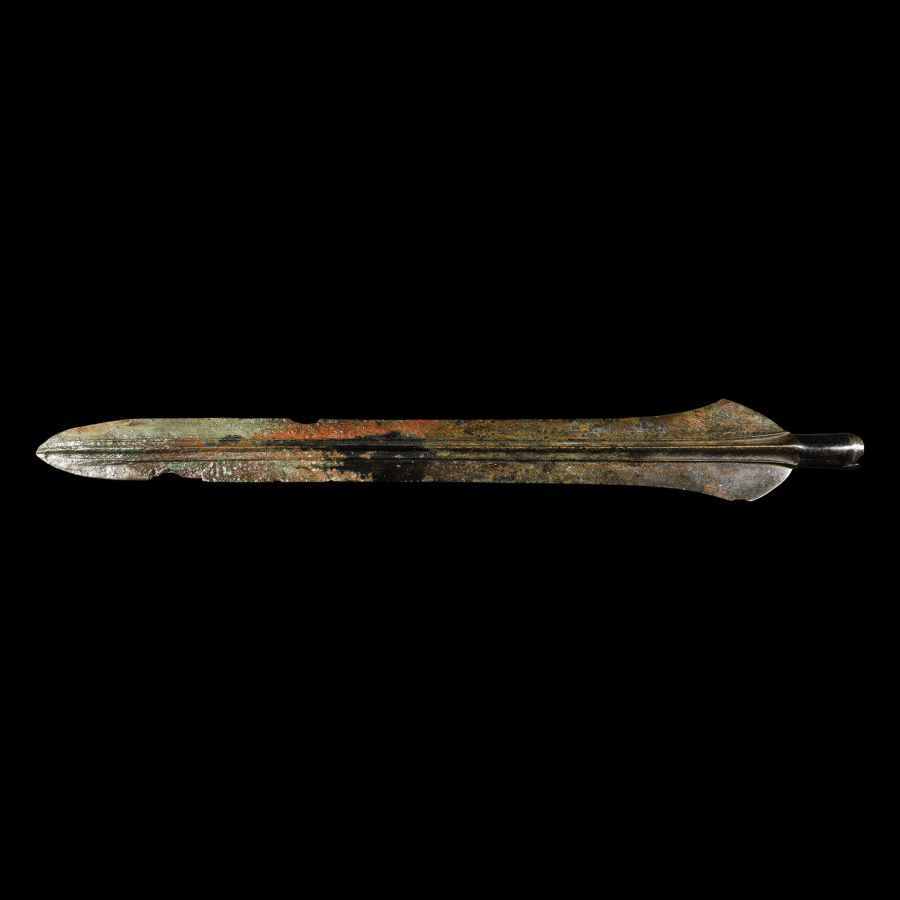
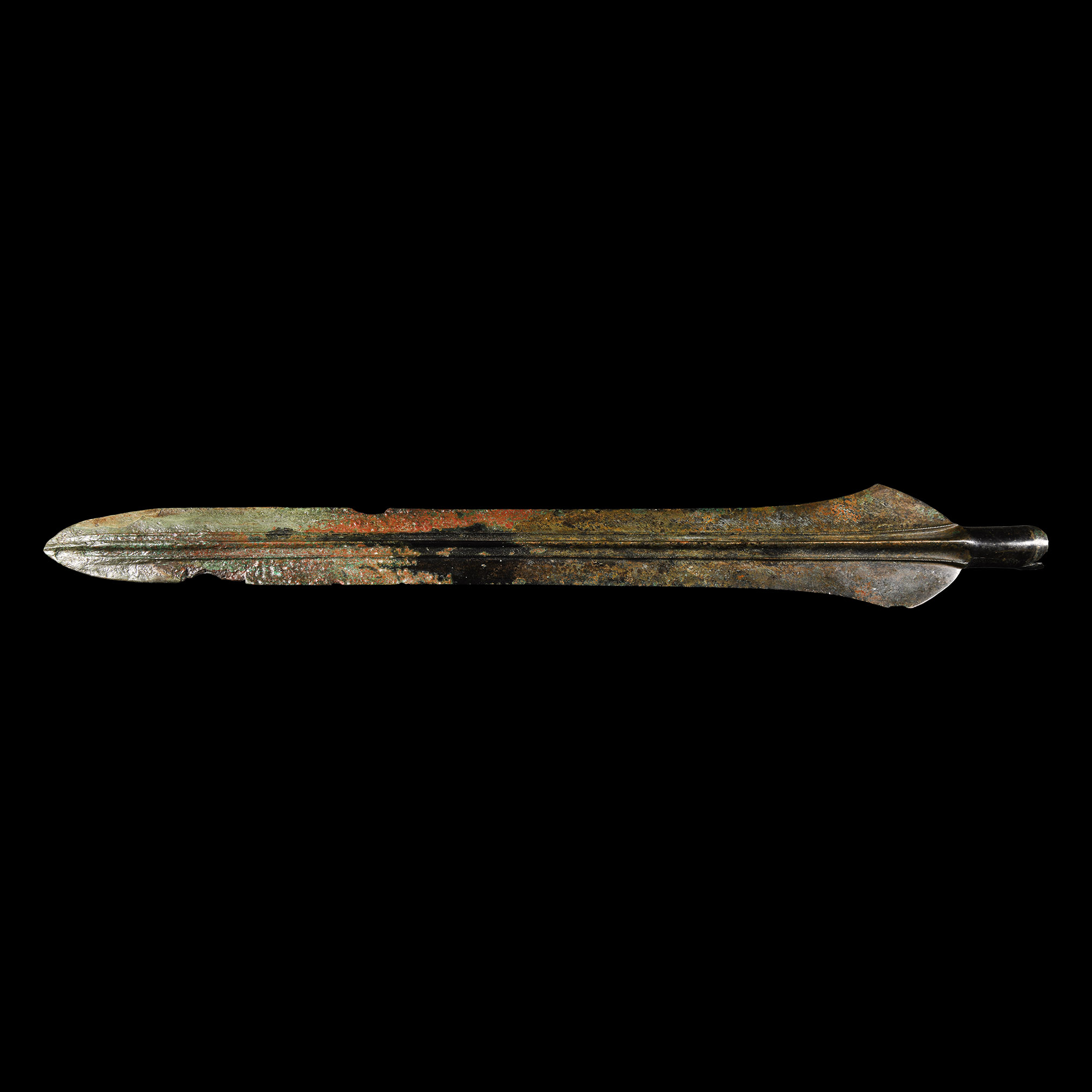
Massive Late European Bronze Age Finely Ribbed Socketted Spearhead
CIRCA 10TH CENTURY B.C.
17 3/4 in. (449 grams, 45 cm).
Formed with an elongated leaf-shaped blade, the socket extending into the blade in the form of a tapered mid-rib with decorative raised central grooves.
ProvenanceAcquired from John Cummings, UK, in 1988.
Ex Lord Alistair McAlpine collection.
Cf. Christie's, The Axel Guttmann Collection of Ancient Arms and Armour, part 1, London, 2002, pp.10-11, no.5, for similar spearhead.
FootnotesThis spear seems to have parallels to those found in the tombs of the 'sword bearers' of central-southern Europe, an aristocratic class of the Urn Fields civilisation who had its last period of splendour between 10th-9th centuries B.C. The weapons were deposited with various objects inside incineration graves, but the spears were often ritually damaged (see tomb 5 of the necropolis of Pontenuovo di Gazzo Veronese, broken into three parts). Our spear, in the upper part, seems to show traces of oxidation due to the fire of the funeral pyre, and probably came from a tomb.
CONDITIONTimeLine Auctions follows a vetting process to ensure the authenticity and legality of all items, reinforcing our commitment to integrity and responsible trading. Each antiquity, antique, and coin lot undergoes thorough examination by a vetting committee of at least ten external specialists, professional trade association members, scientists, and archaeologists: Our Vetting Process
AUCTIONS:
TimeLine is a leading auction house specialising in antiquities, ancient art, collectables, natural history, coins, medals, and books. Our auctions offer museums, collectors, historians, and enthusiasts the opportunity to acquire unique and historically significant pieces.
LOT 0316
Massive Late European Bronze Age Finely Ribbed Socketted Spearhead
Estimate £800 - 1,000€930 - 1,160 (for guidance only)$1,080 - 1,350 (for guidance only)
-
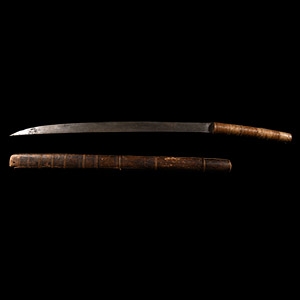
Burmese Iron Single-Edged Sword with Scabbard
19th century A.D. or earlierSold for (Inc. bp): £52
Comprising a smooth, slightly curved and unornamented blade, the hilt wrapped with organic plaited and plain string; tubular bamboo(?) scabbard wrapped with plaited string. 886 grams, 91 cm long
Ex Reeman Dansie, Colchester, Essex, UK.
The dha may have its origins with the Tai people who migrated to the area from present-day Yunnan Province in southern China. This sabre varied considerably according to locality but they shared some features that define them apart from other weapons and tools of the area, like the round cross-section grip, a long, gently curving blade with a single edge, and the absence of a guard. -
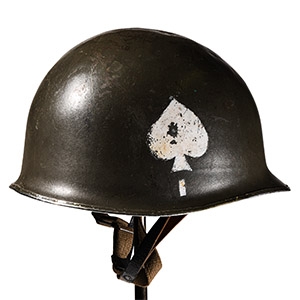
Vietnam M1 Helmet
1950-1970 A.D. or laterSold for (Inc. bp): £150
American Vietnam War era helmet with composition liner with leather lining; leather and fabric chin strap; ace over 1 painted to one side in white. 1.5 kg, 28.5 cm wide
The Kusmirek Collection, UK. -
.jpg)
Roman Bronze Military Mask Helmet Section
3rd century A.D.Sold for (Inc. bp): £975
From the upper part of the right side of the face mask, the upper edge with a band of embossed curved lines, probably representing stylised hairs, intertwined with laurel crown; embossed image of advancing Mars, the god of war, to the centre, depicted nude with military sagum, a pseudo-Corinthian helmet to the head and carrying a circular shield. 55 grams, 17 cm wide
Acquired 1960s-1990s. Late Alison Barker collection, a retired London barrister.
In the decorative patterns of Roman helmets, Mars was among the most revered deities in the Imperial army. After Jupiter, he was the most aristocratic god of the old Italic religion, master of armament, who governed military service (militiae potens) and oversaw the training ground, for which he was named Campester. The emperor Augustus named him Ultor (‘Avenger’) and dedicated to him a luxurious temple in the centre of the forum in gratitude for his victory over the murderers of Caesar and, in addition, granted to him the privileges of the Capitoline Jupiter.
