
Loading, please wait...
LOT 1495
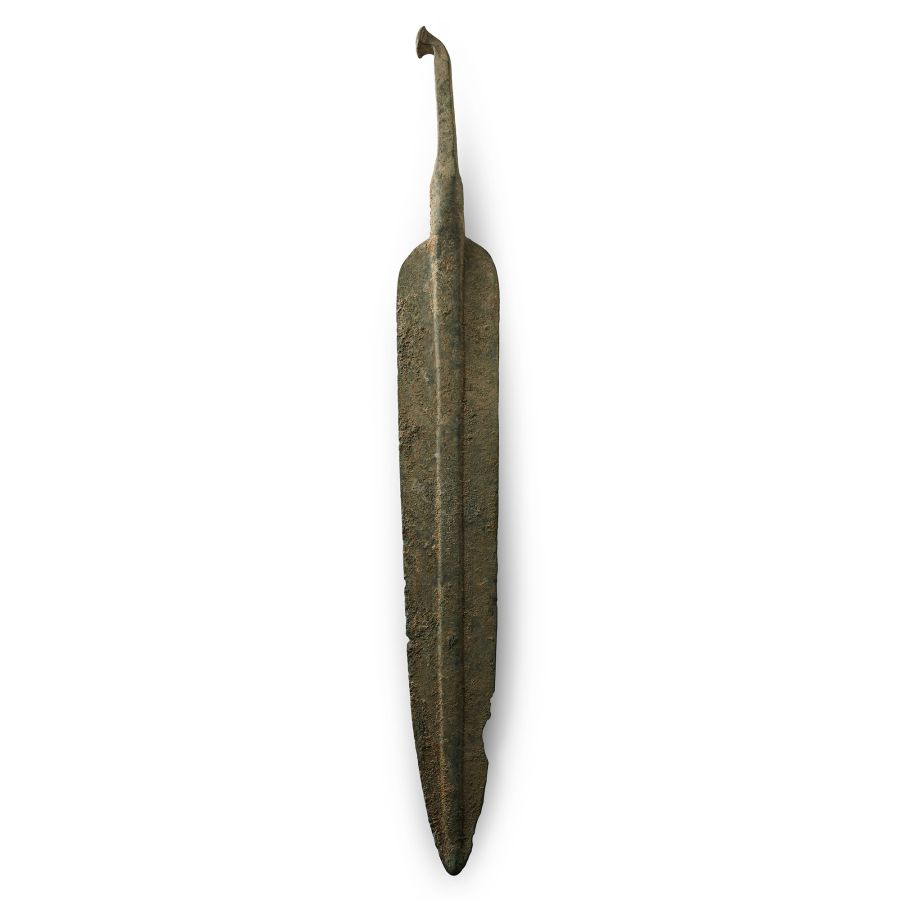
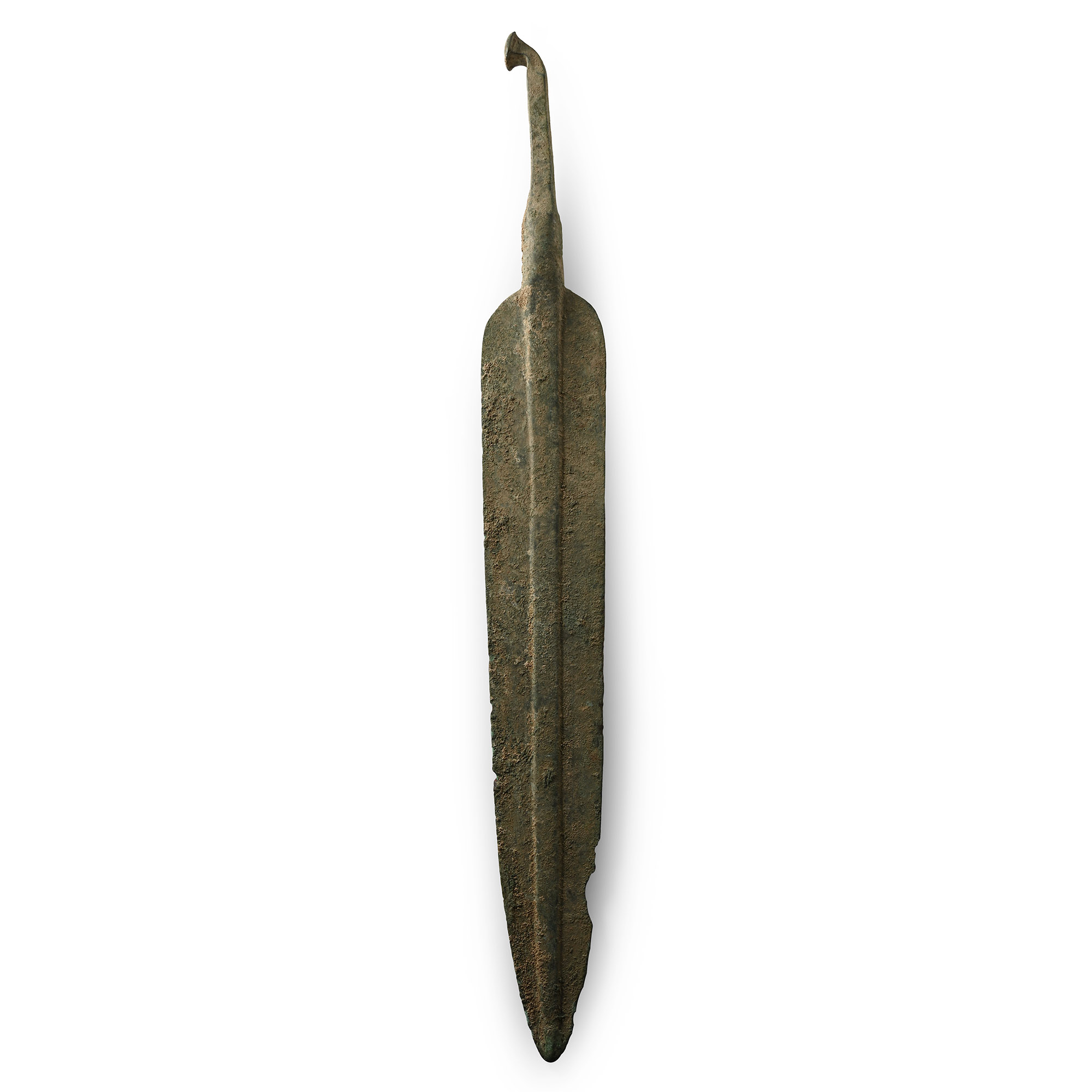
Massive Amlash Bronze Spearhead Blade
13TH-12TH CENTURY B.C.
16 3/4 in. (370 grams, 42.5 cm).
With large ovate blade, broad midrib, rounded shoulders and rectangular-section tang with bent tip ending with a button.
ProvenanceAcquired 1980-2015.
Ex Abelita family collection.
This lot is accompanied by an illustrated lot declaration signed by the Head of the Antiquities Department, Dr Raffaele D’Amato.
This lot is accompanied by an illustrated lot declaration signed by the Head of the Antiquities Department, Dr Raffaele D'Amato.
See Khorasani M.M., Arms and Armour from Iran. The Bronze Age to the End of the Qajar Period, Tübingen, 2006, item 278, for type.
FootnotesThe massive spearhead belongs to type 1 of the Khorasani classification. Similar excavated examples from Marlik attest the use of such spearheads with bent tang in the area, and Stutzinger dated such weapons to 1200-1100 B.C. The type was the evolution of a typology which began much earlier in Mesopotamia and the fertile crescent, the type 4 of the Stronach classification, with straight square-section tang, usually thickened at the base with a button tang.
CONDITIONTimeLine Auctions follows a vetting process to ensure the authenticity and legality of all items, reinforcing our commitment to integrity and responsible trading. Each antiquity, antique, and coin lot undergoes thorough examination by a vetting committee of at least ten external specialists, professional trade association members, scientists, and archaeologists: Our Vetting Process
AUCTIONS:
TimeLine is a leading auction house specialising in antiquities, ancient art, collectables, natural history, coins, medals, and books. Our auctions offer museums, collectors, historians, and enthusiasts the opportunity to acquire unique and historically significant pieces.
-
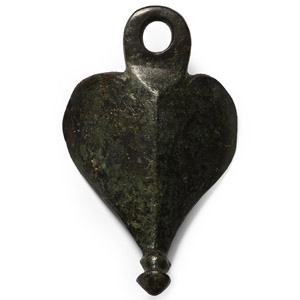
Roman Horse Harness Phalera
1st-4th century A.D.Sold for (Inc. bp): £72
Of carinated profile with pierced lug above and knop finial. 97 grams, 95 mm
Ex German art market, 2000s. Acquired from an EU collector living in London. From the collection of a Surrey, UK, gentleman. This lot is accompanied by an illustrated lot declaration signed by the Head of the Antiquities Department, Dr Raffaele D’Amato. This lot is accompanied by an illustrated lot declaration signed by the Head of the Antiquities Department, Dr Raffaele D'Amato. -
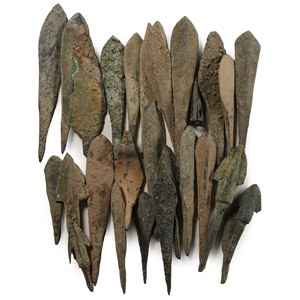
Western Asiatic Bronze Arrowhead Collection
19th-6th century B.C.Estimate: £100 - 140 (+bp*)
Opening Bid: £56
Including triangular, leaf-shaped, barbed, paddle-shaped with a flat, comparatively wide mid-rib, and others. 176 grams total, 25-77 mm
Ex London art market, 1980-1990s. This lot is accompanied by an illustrated lot declaration signed by the Head of the Antiquities Department, Dr Raffaele D'Amato.
Some of the represented arrowheads (paddle-shaped) were typical of the Old Babylonian Empire. The shoulders were pronounced and the arrowhead had a rectangular-section tapering tang. This simple form was popular throughout and are comparatively common finds in the Holy Land. -
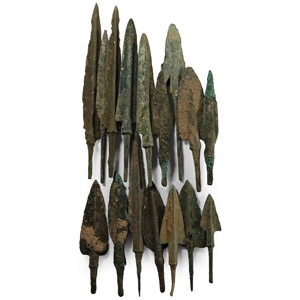
Luristan Bronze Arrowhead Collection
13th-6th century B.C.Sold for (Inc. bp): £182
Comprising a variety of tanged triangular and leaf-shaped arrowheads with thick mid-rib, one barbed-and-tanged example. 375 grams total, 7.7-16 cm
Ex London art market, 1980-1990s. This lot is accompanied by an illustrated lot declaration signed by the Head of the Antiquities Department, Dr Raffaele D'Amato.
One category of the represented arrowheads has a sharp, flat blade, the ends of which extend to form wings or barbs, and a prominent midrib extending into a long tang that often has a stop; the blade shape varies from deltoid to more triangular. Another form has no barbs, but it has a prominent midrib extending to the tang, and a narrow leaf-shaped blade.
