
Loading, please wait...
LOT 0239
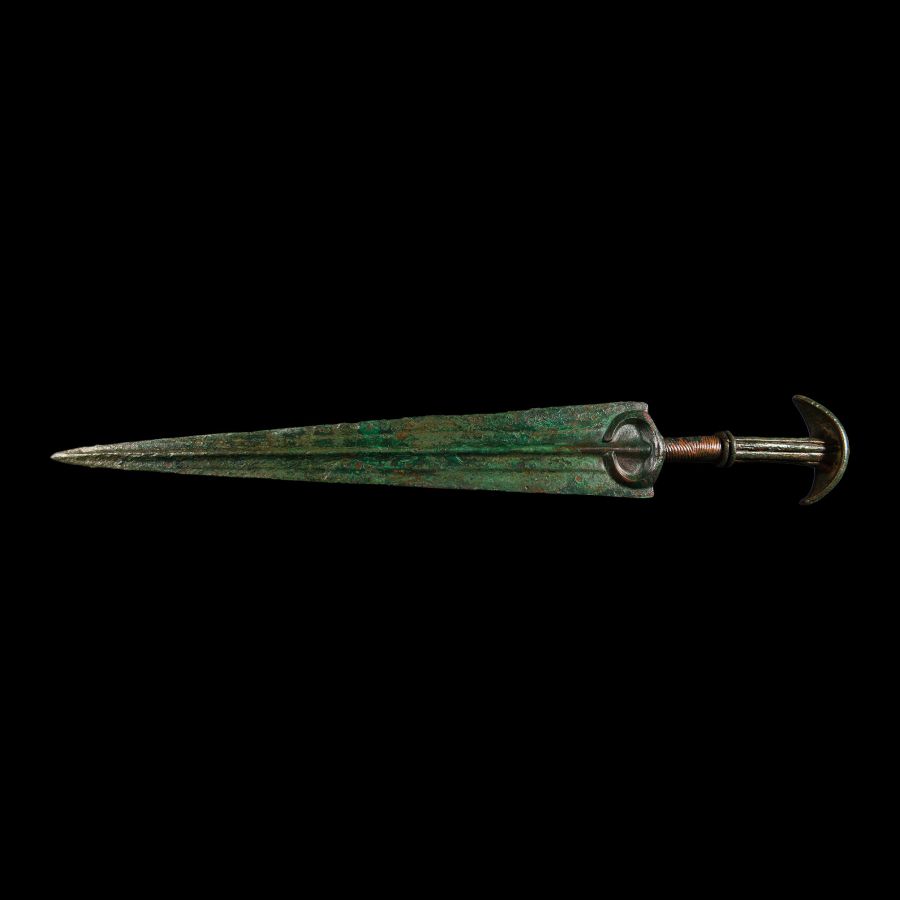
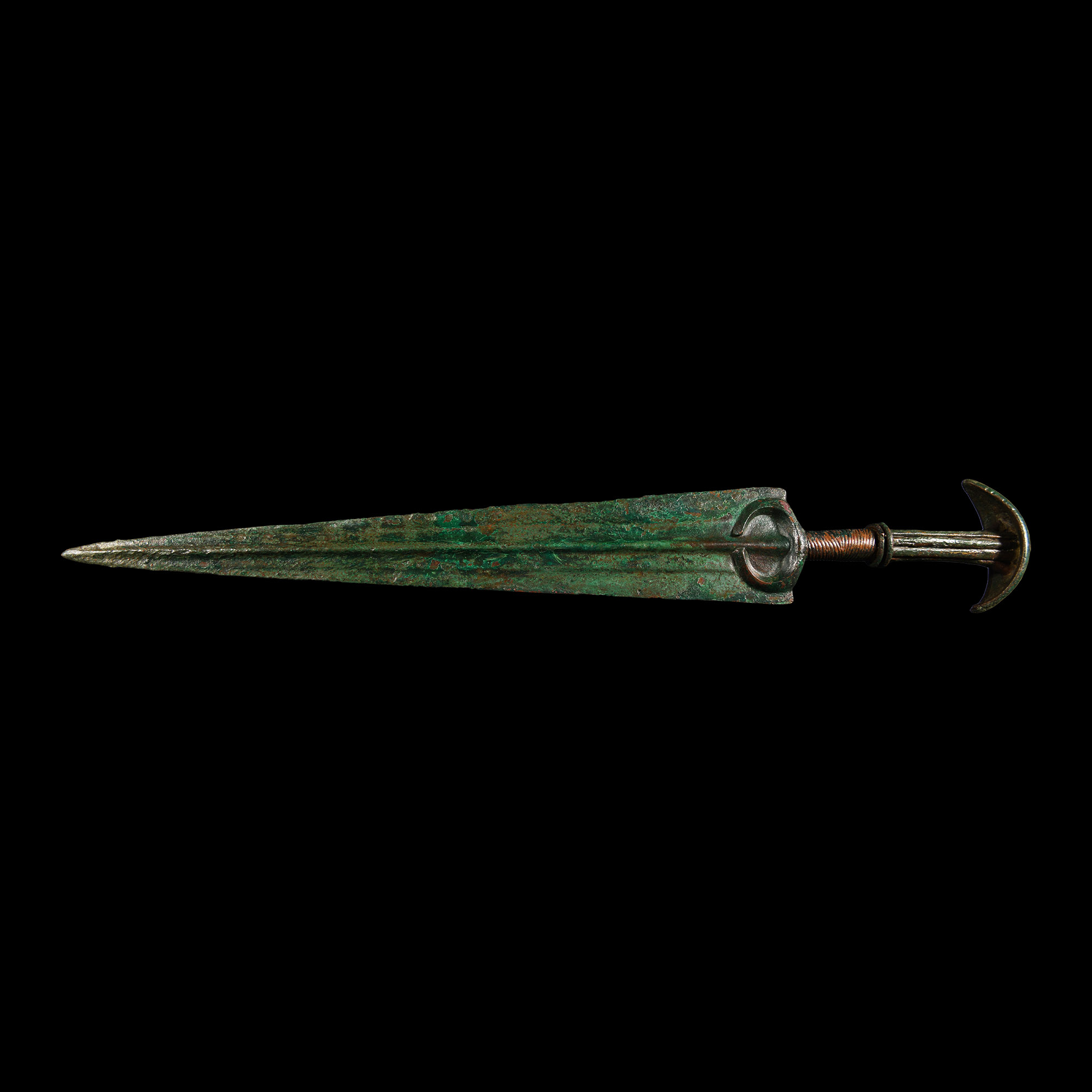
Marlik Bronze Short Sword with Crescentic Pommel
14TH-10TH CENTURY B.C.
17 1/4 in. (430 grams, 44 cm).
Formed with a slender triangular blade, raised midrib with flat upper face, penannular guard and scooped shoulders, columnar grip with two gusseted hoops, the upper half of the grip is decorated with vertical lines, the lower part with horizontal grooves, crescent pommel; short sword or dagger.
ProvenanceEx Alexander Cotton collection, Hampshire, UK 1980s.
LiteratureCf. Khorasani, M.M., Arms and Armour from Iran. The Bronze Age to the End of the Qajar Period, Tübingen, 2006, items 41-43.
FootnotesThis short sword or dagger belongs to the category of blades with pennanular guard, with hilt and guard cast in one piece with the grip. This solid weapon has separate sets of encircling ribs on the grip. Negahban excavated similar weapons from the Marlik cemeteries, although sometimes the type combines grip and penannular guard with flanged hilts open to accept inlays.
CONDITIONTimeLine Auctions follows a vetting process to ensure the authenticity and legality of all items, reinforcing our commitment to integrity and responsible trading. Each antiquity, antique, and coin lot undergoes thorough examination by a vetting committee of at least ten external specialists, professional trade association members, scientists, and archaeologists: Our Vetting Process
AUCTIONS:
TimeLine is a leading auction house specialising in antiquities, ancient art, collectables, natural history, coins, medals, and books. Our auctions offer museums, collectors, historians, and enthusiasts the opportunity to acquire unique and historically significant pieces.
-
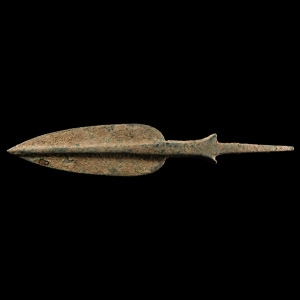
Amlash Bronze Spear Blade
12th-11th century B.C.Sold for (Inc. bp): £208
Leaf-shaped blade with pronounced midrib, square-section neck with flared ends and thick square-section tang. 299 grams, 26.7 cm
Ex German collection, Cologne, 1980-1990s.
The spearhead belongs to the type I of tripartite spears with broad mid-rib, reinforced shaft opening to reveal the tang and rounded shoulders. The blade with curved shoulders, a sharp point and a rectangular mid-rib. Stutzinger dated these pieces to 1200-1100 B.C. -
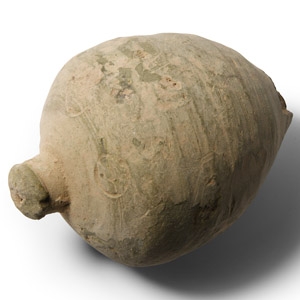
Byzantine 'Greek Fire' Ceramic Fire Bomb or Hand Grenade
9th-11th century A.D.Sold for (Inc. bp): £98
Pear-shaped ceramic vessel with domed filler-hole; intended to be filled with explosive liquid and wick, used as a hand grenade. 640 grams, 13.5 cm
Ex London, UK, collection, 1990s. Accompanied by an academic paper by military specialist Dr Raffaele D'Amato, dated 15 July 2019 and titled 'Eastern Roman Empire - Greek Fire Bomb or Hand Grenade (μεσαίον kακάβιον) 9th-11th century AD'.
Apart from the use of siphons or manual flame-throwers called cheirosiphona, special corps of Roman soldiers employed terracotta grenades, in the form of small jars, abundantly evidenced in archaeological excavations. Such were the γανωτα, vessels (sometimes also of bronze) used for Greek fire. They were called μεσαία kακαβιά or κυτροκακάβια where the former had a bulbous shape and the latter a more cylindrical form. -
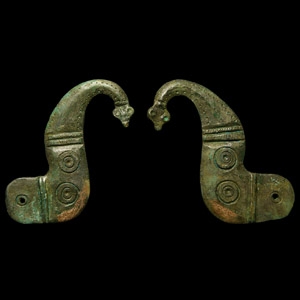
Roman Bronze Armour Double Fastening Hook
1st century A.D.Sold for (Inc. bp): £176
Each a tapering scrolled bar of zoomorphic form representing serpents or other animals with stylised geometric detailing; attachment perforations to both terminals. 32.7 grams total, 63-67 mm
Acquired on the London art market, 1980s-1990s.
In the 1st century B.C.-1st century A.D., the Celtic fastening system of the ring mail armour (gallica, lorica ferro aspera) became the standard in the Imperial Roman army, with a pivot attached to the breast and hinged to the edges of the humeralia (shoulder guards). The chest fastener had various different designs. The double hooks, S-shaped and usually with snake-head terminals, were secured by a central rivet on the chest. The system allowed excellent freedom of movement, giving greater protection to the shoulders and the arms. Similar fasteners for infantry mail have been found on the Kalkriese battlefield, some of them also decorated with niello and inscribed with the name of the soldier.
