
Loading, please wait...
LOT 1422
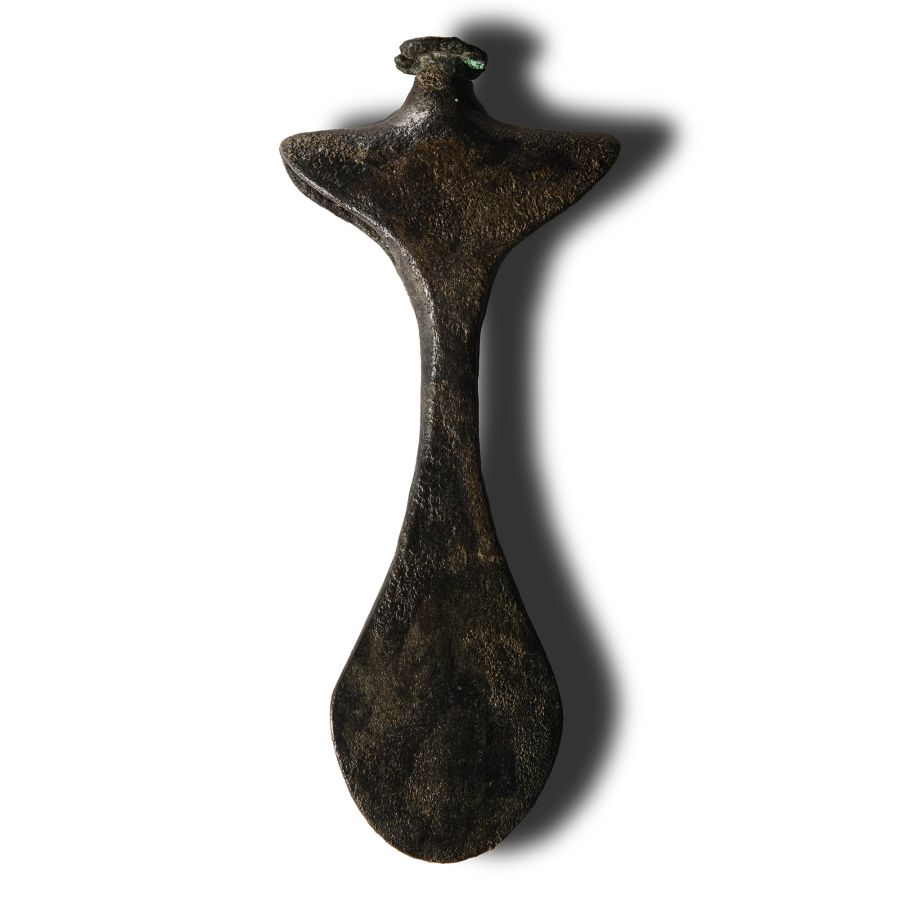
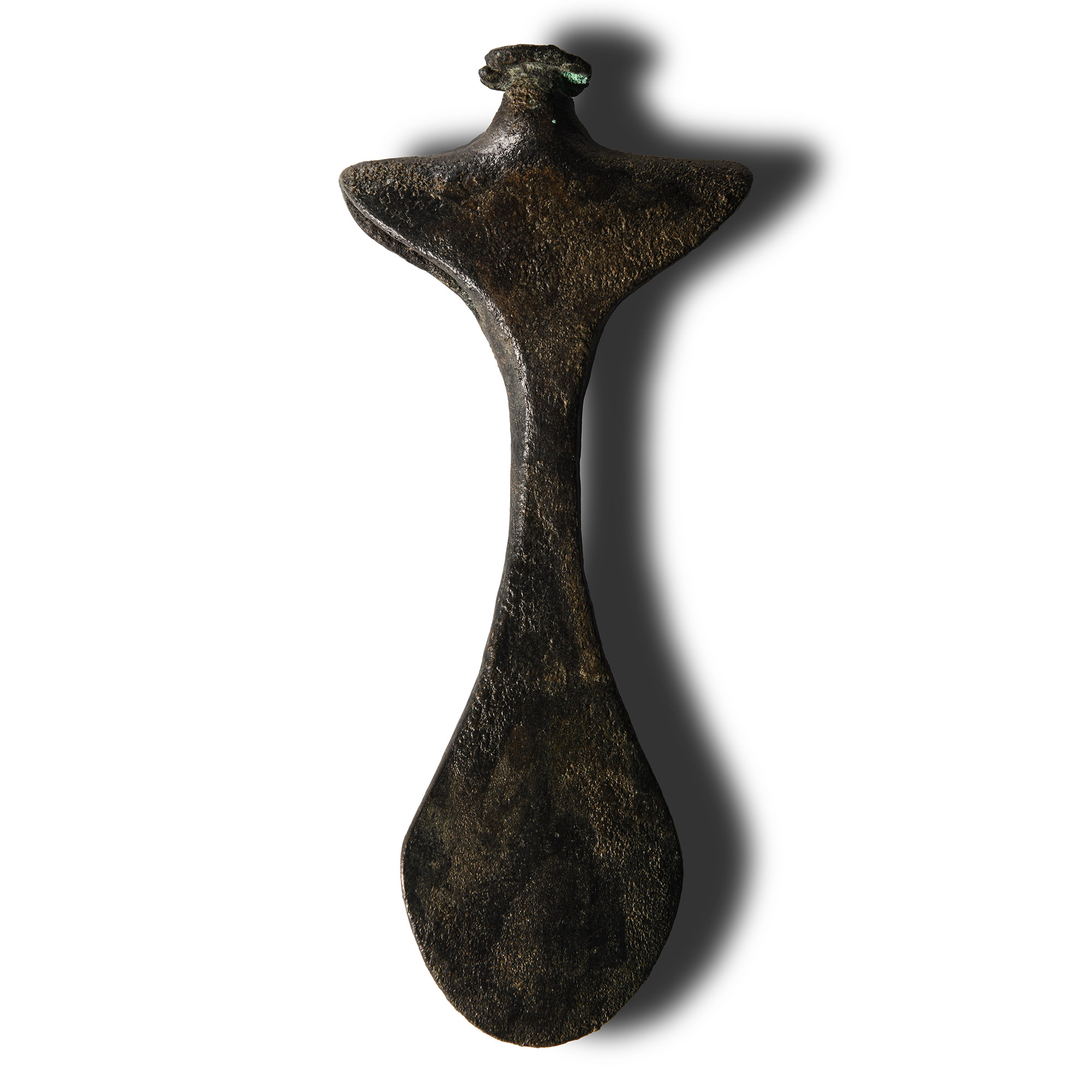
Margiana Bronze Axehead
LATE 2ND MILLENNIUM B.C.
7 1/4 in. (289 grams, 18.3 cm).
With a narrow neck and rounded bill-shaped blade, rounded wings to the socket and square-headed stud behind.
ProvenanceEx Abelita family collection, 1988.
LiteratureCf. Gorelik, M., Weapons of Ancient East, IV millennium BC-IV century BC, Saint Petersburg, 2003 (in Russian), pl.XXI, no.84; cf. Gernez, G., L’armament en métal au Proche et Moyen-Orient: des origines a 1750 av. J.C., Paris, 2007, fig.2.16, subtype H2.J.b.
FootnotesThese categories of axes were of Oriental production, coming from the territories of Bactria and Margiana, occasionally imported to Elam and Luristan. The anthropomorphic and zoomorphic patterns are sometimes visible, and the button at the back of the heel (very common) is related to examples from Luristan, but the style differs markedly.
CONDITIONTimeLine Auctions follows a vetting process to ensure the authenticity and legality of all items, reinforcing our commitment to integrity and responsible trading. Each antiquity, antique, and coin lot undergoes thorough examination by a vetting committee of at least ten external specialists, professional trade association members, scientists, and archaeologists: Our Vetting Process
AUCTIONS:
TimeLine is a leading auction house specialising in antiquities, ancient art, collectables, natural history, coins, medals, and books. Our auctions offer museums, collectors, historians, and enthusiasts the opportunity to acquire unique and historically significant pieces.
LOT 1422
Margiana Bronze Axehead
Estimate £200 - 300€230 - 350 (for guidance only)$270 - 410 (for guidance only)
-
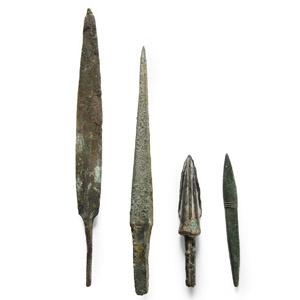
Western Asiatic Bronze Arrowhead Collection
1st millennium B.C.Sold for (Inc. bp): £33
Including a slender leaf-shaped type, square-section tanged type and others. 67.1 grams total, 5.8-12.3 cm
From a collection acquired on the UK art market from various auction houses and collections mostly before 2000. From an important Cambridgeshire estate; thence by descent. -
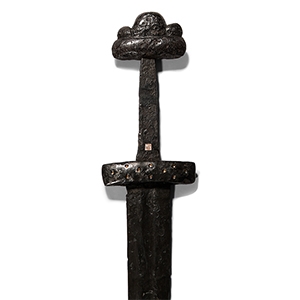
Viking Sword with Inlaid Cross and Orb Mark
Circa 10th-11th century A.D.Sold for (Inc. bp): £3,900
With three-lobe pommel and decorated guard; the blade 45mm wide at the upper end, gently tapering with fuller to both faces, rounded tip, indented ring to one face with silver inlay, scaphoid-section lower guard with two rows of shallow pellets to each face gilt or latten inlay; flat tapering tang; pommel of Petersen's Type S with traces of vertical inlaid wire. 752 grams, 93 cm
From the family collection of a London gentleman; formed in the late 1940s-1950s; thence by descent. Accompanied by metallurgic analytical report number 114366/569, written by metallurgist Dr Brian Gilmour of the Research Laboratory for Archaeology and the History of Art, University of Oxford. Accompanied by an academic report by Dr Raffaele D’Amato. This lot has been checked against the Interpol Database of stolen works of art and is accompanied by a search certificate number no.12020-214090. -
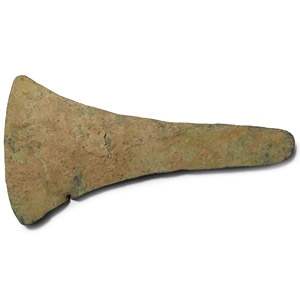
Western Asiatic Bronze Flat Axe
4th millennium B.C.Sold for (Inc. bp): £33
Formed with a rounded butt and slightly flared cutting edge; flat in cross-section. 138 grams, 18.5 cm
Acquired 1980-2015. Ex Abelita family collection.
This type of flat axes appeared in the last phase of the Late Chalcolithic Age. Flat axes without lugs were used as cutting tools or in war. In the later examples the sides of the blades was gradually widening towards the convex cutting edge.
