
Loading, please wait...
LOT 0261
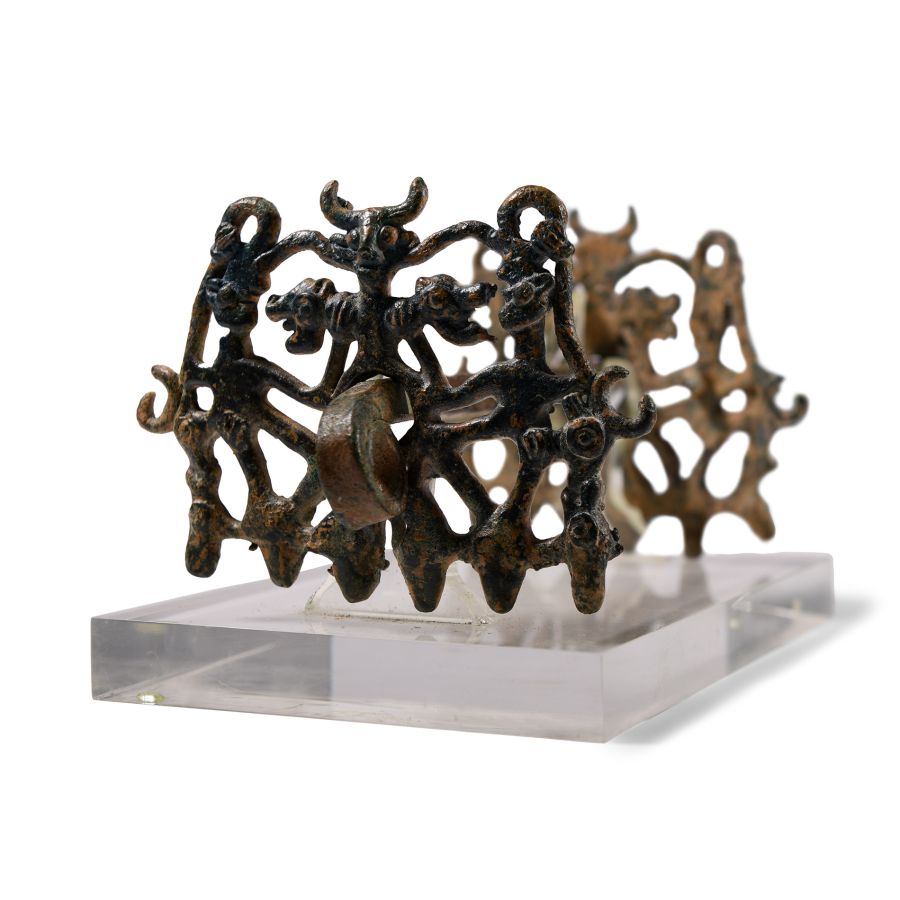
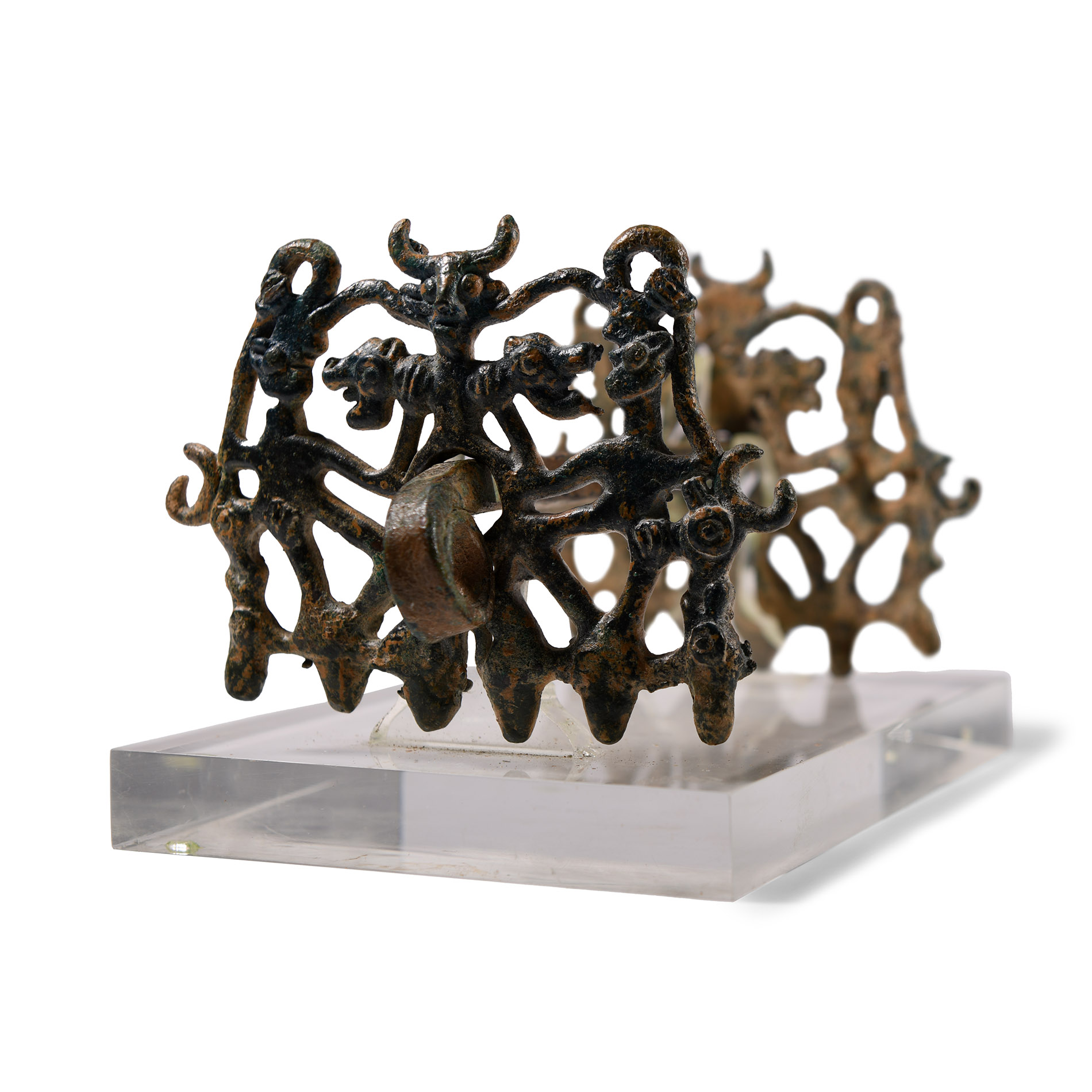
Luristan 'Master of Animals' Bridle Bit
CIRCA 9TH-7TH CENTURY B.C.
7 3/4 in. (1.17 kg total, 19.5 cm wide including stand).
Comprising: a square-section bar with the ends scrolled in opposite directions; matched pair of outward-facing detailed openwork castings, each cheek-piece showing a god with a horned head above a figural scene with two opposed human figures in profile advancing towards a column with profile animal heads and other detailing; accompanied by a custom-made stand.
ProvenanceFrom an old private Japanese collection.
Acquired from Shimojo Art, Tokyo, Japan, in 2014.
From the private collection of a North West London, UK, gentleman.
Accompanied by a previous collection photograph, and the original official Japanese cultural export certificate issued by the Director of Art and Curatorial Division, Cultural Properties Department, Agency for Cultural Affairs, and invoice, dated 7th November 2014.
Accompanied by an academic report by Dr Raffaele D'Amato.
This lot has been checked against the Interpol Database of stolen works of art and is accompanied by a search certificate number no.12050-217397.
Cf. Legrain, L., Luristan Bronzes in the University Museum, Philadelphia, 1934, pl.XVI, for the bit; Godard, F., The Art of Iran, London, 1965, item 16; Moorey, P.R.S., Ancient Bronzes from Luristan, London, 1974, plate V (A), for the bronze harness bit, and VIIB for a complete similar bronze bit; Moorey, P.R.S., ‘ The Art of Ancient Iran’ in Ancient Bronzes, Ceramics and Seals, Los Angeles, 1981, item 43; Musée Cernuschi, Bronzes du Luristan, Enigmes de l’Iran Ancien, IIIe-Ier Millenaire av.J.C., Paris, 2008, no.87, p.123, for a similar bit.
FootnotesIn the Mesopotamian world the forces of chaos are often represented by animals and the gods are seen as the restraining force to these unpredictable powers that could harm the human world. The presence of horns on these figures distinguishes them as being divine and is often found being worn by kings who saw themselves as close to the gods.
CONDITIONTimeLine Auctions follows a vetting process to ensure the authenticity and legality of all items, reinforcing our commitment to integrity and responsible trading. Each antiquity, antique, and coin lot undergoes thorough examination by a vetting committee of at least ten external specialists, professional trade association members, scientists, and archaeologists: Our Vetting Process
AUCTIONS:
TimeLine is a leading auction house specialising in antiquities, ancient art, collectables, natural history, coins, medals, and books. Our auctions offer museums, collectors, historians, and enthusiasts the opportunity to acquire unique and historically significant pieces.
LOT 0261
Luristan 'Master of Animals' Bridle Bit
Estimate £3,000 - 4,000€3,480 - 4,640 (for guidance only)$4,050 - 5,400 (for guidance only)
-
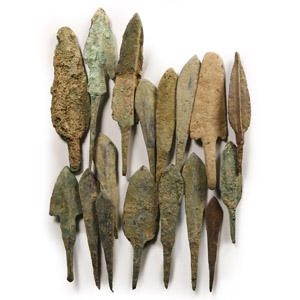
Luristan Bronze Arrowhead
Circa 13th-7th century B.C.Estimate: £100 - 140 (+bp*)
Opening Bid: £50
Including teardrop, barbed, leaf-shaped and other types, all tanged. 148 grams total, 52-91 mm
Acquired 1980-2015. Ex Abelita family collection. -
.jpg)
Medieval 'Thames' Iron Dagger with Wood Handle
Circa 15th century A.D.Sold for (Inc. bp): £260
Sturdy single-edged triangular whittle-tang blade with thick back; with reproduction wooden handle. 137 grams, 34 cm
Found Billingsgate spoil from the Thames foreshore, London, UK, circa 1984. Property of an Essex collector. -
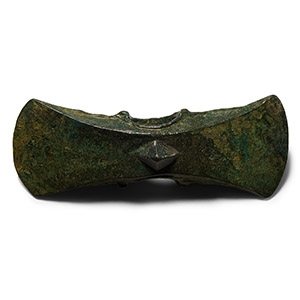
Luristan Bronze Double Axehead
13th-7th century B.C.Sold for (Inc. bp): £286
Double-edge axehead with flared blades, knops flanking the socket, pyramidal spurs. 222 grams, 10.8 cm
Ex German art market, 2000s. Acquired from an EU collector living in London. From the collection of Surrey, UK, gentleman.
