Loading, please wait...
LOT 1229
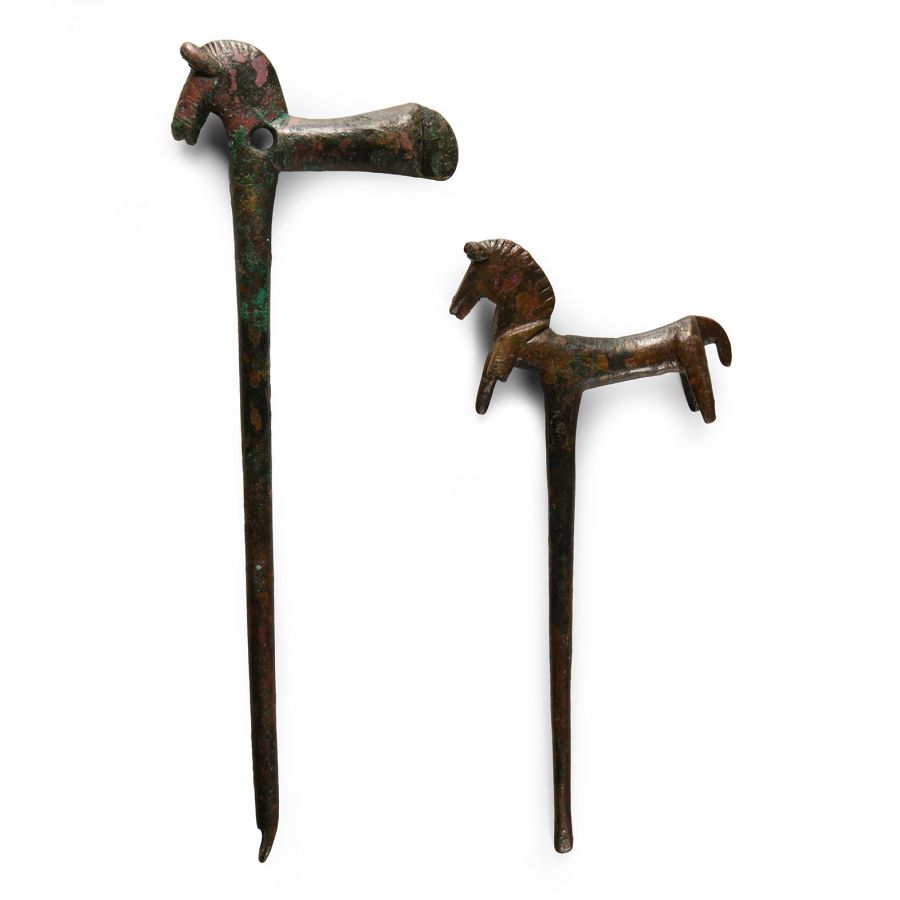
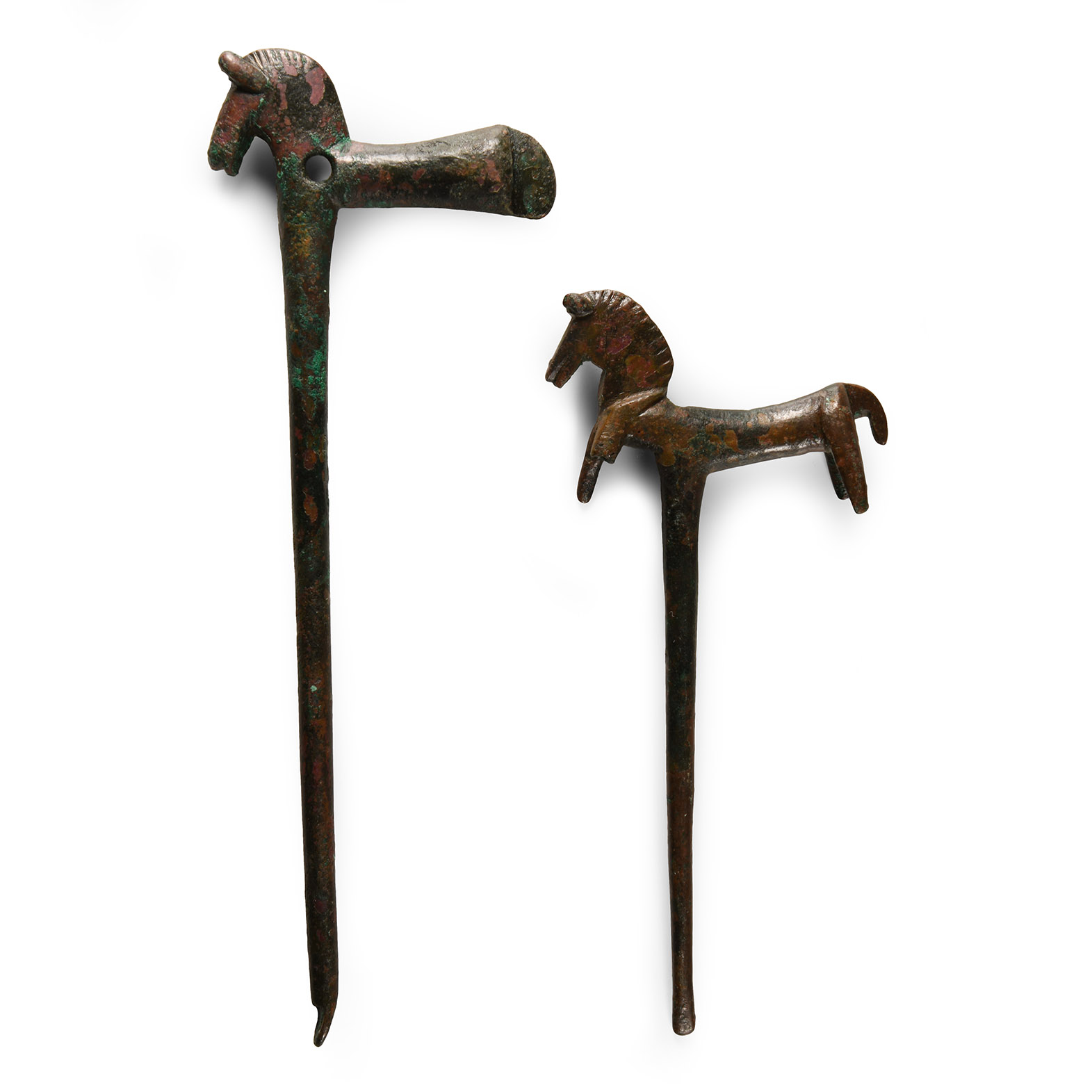
Luristan Cosmetic Horse Pin Group
2ND MILLENNIUM B.C.
4 1/8 - 5 1/2 in. (76 grams total, 10.6 - 14 cm).
Comprising: horse finial pierced at the shoulder and with flange to the rump; similar with splayed legs. [2]
ProvenanceUK private collection before 2000.
On the UK art market.
Property of a London gentleman.
TimeLine Auctions follows a vetting process to ensure the authenticity and legality of all items, reinforcing our commitment to integrity and responsible trading. Each antiquity, antique, and coin lot undergoes thorough examination by a vetting committee of at least ten external specialists, professional trade association members, scientists, and archaeologists: Our Vetting Process
AUCTIONS:
TimeLine is a leading auction house specialising in antiquities, ancient art, collectables, natural history, coins, medals, and books. Our auctions offer museums, collectors, historians, and enthusiasts the opportunity to acquire unique and historically significant pieces.
-
Neo-Babylonian Chalcedony Duck Weight with Engraved Figure
Circa 8th-6th century B.C.Sold for (Inc. bp): £169
The animal carved with its head and neck resting along its back; stylised figure with crescent horns or headdress engraved to base; pierced for suspension. 5.07 grams, 21 mm
From an early 20th century collection, Caernarfon, North Wales, UK.
A corpus of similar pieces was found by Italian archaeologists in the city of Karkemish. They were produced and in use in the Iron Age I-III (i.e. from ca. 1190 B.C., date of the collapse of the Hittite Empire and the rise of the “Great Kings” of Karkemish, to 605 B.C., date of the “battle of Karkemish”, when the Babylonian army conquered the city. -
Assyrian Red Stone Cylinder Seal
Early 1st millennium B.C.Sold for (Inc. bp): £650
With intaglio frieze depicting a pair of addorsed ibexes in rampant pose, their horns held in the grip of a nude facing female with spread wings; tall male winged figure looking backwards towards the female, advancing towards two opposed hounds with heads thrown back and a small figure leaping over them holding two reeds or wands; tall male figure in pleated garment and broad-brimmed cap holding the tether of one ibex, star above; supplied with a museum-quality impression. 28.4 grams, 30 mm
From the property of late Mr SM, London, UK, 1970-1990s, thence by descent. Examined by Professor Wilfrid George Lambert FBA (1926-2011), historian, archaeologist, and specialist in Assyriology and Near Eastern archaeology, in the late 1980s and early 1990s. -
Cylinder Seal Group
Circa 2300-2200 B.C. and laterSold for (Inc. bp): £286
Comprising: an Akkadian example with a heroic scene carved in shell, accompanied by an old scholarly note, typed and signed by W.G. Lambert, late Professor of Assyriology, University of Birmingham, 1970-1993, which states: 'Cylinder Seal of White Marble, 18 x 10 mm. The design shows hero in the middle, succouring on either side a domestic quadruped on its hind legs, each being attacked by a lion. This is an Akkadian seal from Mesopotamia or West Iran, c. 2300-2200 B.C. The surface is somewhat worn.'; a haematite seal engraved with a walking dog or wolf with three stars above, rosette to the back; a carnelian seal engraved with a group of worshippers wearing long robes and Median caps, tree motif to the back. 7.62 grams total, 13-18 mm
The first property of a London gentleman; part of his family collection since the 1970s. Academically researched and catalogued by the late Professor Lambert in the 1980s. The other examples the property of a London gentleman; acquired before 1995. From a collection acquired from various auction houses in the UK. From the estate of Mr R.W., a private Wiltshire, UK, collector; thence by descent. Accompanied by a original typed and signed scholarly note by the late W.G. Lambert, Professor of Assyriology at the University of Birmingham, 1970-1993.