
Loading, please wait...
LOT 1483
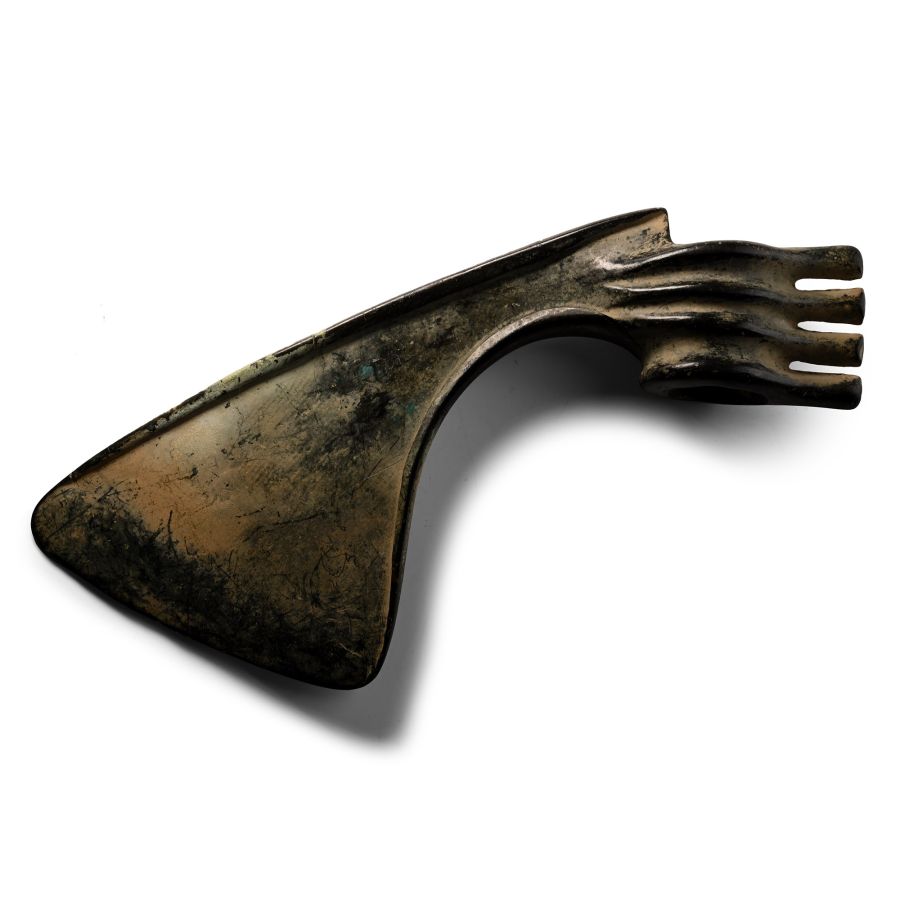
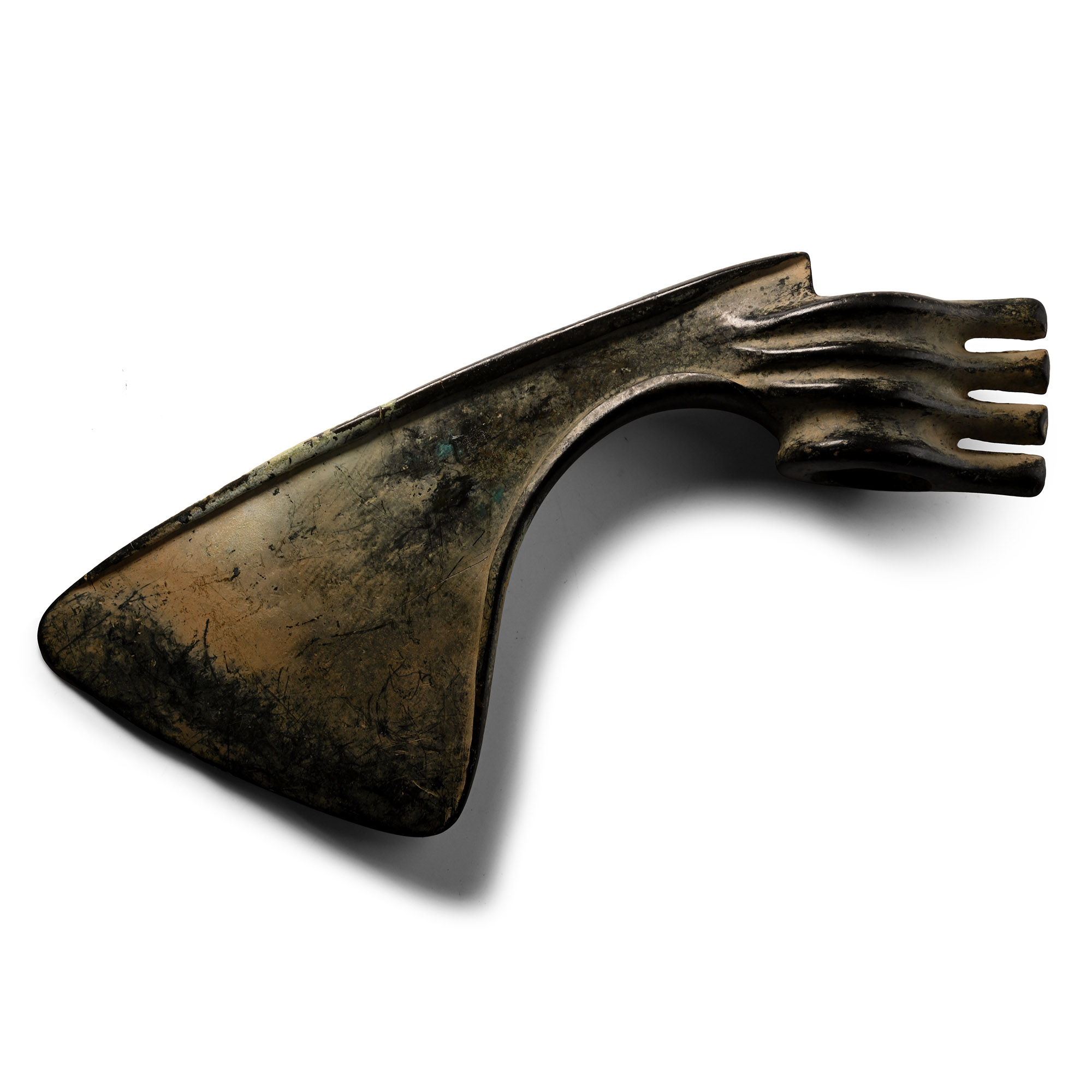
Luristan Comb-Backed Axehead
2ND-1ST MILLENNIUM B.C.
8 1/4 in. (400 grams, 21 cm).
With ribbed openwork socket terminating in a butt formed of four cones, the blade expanding from the socket.
ProvenanceFrom a London collection, early 2000s.
LiteratureCf. Godard, F., The Art of Iran, London, 1965, item 99, for type.
CONDITIONTimeLine Auctions follows a vetting process to ensure the authenticity and legality of all items, reinforcing our commitment to integrity and responsible trading. Each antiquity, antique, and coin lot undergoes thorough examination by a vetting committee of at least ten external specialists, professional trade association members, scientists, and archaeologists: Our Vetting Process
AUCTIONS:
TimeLine is a leading auction house specialising in antiquities, ancient art, collectables, natural history, coins, medals, and books. Our auctions offer museums, collectors, historians, and enthusiasts the opportunity to acquire unique and historically significant pieces.
LOT 1483
Luristan Comb-Backed Axehead
Estimate £250 - 350€290 - 410 (for guidance only)$340 - 470 (for guidance only)
-
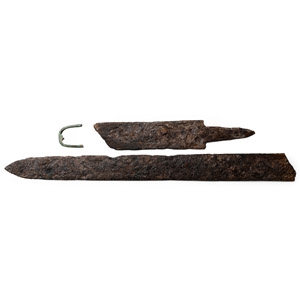
Saxon Sacrificed Iron Spatha with Bronze Chape
5th-6th century A.D.Estimate: £1,500 - 2,000 (+bp*)
Opening Bid: £600
Double-edged long sword (spatha) of type Osterburken-Kemathen; the blade with squared shoulders, broken into two parts for sacrificial reasons, tapering towards the point; sturdy tang partially preserved; wooden traces of the scabbard and hilt still visible; accompanied by a bronze outer rim of a scabbard; restored. 630 grams total, 78 cm long
From the private collection of a London gentleman, from his grandfather's collection formed before the early 1970s.
The deliberate fragmentation of a sword, often into three pieces, was a symbolic act of ‘killing’ the weapon, which was then placed as a grave good or offered in a ceremonial context. This was a Germanic custom already visible in the Vandal Przeworsk culture around the 3rd or 4th century A.D., which continued in Northern European areas until the 5th and the 6th centuries A.D. -
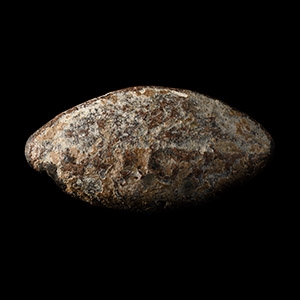
Greek Lead Slingshot
3rd-1st century B.C.Sold for (Inc. bp): £78
Biconical in profile with casting seam and reserved legend 'ΛY-P-N' = maybe ΛYKOΦ-PONO = Lykophronos (name). 25.6 grams, 31 mm
Acquired on the German art market before 2000. Private collection, Munich, Germany.
The leaden bullets, which were thrown from slings, were called in Greek molivdainai (μολύβδαιναι), and in Latin glandes; the former indicating the material ‘lead’, the latter the shape ‘acorns’. These bullets were cast in a mould and bore letters or devices, or both, on two sides or on only one. In form they were more like an almond than an acorn, but many are pointed at both ends. -
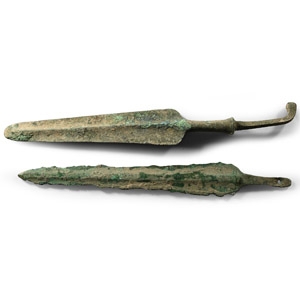
Luristan Bronze Spearhead Group
13th-11th century B.C.Sold for (Inc. bp): £46
Comprising a tanged spearhead with heavily ridged and tapered blade, short collared shaft and square-section tapered tang bent at the tip; a spearhead with foliate narrow blade, short tang with fastening hole. 300 grams total, 26.2-28.7 cm
Acquired 1980-2015. Ex Abelita family collection. This lot is accompanied by an illustrated lot declaration signed by the Head of the Antiquities Department, Dr Raffaele D’Amato.
Both types of spearheads were found in Amlash and Marlik, and are connected with the types 1 and 2 of the Khorasani classification. The type 1 is characterised by a bent tang and was the evolution of a typology which began much earlier in Mesopotamia and the fertile crescent, the type 4 of the Stronach classification, with a straight square-section tang, usually thickened at the base with a button tang.
