
Loading, please wait...
LOT 0241
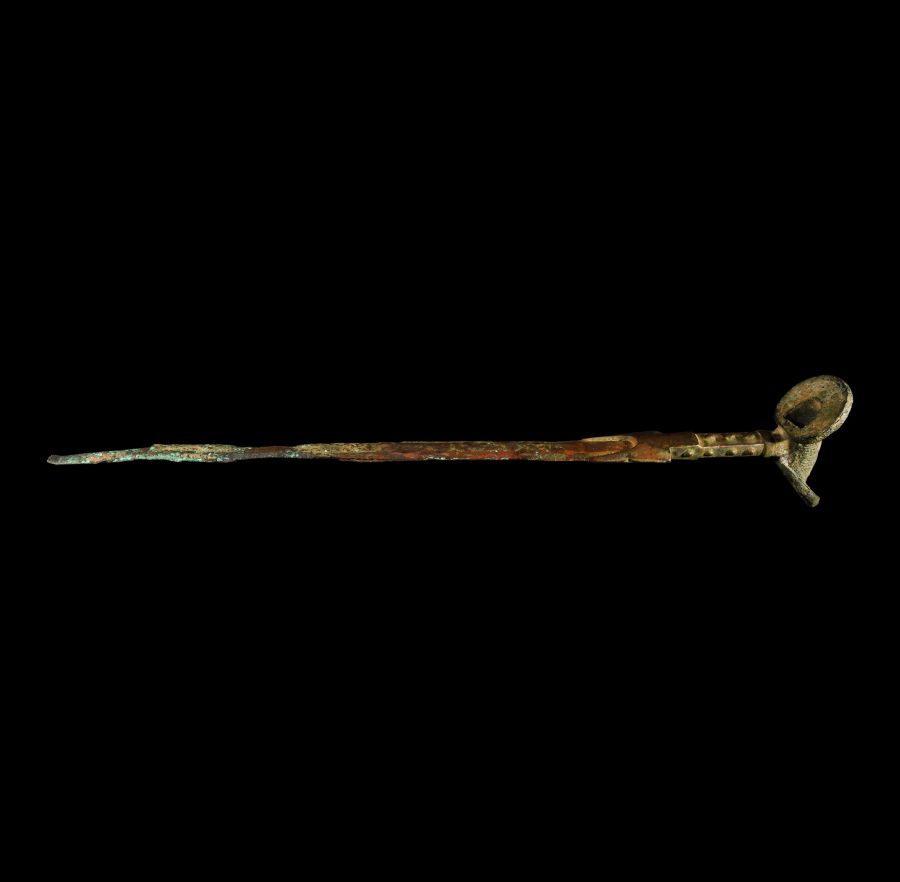
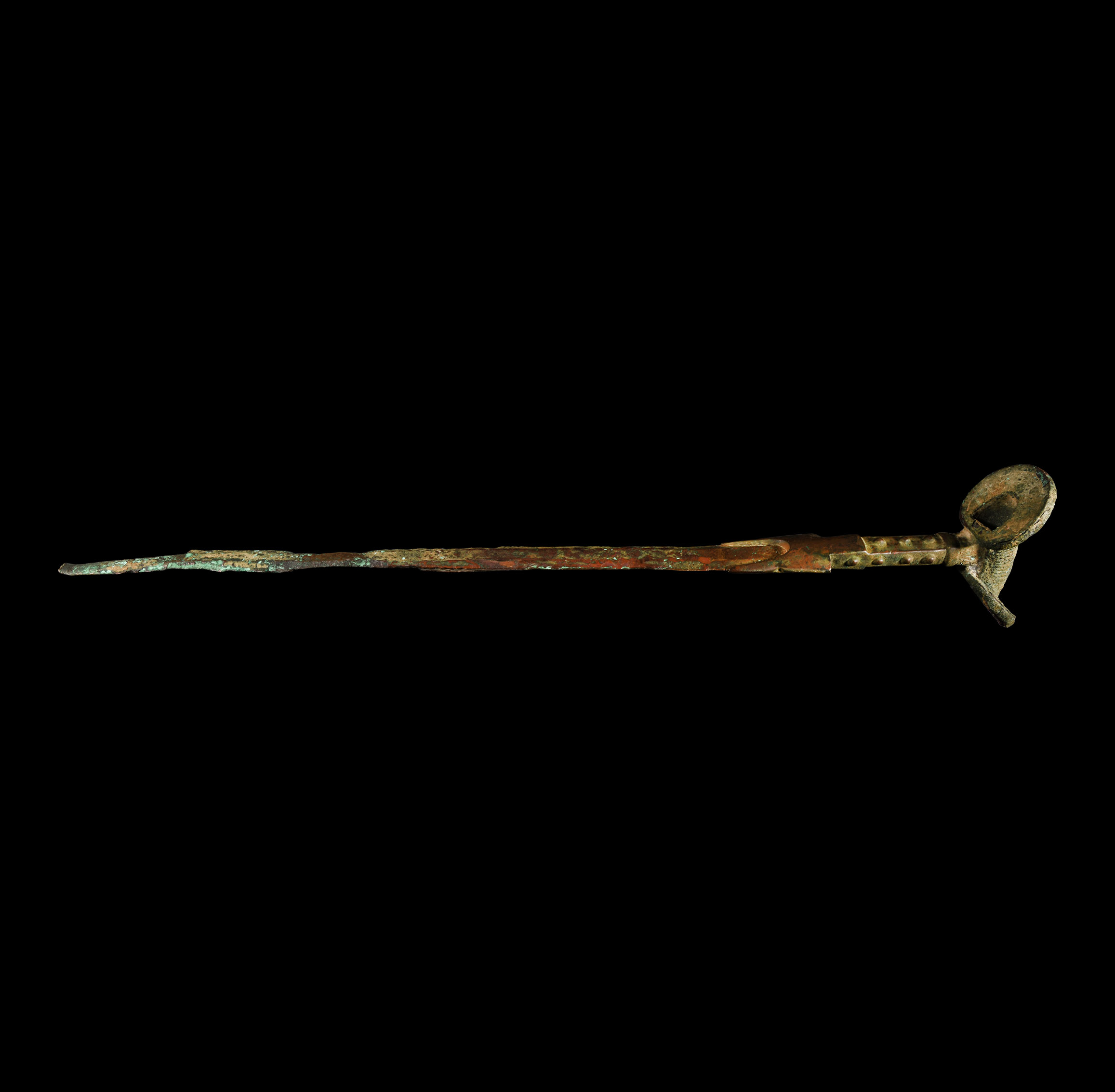
Luristan Bronze Sword with 'Ear' Pommel
10TH-9TH CENTURY B.C.
26 in. (1.17 kg, 66 cm).
Comprising a long tapering blade, rectangular-section hilt with raised circular bosses, horned crescent-shaped guard curved to accept the blade and a large bifurcated pommel formed as two ear-lobes with ribbed joining shank.
ProvenanceAcquired in the early-1990s.
Ex Guernsey collection.
The Kusmirek Collection, UK.
Cf. Khorasani, M. M., Arms and Armor from Iran: The Bronze Age to the End of the Qajar Period, Tübingen, 2006, Cat.45,46, for type.
FootnotesThis kind of sword was entirely made of cast bronze. They were characterised by an 'ear' pommel and raised mid-rib on the blade, square shoulders and rectangular, open guard. The handle was cast on the blade. The square and solid sectioned handle has bossed with reinforcements which allow a better grip.
CONDITIONTimeLine Auctions follows a vetting process to ensure the authenticity and legality of all items, reinforcing our commitment to integrity and responsible trading. Each antiquity, antique, and coin lot undergoes thorough examination by a vetting committee of at least ten external specialists, professional trade association members, scientists, and archaeologists: Our Vetting Process
AUCTIONS:
TimeLine is a leading auction house specialising in antiquities, ancient art, collectables, natural history, coins, medals, and books. Our auctions offer museums, collectors, historians, and enthusiasts the opportunity to acquire unique and historically significant pieces.
-
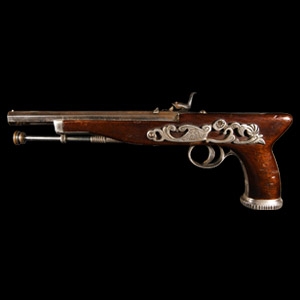
Saw-Butted Percussion Pistol
19th century A.D.Sold for (Inc. bp): £260
With wood butt and silvered butt cap, sideplate, fore-end and trigger guard, fitted with steel ramrod and an octagonal lined sighted barrel with foliate engraved percussion lock signed 'HENRY CLARKE' (lacking hammer retaining screw). 1.1 kg, 35.5 cm
Property of a Luton, UK gentleman, by inheritance.
The Clarkes were a Midlands, UK gunsmithing family. Sold as an exempt item under Section 58 (2) of the Firearms Act, 1968, to be held as a curiosity or ornament. No license required but buyer must be over 18 years of age. Overseas bidders should note that, due to UK regulations governing export of all firearms, overseas buyers will need to make arrangements for shipping this lot out of the UK directly, by air freight, with a specialist company or agent. -
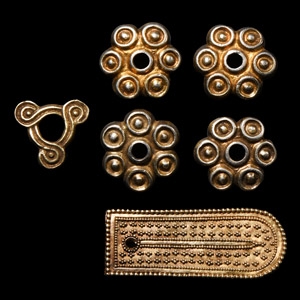
Avar-Byzantine Silver-Gilt Sword Belt Mount Group
7th century A.D.Estimate: £200 - 300 (+bp*)
Opening Bid: £80
Comprising six mounts: four 'floral' plates composed of six raised pellet-in-ring motifs arranged around a central hole, some mounting lugs remaining to the reverses; an openwork knotwork type with three mounting lugs to reverse; a hollow-formed rectangular plate with one rounded end, granulated borders framing granulated clusters arranged in orderly rows around a central arm and piercing; granulated border to reverse. 25.1 grams total, 18-48 mm
Fine condition.
Acquired in the 1980s-1990s. Ex an important central London gallery, London W1.
This type of belt element decorated with granulation, is present in the Avar graves of the second half of the 7th century, and was most likely produced in the workshops of the Eastern Roman Empire, from where they reached the Avar lands as imperial gifts (tomb of Kunbàboni) or spoils of war. They were part of multiple belts, to which sabers and knives were attached, commonly used among Avars, Bulgars and Romans during the 7th and 8th centuries AD. -
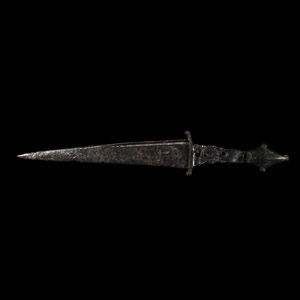
Medieval Quillon Dagger with Bronze Pommel
England or Germany, 16th century A.D.Sold for (Inc. bp): £1,430
Featuring a hexagonal brass pommel engraved with a fleur-de-lis to one side and a dragon to the other; pierced tang, two short quillons inclining towards the blade, terminating in lion head-shaped finials; straight single-edged blade, with side ridges to both faces of the blade, tapering to a fine point. 177 grams, 34 cm
Tang is heavily corroded, trace of employment on the battlefield.
Acquired 1960s-1990s. Late Alison Barker collection, a retired London barrister.
Quillon daggers were predominantly employed as a military weapon. During the 16th century, this dagger continued to be popular, although the hilt no longer resembled that of the contemporary sword, as sword hilts had developed into more intricate forms.
