
Loading, please wait...

LOT 1444
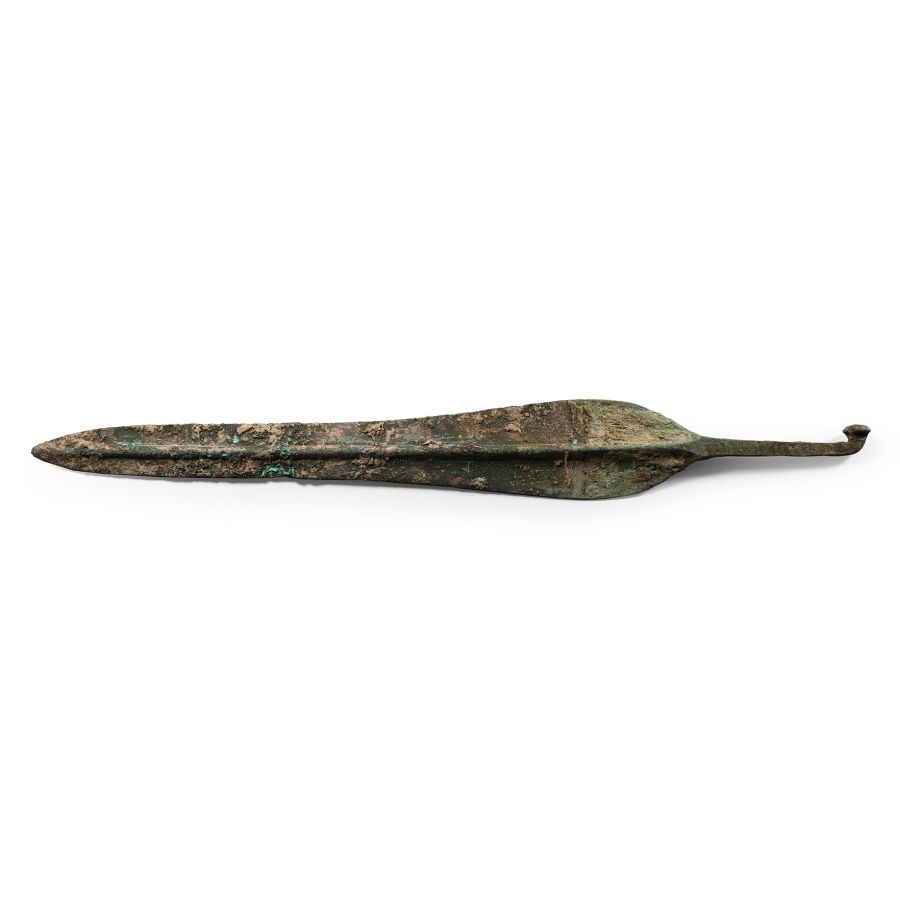
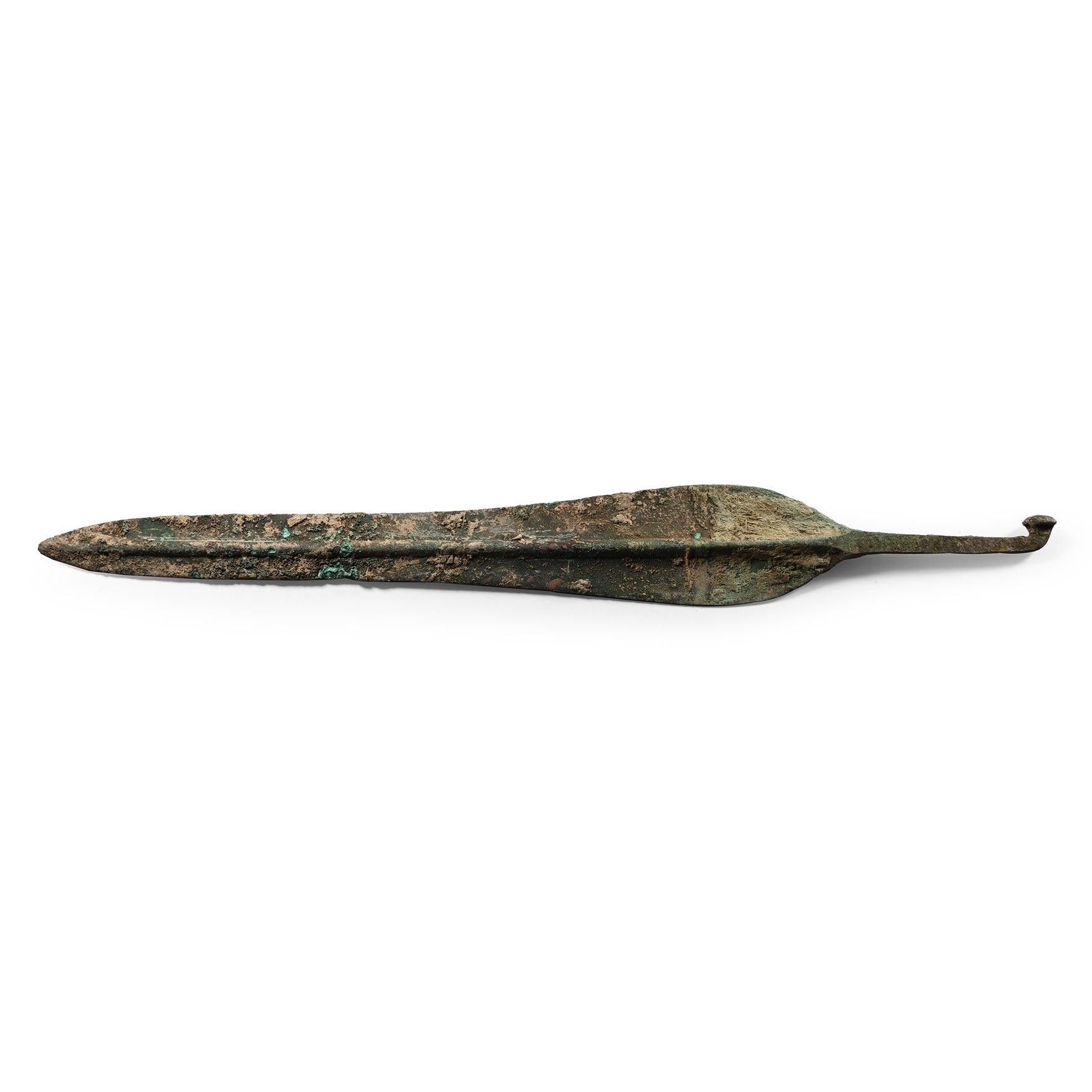
Luristan Bronze Spearhead
EARLY 2ND MILLENNIUM B.C.
16 3/4 in. (412 grams, 42.5 cm).
Having foliate blade with central rib and slender shoulders, short rectangular shaft and tang with a bent end.
ProvenanceAcquired 1980-2015.
Ex Abelita family collection.
This lot is accompanied by an illustrated lot declaration signed by the Head of the Antiquities Department, Dr Raffaele D’Amato.
This lot is accompanied by an illustrated lot declaration signed by the Head of the Antiquities Department, Dr Raffaele D'Amato.
Cf. Muscarella, O.W., Bronze and Iron, ancient Near Eastern Artifacts in the Metropolitan Museum of Art, New York, 1988, no.176, for the type.
FootnotesA number of similar blades, some considered to be spearheads and others to be daggers, all with bent tang, derived from Tepe Hissar Culture III. Some of them, like our specimen, have a button terminal, some others have a plain, pointed terminal. The general dating of these specimens is fixed to the early 2nd millennium B.C.
CONDITIONTimeLine Auctions follows a vetting process to ensure the authenticity and legality of all items, reinforcing our commitment to integrity and responsible trading. Each antiquity, antique, and coin lot undergoes thorough examination by a vetting committee of at least ten external specialists, professional trade association members, scientists, and archaeologists: Our Vetting Process
AUCTIONS:
TimeLine is a leading auction house specialising in antiquities, ancient art, collectables, natural history, coins, medals, and books. Our auctions offer museums, collectors, historians, and enthusiasts the opportunity to acquire unique and historically significant pieces.
-
.jpg)
Large Medieval Silver Inlaid Iron Spearhead
15th-16th century A.D.Sold for (Inc. bp): £1,300
Comprising: a hexagonal-section tapering socket, lentoid-section neck and leaf-shaped blade; inlaid silver-wire scrolled tendril detailing to the socket and neck. 693 grams, 42 cm
Private collection formed in Europe in the 1980s. Westminster collection, central London, UK. This lot has been cleared against the Art Loss Register database, and is accompanied by an illustrated lot declaration signed by the Head of the Antiquities Department, Dr Raffaele D'Amato.
The spearhead likely belonged to a family fighting in the Balkanic wars among Christian and Ottomans in the late 15th century A.D. Spears with such shape are dated to the 16th century and are defined by specialists as ‘schefflin’ type. The ornament of the blade imitates Ottoman decorative models. -
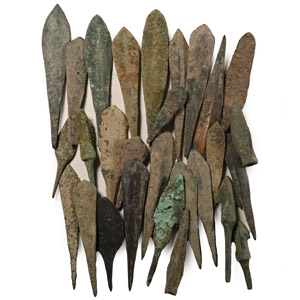
Western Asiatic Bronze Arrowhead Collection
18th-7th century B.C.Sold for (Inc. bp): £130
Including triangular, leaf-shaped, barbed, paddle-shaped with a flat, comparatively wide mid-rib, and others. 176 grams total, 33-77 mm
Ex London art market, 1980-1990s. This lot is accompanied by an illustrated lot declaration signed by the Head of the Antiquities Department, Dr Raffaele D'Amato.
Some of the represented arrowheads (paddle-shaped) were typical of the Old Babylonian Empire. The shoulders were pronounced and the arrowhead had a rectangular-section tapering tang. This simple form was popular throughout and are comparatively common finds in the Holy Land. -
.jpg)
North-Western Persian Type Bronze Blade
Early 1st millennium B.C.Sold for (Inc. bp): £59
With tapering triangular blade, having straight shoulders, flat midrib and tapering square-sectioned tang ending with a rounded pommel. 99 grams, 33 cm
Acquired 1980-2015. Ex Abelita family collection. This lot is accompanied by an illustrated lot declaration signed by the Head of the Antiquities Department, Dr Raffaele D’Amato. This lot is accompanied by an illustrated lot declaration signed by the Head of the Antiquities Department, Dr Raffaele D'Amato.
Moorey, Gordon and Khorasani created a classification of bladed weapons, according to which daggers are edged weapons not greater than 36cm in length, dirks (short swords) are between 36cm and 50cm in length, and swords are edged weapons greater than 50cm in length.
