
Loading, please wait...
LOT 1486
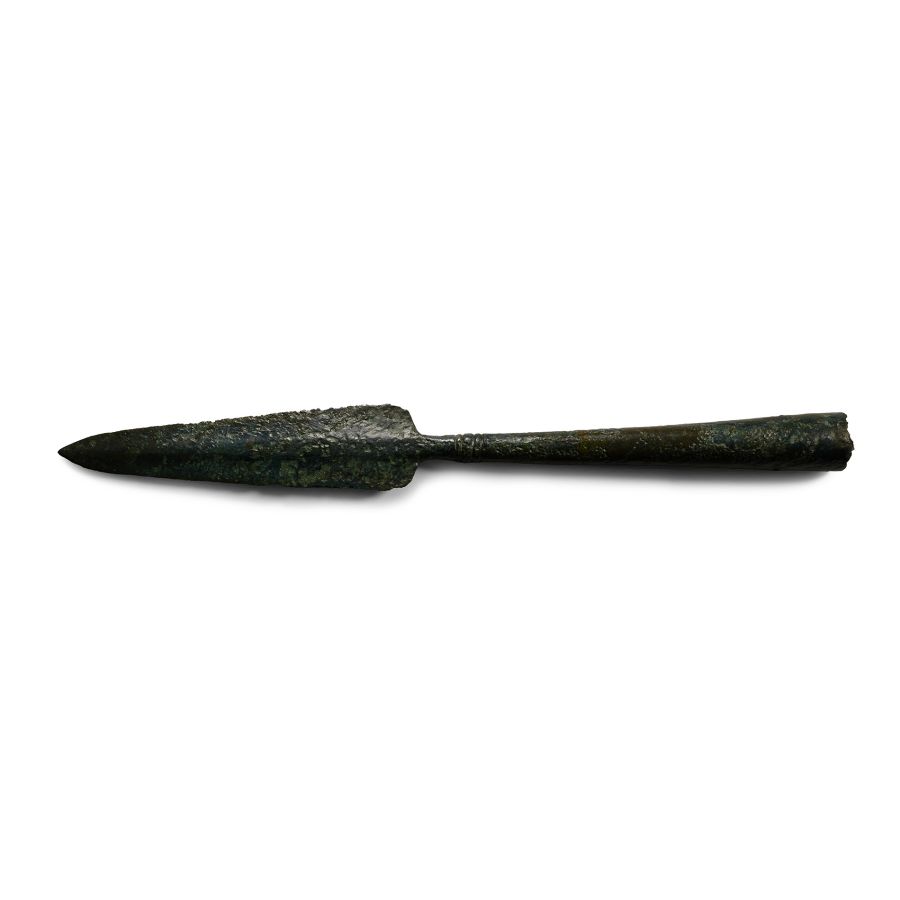
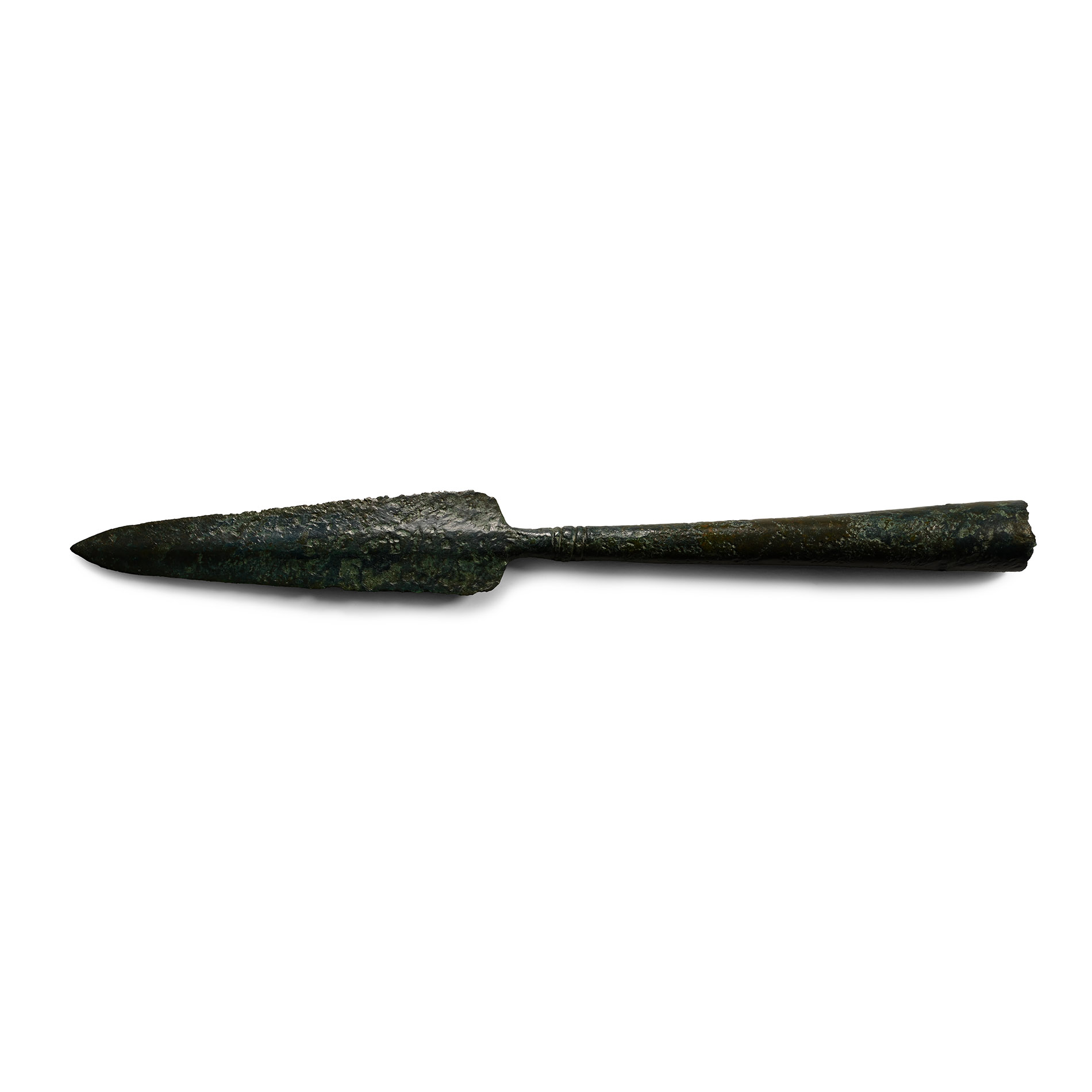
Luristan Bronze Spearhead
13TH-7TH CENTURY B.C.
12 1/2 in. (161 grams, 31.5 cm).
Composed of a leaf-shaped blade with tapering socket.
ProvenanceAcquired 1980-2015.
Ex Abelita family collection.
This lot is accompanied by an illustrated lot declaration signed by the Head of the Antiquities Department, Dr Raffaele D’Amato.
This lot is accompanied by an illustrated lot declaration signed by the Head of the Antiquities Department, Dr Raffaele D'Amato.
Cf. Christie's, The Axel Guttmann Collection of Ancient Arms and Armour, part 2, London, 2004, p.36, no.40; cf. Khorasani, M.M., Arms and Armour from Iran. The Bronze Age to the End of the Qajar Period, Tübingen, 2006, p.630, no.280.
CONDITIONTimeLine Auctions follows a vetting process to ensure the authenticity and legality of all items, reinforcing our commitment to integrity and responsible trading. Each antiquity, antique, and coin lot undergoes thorough examination by a vetting committee of at least ten external specialists, professional trade association members, scientists, and archaeologists: Our Vetting Process
AUCTIONS:
TimeLine is a leading auction house specialising in antiquities, ancient art, collectables, natural history, coins, medals, and books. Our auctions offer museums, collectors, historians, and enthusiasts the opportunity to acquire unique and historically significant pieces.
-
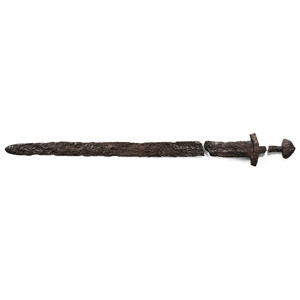
Scandinavian Viking Sacrificed Iron Sword
10th-11th century A.D.Sold for (Inc. bp): £4,160
Deliberately broken up on deposition, Petersen's Type L variant, comprising: D-shaped pommel with peened tang above and upper portion of tang forming the grip; lower section of tang with separate lower guard, scaphoid in plan and gently drooping in profile with convergent ends; upper portion of double-edged lentoid-section blade; lower section of parallel-sided blade with rounded tip. 1.15 kg total, 9-66 cm
From the private collection of a London gentleman, from his grandfather's collection formed before the early 1970s. This lot has been checked against the Interpol Database of stolen works of art and is accompanied by a search certificate number no.12726-234732. This lot has been cleared against the Art Loss Register database, and is accompanied by an illustrated lot declaration signed by the Head of the Antiquities Department, Dr Raffaele D'Amato. -
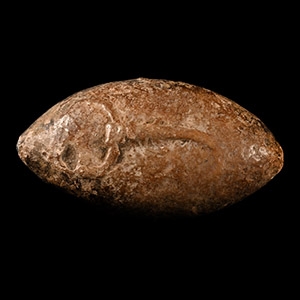
Hellenistic Rhodian Lead Slingshot with Scorpion
3rd century B.C.Sold for (Inc. bp): £598
Lentoid-section and depicting a stylised scorpion to one side, a type sometimes known to have the Rhodian legend ΚΑΛΑ to verso. 29.6 grams, 29 mm
From a Manchester, UK, collection, 1990s. This lot is accompanied by an illustrated lot declaration signed by the Head of the Antiquities Department, Dr Raffaele D'Amato.
Together with the Balearic slingers, Rhodian slingers were considered to be the best of the Hellenistic world, and they were also used in the Roman army. The slingshots with an image of a scorpion on one side and with an inscription ΚΑΛΑ on the other are believed to originate from the Island of Rhodes. On these sling bullets ΚΑΛΑ should be translated as “nice things.” Of course, ironically, these “nice things” were designed to kill enemies and to sting like a scorpion, and the message of those with the image of a scorpion could be understood, as proposed by M. Manov and N. Torbov, as: “nice things sting like a scorpion.” -
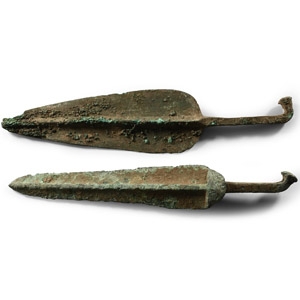
Western Asiatic Bronze Spearheads
14th-10th century B.C.Sold for (Inc. bp): £111
The leaf-shaped ovate blade with rounded, gently curved shoulders and raised midrib, flat rectangular-sectioned tang tapering to a bent end with a fastening button; in one specimen the tang is protruding from the 'blade sheath'. 507 grams total, 26-27.5 cm
Acquired 1980-2015. Ex Abelita family collection. This lot is accompanied by an illustrated lot declaration signed by the Head of the Antiquities Department, Dr Raffaele D’Amato. This lot is accompanied by an illustrated lot declaration signed by the Head of the Antiquities Department, Dr Raffaele D'Amato.
Similar spearheads were excavated in the Marlik Royal cemetery by Dr Negahban, see for example in tomb 47, Trench XXIIE. They were the evolution of a typology which began much earlier in Mesopotamia and the fertile crescent, the type 4 of the Stronach classification, with straight tang and square section, usually thickened at the base with a button tang. The foliate blade was wide and exaggerated in some specimens excavated at Marlik.
