
Loading, please wait...
LOT 1022
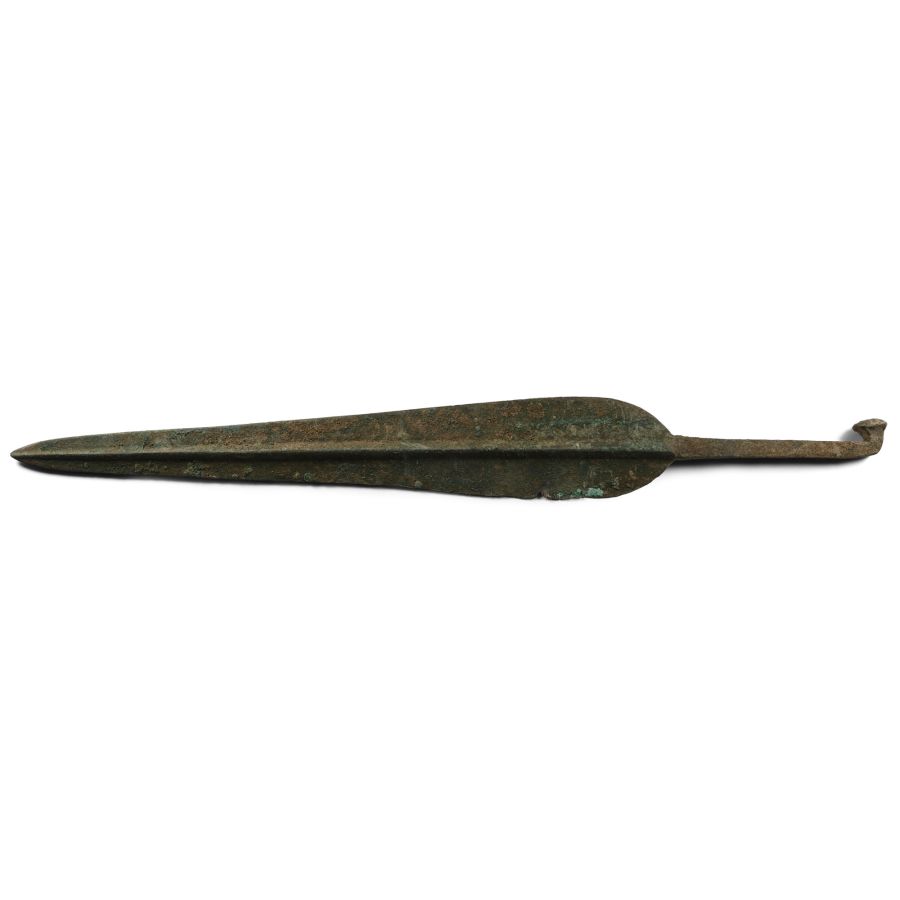
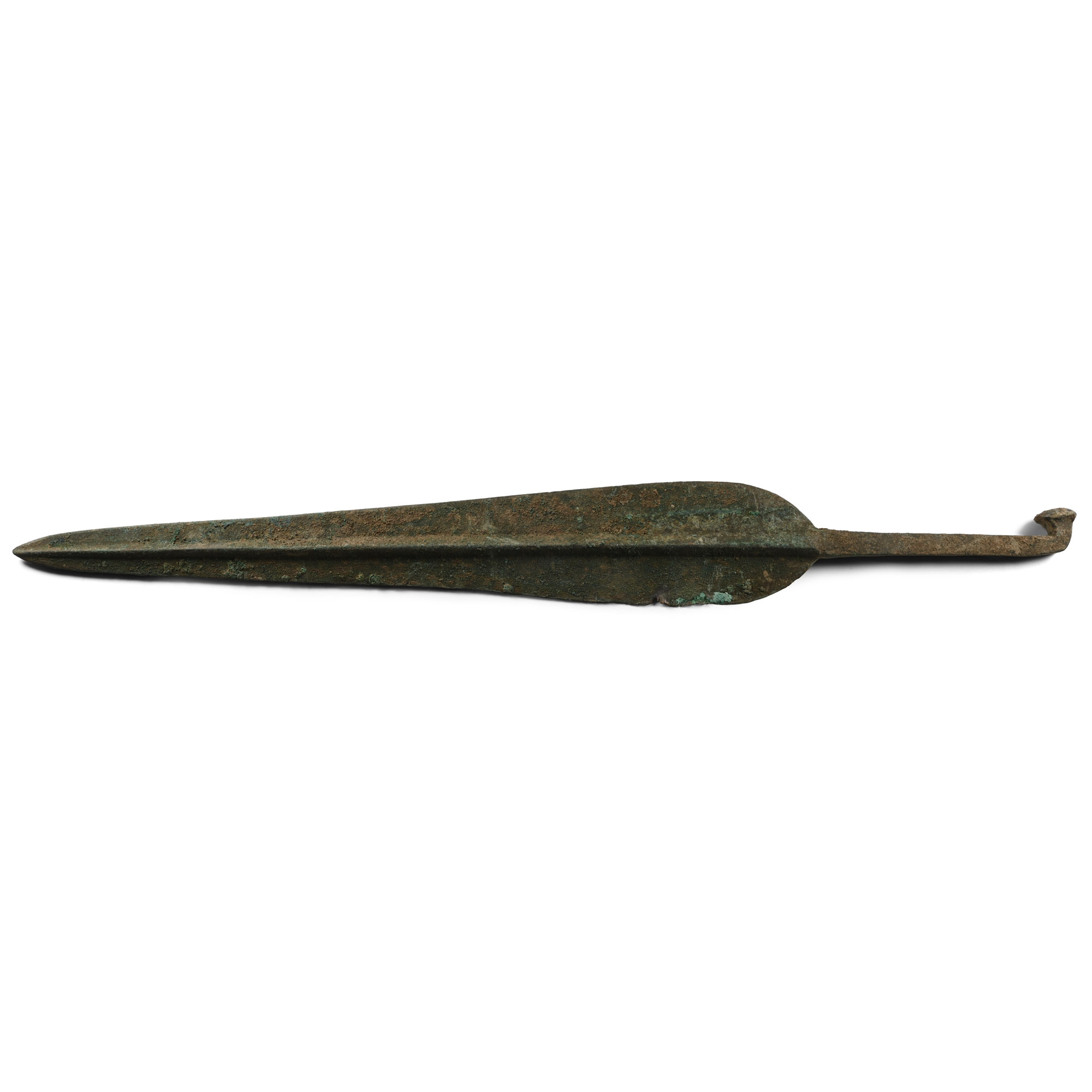
Luristan Bronze Spearhead
EARLY 2ND MILLENNIUM B.C.
13 3/8 in. (243 grams, 34 cm).
Leaf-shaped blade with a raised midrib, rectangular-section tang bent to a right-angle with a knop to the end.
ProvenanceEx London art market, 1980-1990s.
This lot has been cleared against the Art Loss Register database, and is accompanied by an illustrated lot declaration signed by the Head of the Antiquities Department, Dr Raffaele D'Amato.
Cf. Muscarella, O.W., Bronze and Iron, ancient Near Eastern Artifacts in the Metropolitan Museum of Art, New York, 1988, no.176, for the type.
FootnotesA number of similar blades, some considered to be spearheads and others to be daggers, all with bent tang, derived from Tepe Hissar Culture III. Some of them, like our specimen, have a button terminal, some others have a plain, pointed terminal. The general dating of these specimens is fixed to the early 2nd millennium B.C.
CONDITIONTimeLine Auctions follows a vetting process to ensure the authenticity and legality of all items, reinforcing our commitment to integrity and responsible trading. Each antiquity, antique, and coin lot undergoes thorough examination by a vetting committee of at least ten external specialists, professional trade association members, scientists, and archaeologists: Our Vetting Process
AUCTIONS:
TimeLine is a leading auction house specialising in antiquities, ancient art, collectables, natural history, coins, medals, and books. Our auctions offer museums, collectors, historians, and enthusiasts the opportunity to acquire unique and historically significant pieces.
-
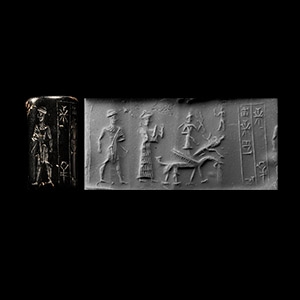
Old Babylonian Haematite Cylinder Seal with Inscription
Circa 1900-1600 B.C.Sold for (Inc. bp): £1,040
Accompanied by a copy of an old scholarly note, typed and signed by W.G. Lambert, late Professor of Assyriology, University of Birmingham, 1970-1993, which states: 'Two standing gods face a complex scene. The first deity is a Lamma goddess, in horned tiara, long flounced robe, and she is raising both hands. Behind her stands the god with mace: hat with deep brim, clothes to the knees, and holding his mace at the waist. What they are witnessing is a standing monster: general build of a lion, but wings, a brush tail and talons of a bird of prey for legs. Its head is leaning down. Above it stands a god in long robe and long tiara, with one leg projecting and foot resting on some strange being. The god holds a whip over one shoulder and forked lightning in the other hand. Facing him in the distance is a small walking figure holding up some object. A two-line cuneiform inscription names two gods: Adad and Shala. This is an Old Babylonian seal, c. 1900-1600 B.C. It is somewhat worn, but the design is rare for the animal and god above it. This god is Adad, the storm god, identified by whip, forked lightning, and the animal on which he stands, which was passed down to the Old Babylonian period from the Akkad period. Thus the design is of considerable interest. Shala was the wife of Adad.'; supplied with a museum-quality impression. 15.9 grams, 30 mm
From the private collection of a North American lady, formed 1970s-early 1990s, with collection reference no.P105. Accompanied by a copy of a scholarly note, typed and signed by Professor Wilfrid George Lambert. This lot has been cleared against the Art Loss Register database, and is accompanied by an illustrated lot declaration signed by the Head of the Antiquities Department, Dr Raffaele D'Amato. -
.jpg)
Bactrian Gold Coiled Wire Necklace with Pendant
3rd-2nd millennium B.C.Estimate: £2,500 - 3,500 (+bp*)
Opening Bid: £1,250
Tightly-coiled wire band with graduated profile, domed disc closure with repoussé central boss and pellets to the rim, pendant formed as a rectangular frame enclosing two fusiform banded agate and another fusiform bead, barrel-shaped gold collars and coiled wire finials. 37.20 grams, 66 cm
with Ancient and Islamic Art Ltd, 1993. Private European collection, early 1990s. This lot has been checked against the Interpol Database of stolen works of art and is accompanied by a search certificate no.12597-232360. This lot has been cleared against the Art Loss Register database, and is accompanied by an illustrated lot declaration signed by the Head of the Antiquities Department, Dr Raffaele D'Amato.
In Old Bactria there are a number of necklaces with compartmented chlorite rosettes containing settings in lapis lazuli, cornelian, and turquoise, which seem to indicate a tradition of purely local taste; together with these should be considered other examples in twisted gold lamina, like our example, with pendants in gold or in semi-precious stones such as rock crystal. -
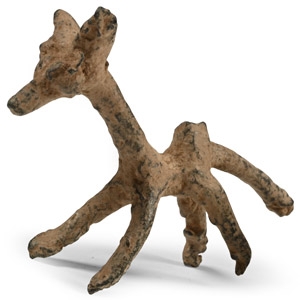
Western Asiatic Bronze Animal Figure
2nd-1st millennium B.C.Sold for (Inc. bp): £20
Formed with a flange to the rump, legs spread. 8.92 grams, 45 mm long
Acquired in the 1990s. Ex Abelita family collection. This lot has been cleared against the Art Loss Register database, and is accompanied by an illustrated lot declaration signed by the Head of the Antiquities Department, Dr Raffaele D'Amato.
