
Loading, please wait...
LOT 1394
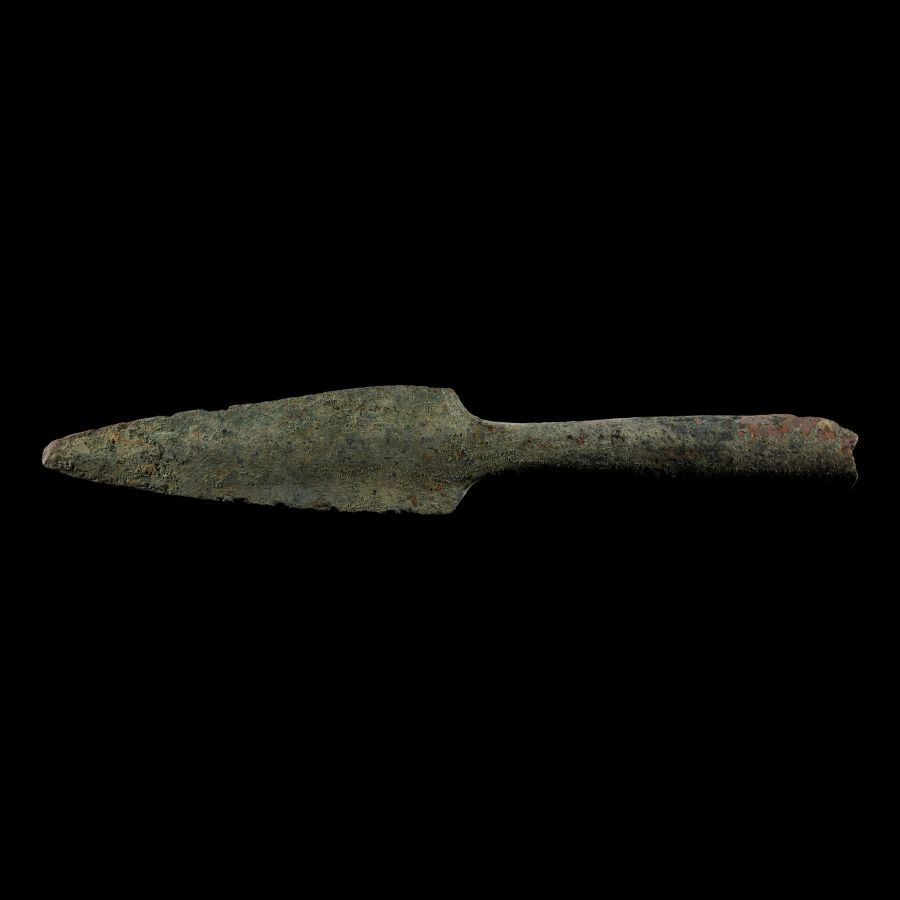
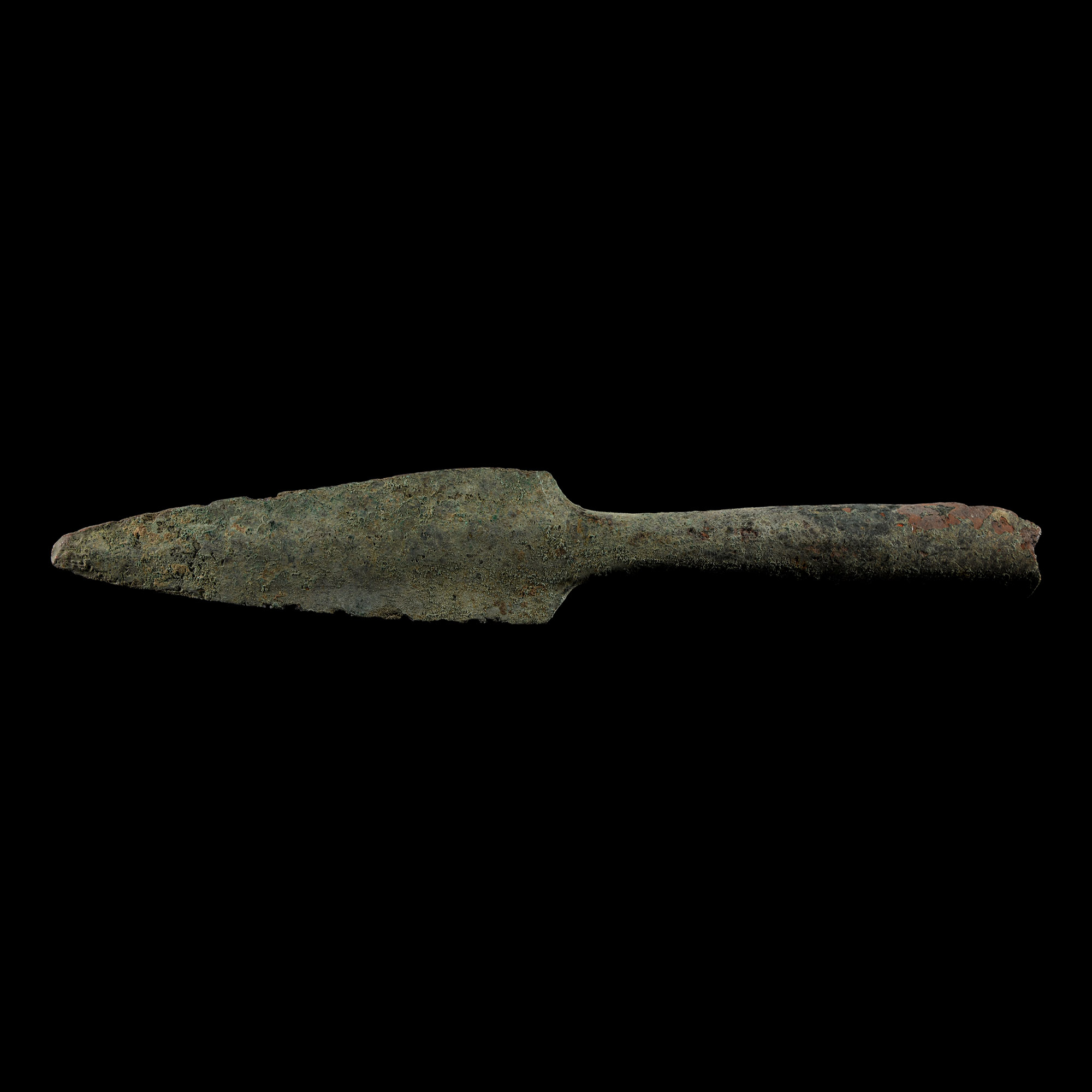
Luristan Bronze Socketted Spearhead
13TH-6TH CENTURY B.C.
9 1/2 in. (155 grams, 24 cm).
With broad leaf-shaped blade and tapering tubular socket.
ProvenanceAcquired 1980-2015.
Ex Abelita family collection.
Cf. Overlaet, B., ‘Luristan metalwork in the Iron Age’ in Stöllner, T., Slotta, R. & Vatandoust, A., (eds.), Persiens Antike Pracht. Bergbau - Handwerk – Archäologie, Bochum, 2004, pp. 328-338, fig.7, p.335; Khorasani M.M., Arms and Armour from Iran. The Bronze Age to the End of the Qajar Period, Tübingen, 2006, pp.242-243.
FootnotesThe spear belongs to the type VIII classified by Khorasani (spearheads with well-projecting midribs and long folded sockets) and more specifically to subtype C (with leaf-shaped blade and short hollow socket). Usually the willow-leaf blade has an almost straight shoulder base and a wide, flat midrib tapering towards the point.
CONDITIONTimeLine Auctions follows a vetting process to ensure the authenticity and legality of all items, reinforcing our commitment to integrity and responsible trading. Each antiquity, antique, and coin lot undergoes thorough examination by a vetting committee of at least ten external specialists, professional trade association members, scientists, and archaeologists: Our Vetting Process
AUCTIONS:
TimeLine is a leading auction house specialising in antiquities, ancient art, collectables, natural history, coins, medals, and books. Our auctions offer museums, collectors, historians, and enthusiasts the opportunity to acquire unique and historically significant pieces.
LOT 1394
Luristan Bronze Socketted Spearhead
Estimate £100 - 140€120 - 160 (for guidance only)$140 - 190 (for guidance only)
-
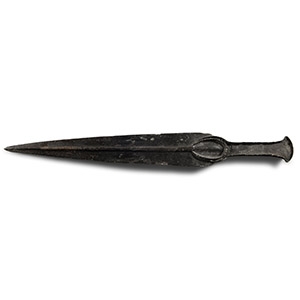
Luristan Bronze Dirk
Circa 1000 B.C.Sold for (Inc. bp): £364
Composed of a leaf-shaped blade with a raised penannular rib and slot below the shoulder connected to the grip with lateral flanges and integral pommel, recessed to accept an organic insert. 231 grams, 39 cm
From a collection acquired on the UK art market from various auction houses and collections mostly before 2000. From an important Cambridgeshire estate; thence by descent.
This dirk, cast in one piece mould, belongs to the daggers that Medvedskaya believes support the thesis that majority of them were cast in one piece. However, there are examples where the penannular grip was cast on later. -
.jpg)
Viking Age Iron Sword with Bronze Hilt
10th-13th century A.D.Sold for (Inc. bp): £4,160
With a double-edged tapering blade, long tapering fullers and a narrow tang; boat-shaped bronze cross-guard with Jellinge Style decoration; the upper guard with similar ornament topped by a seven-lobed pommel. 675 grams, 88 cm
The blade is generally complete and in good conditions, although traces of corrosion are visible on the surface and on the edges; both cutting edges show strong traces of employ on battlefield, with battle-nicks along their length; pitting from possible water depot; still-homogenous blade structure, with strong delamination and material losses visible on the original surface of the metal.
From the private collection of a London gentleman, from his grandfather's collection formed before the early 1970s. Accompanied by an academic report by Dr Raffaele D’Amato. This lot has been checked against the Interpol Database of stolen works of art and is accompanied by search certificate number no.12011-213595.
This Couronian sword finds a good parallel with Baltic swords, used by Prussian, Couronians, Estonian and Lithuanian pagan warriors; see a sword once in the Prussian Museum, inventory V. Nr. 8368, from Janischken (Fig. 1,a); other clear parallels can be seen in Kazakevičius, 1996, figs.62-63 (fig.2) and Tomsons, 2012, fig.2 (Fig.3),3,7. The Curonian swords of this type, sometimes with animal head decoration on the lower guard, were widespread and used in the Eastern Baltic lands from 10th to 13th century. -
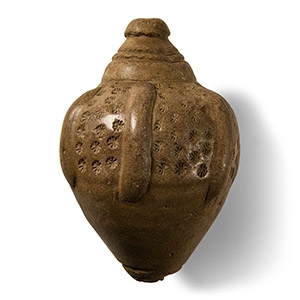
Byzantine 'Greek Fire' Ceramic Fire Bomb or Hand Grenade
9th-11th century A.D.Sold for (Inc. bp): £176
Piriform body with thick ribs to the shoulder and impressed panels between, domed filler-hole, intended to be filled with explosive liquid and wick, used as a hand grenade. 708 grams, 15 cm
Acquired 1980-2015. Ex Abelita family collection. Accompanied by an academic paper by military specialist Dr Raffaele D'Amato, dated 15 July 2019 and titled 'Eastern Roman Empire - Greek Fire Bomb or Hand Grenade (μεσαίον kακάβιον) 9th-11th century AD'.
Apart from the use of siphons or manual flame-throwers called cheirosiphona, special corps of Roman soldiers employed terracotta grenades, in the form of small jars, abundantly evidenced in archaeological excavations. They were called μεσαία kακαβιά or κυτροκακάβια where the former had a bulbous shape and the latter a more cylindrical form.
