
Loading, please wait...
_900x900.jpg "Luristan Bronze Socketted Axehead")
_200x200.jpg "Luristan Bronze Socketted Axehead")
.jpg "Luristan Bronze Socketted Axehead")
LOT 1134
Luristan Bronze Socketted Axehead
CIRCA 13TH-7TH CENTURY B.C.
5 3/4 in. (1.2 kg, 14.5 cm).
Featuring an oval-shaped socket, straight upper edge and curved lower edge with slightly convex cutting edge. [No Reserve]
ProvenanceAcquired 1990s-early 2000s.
East Anglian private collection.
Cf. Calmeyer, P., Datierbare Bronzen aus Luristan und Kirmanshah II. Datierbare Gruppen (chronologisch geordnet), De Gruyter, 1969, fig.6, p.10, group 2, type A3 a, of the Calmeyer classification.
FootnotesUnadorned weapons, especially axes, adzes and picks, were made by Luristan craftsmen using simple clay or stone bivalve moulds, into which was inserted a core to form the socket for the shaft. Typically, the metallic composition consisted of a combination of arsenical bronze and copper, together with a small percentage of lead.
CONDITIONTimeLine Auctions follows a vetting process to ensure the authenticity and legality of all items, reinforcing our commitment to integrity and responsible trading. Each antiquity, antique, and coin lot undergoes thorough examination by a vetting committee of at least ten external specialists, professional trade association members, scientists, and archaeologists: Our Vetting Process
AUCTIONS:
TimeLine is a leading auction house specialising in antiquities, ancient art, collectables, natural history, coins, medals, and books. Our auctions offer museums, collectors, historians, and enthusiasts the opportunity to acquire unique and historically significant pieces.
-
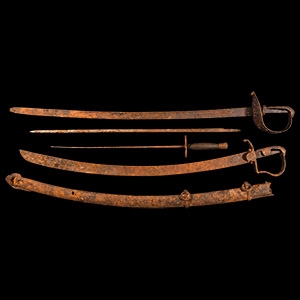
Post Medieval Iron Sword Group
18th-19th century A.D.Sold for (Inc. bp): £156
Comprising military and civilian weapons: short rapier; basket hilted sword; sabre seemingly with scabbard; rapier blade. 3.45 kg total, 62-100 cm
Acquired 1990s-early 2000s. East Anglian private collection.
The two sabres, with the particular hilt and steel scabbard, seems to have affinities with Hungarian sabres of about 1837-1838, destined to staff and senior officers of the Austro-Hungarian Kingdom Hussars. At the end of the 1830s, the Austrian military leaders introduced a new type of sabre for the Hussar officers, while the 1837 infantry officer sabre was standardised. -
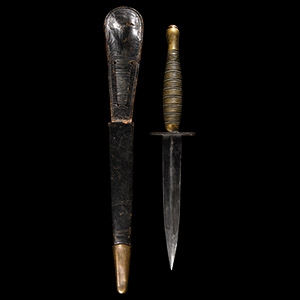
British Fairbairn-Sykes 'Beaded and Ringed' Commando Dagger in Scabbard
Circa 1942 A.D.Sold for (Inc. bp): £715
By Rodgers, with finely shaped 15cm stiletto blade with traces of original black finish tapering to a steel oval guard and fitted with a brass 'beaded and ringed' shaped hilt secured by a copper pommel nut; the hilt bearing the War Department 'broad arrow' and '2' marks near to the guard; with the original leather scabbard fitted with brass rivets and chape, pierced for belt wear and with the side flaps for sewing cut away as commonly seen when belt worn; the dagger showing wear with minor chipping to the blade. 254 grams, 33 cm overall
Property of a Luton, UK gentleman, by inheritance.
In the autumn of 1942, the Rodgers firm produced what many consider to be the best of all the wartime Fairbairn-Sykes knives: the 'Beads and Ridges' model (or 'Beaded and Ringed'); so-called for its distinctive grip pattern to the brass hilt of single rings of tiny beads, interspersed between sections of four to seven plain rings. The blade is delicate and uniform, and the weapon, though light, is well balanced. The blade finish was black (as this example) or nickel. All of this type are considered to be at least scarce. According to both Fredrick Stephens and Leroy Thompson the type was a commercial variant for private purchase; however, there are some rare cases of this type which were officially issued with the War Department broad arrow and number marks, as with this example. -
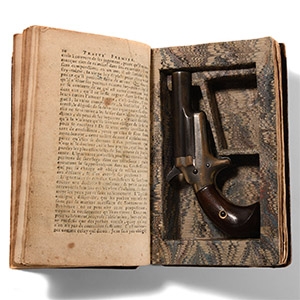
Colt .41 Rimfire Derringer Pistol and Book Case
19th century A.D.Sold for (Inc. bp): £572
Comprising a Colt .41 calibre single action rimfire single-shot derringer pocket pistol, the barrel top marked 'COLT' and the left frame '41 CAL'; with nickel-plated brass frame and steel rifled barrel (swivel to load) and bird's beak butt with plain wood grips; the pistol contained in an original case formed from a hollowed out leather-bound book Pratique du Sacrament de Penitence ou Methode pour L'Administrer Utilement, published Paris, 1714, the compartment lined with marbled paper with section for spare bullets; action in working order. 450 grams total, book 17 x 10 cm
Acquired from Holts Auction, 2020, lot 899. Formerly with a Kent collector. With TimeLine Auctions, lot 1086. Property of an Australian collector. Accompanied by Holts lot ticket.
Sold as an exempt item under Section 58 (2) of the Firearms Act, 1968, to be held as a curiosity or ornament. No license required but buyer must be over 18 years of age. Overseas bidders should note that, due to UK regulations governing export of all firearms, overseas buyers will need to make arrangements for shipping this lot out of the UK directly, by air freight, with a specialist company or agent.
