
Loading, please wait...
LOT 1450
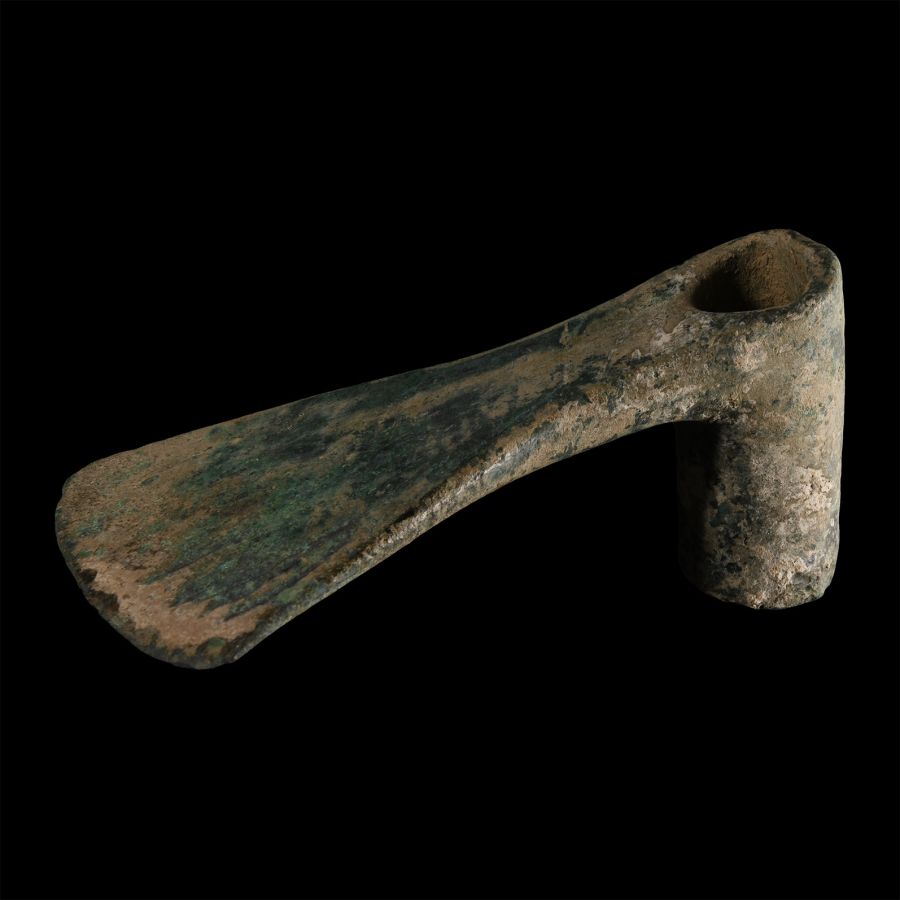
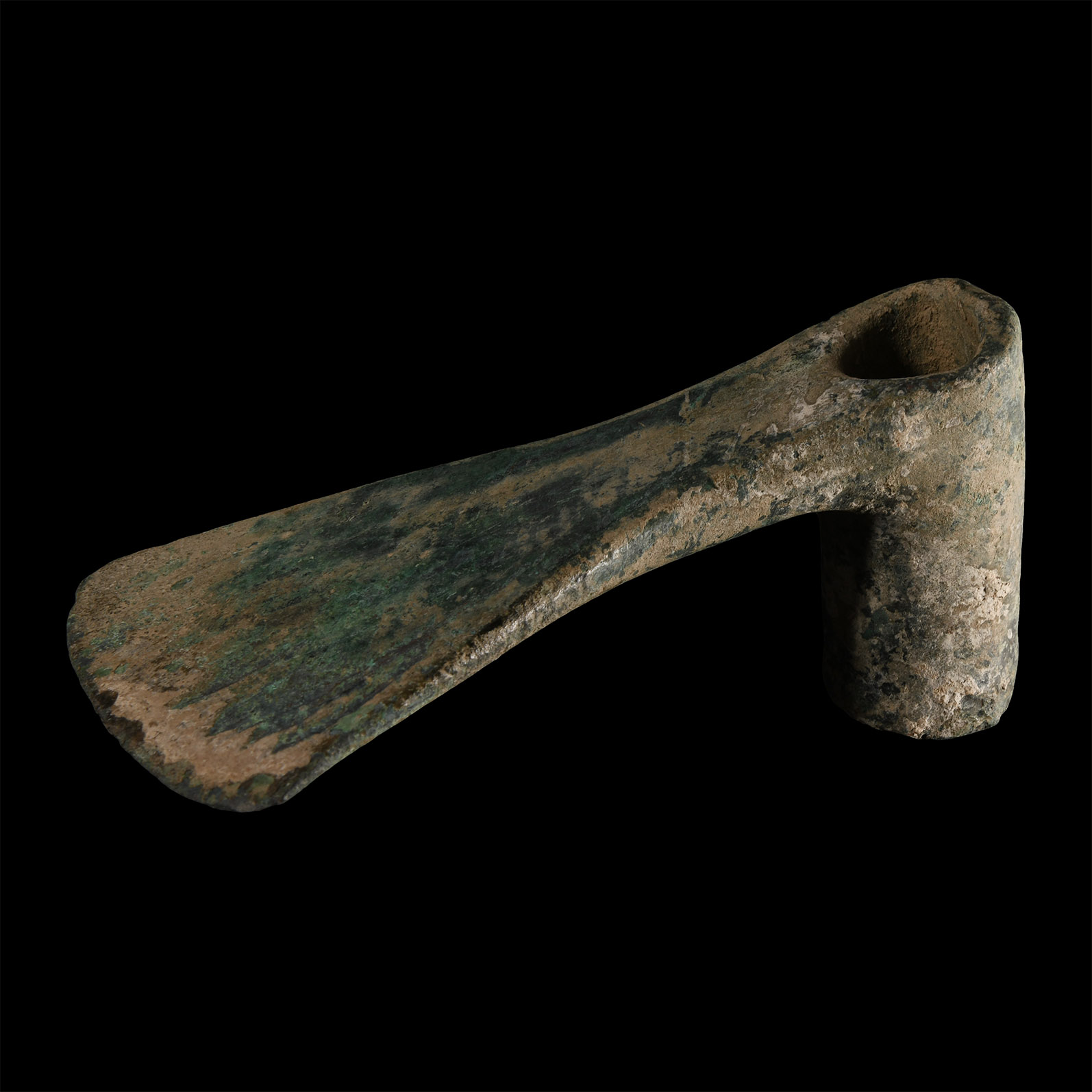
Luristan Bronze Socketted Adze
13TH-7TH CENTURY B.C.
5 3/4 in. (590 grams, 14.5 cm).
With short tubular socket and flared cutting edge perpendicular to the socket.
ProvenanceFrom an old English collection formed in the 1980s.
Property of an Essex gentleman; acquired on the UK art market.
TimeLine Auctions follows a vetting process to ensure the authenticity and legality of all items, reinforcing our commitment to integrity and responsible trading. Each antiquity, antique, and coin lot undergoes thorough examination by a vetting committee of at least ten external specialists, professional trade association members, scientists, and archaeologists: Our Vetting Process
AUCTIONS:
TimeLine is a leading auction house specialising in antiquities, ancient art, collectables, natural history, coins, medals, and books. Our auctions offer museums, collectors, historians, and enthusiasts the opportunity to acquire unique and historically significant pieces.
-
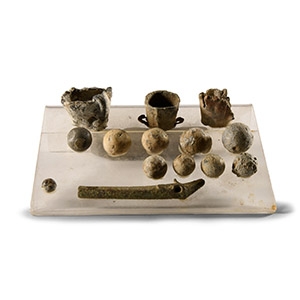
Post Medieval Weaponry Display
17th-18th century A.D.Sold for (Inc. bp): £46
Mixed group comprising: a petronel; lead musket ball and pistol shot in various gauges; three powder-charge containers; mounted on a display frame. 489 grams total, 13 cm wide including stand
From a collection acquired on the UK art market from various auction houses and collections mostly before 2000. From an important Cambridgeshire estate; thence by descent. -
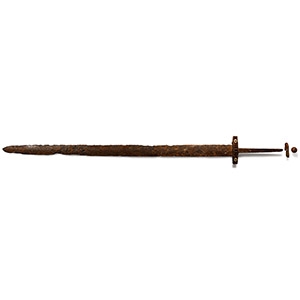
Migration Period Iron Sword with Garnet and Shell Cross Guard with Gold and Amber Sword Bead
5th-6th century A.D.Sold for (Inc. bp): £6,240
Eastern Roman or Germanic cavalry spatha with a parallel-sided blade and broad pointed tip, long tang; the trapezoidal lower guard with a gilt chip-carved plate divided in segments set with garnets to one side, each end with a shell disc set with a central garnet cabochon; accompanied by a strap from the scabbard and an amber sword bead with a beaded gold setting with a garnet cabochon. 970 grams total, 2-100 cm
From the private collection of a London gentleman, from his grandfather's collection formed before the early 1970s. Accompanied by an academic report by Dr Raffaele D’Amato. This lot has been checked against the Interpol Database of stolen works of art and is accompanied by search certificate number no.12012-213600.
The western spatha of the 4th-6th centuries was developed in a context that one can qualify as Romano-Germanic. Certain characteristics of the future Merovingian sword were already present in late Roman swords. It is quite natural that Type IV swords have been found in the countries conquered or settled by the Goths in southern, central and western Europe. -
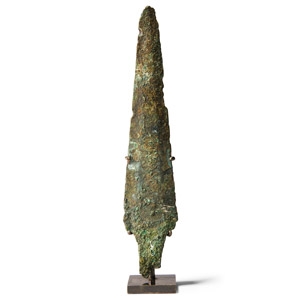
Western Asiatic Bronze Dagger
2nd millennium B.C.Estimate: £100 - 140 (‡+bp*)
Opening Bid: £50
With a narrow pointed blade and wide raised flange down centre, straight sides, well marked shoulders with narrow tang, one hole for rivet. 128 grams total, 17.6 cm high including stand
From the possessions of a member of a German princely family, gathered in the late 19th century, until the 1930s. with Auction House CUSP, Vienna, Auction Antique Art from Asia and from the Eastern Mediterranean, 16 June 2012, lot 75 [Part].
The type was technically more advanced than previous types of blades in the Near East, owing to the shape of the weapon, with its slightly convex sides widening out near the point, which combined the advantages of the leaf-shaped and straight-sided forms.
