
Loading, please wait...


LOT 1480
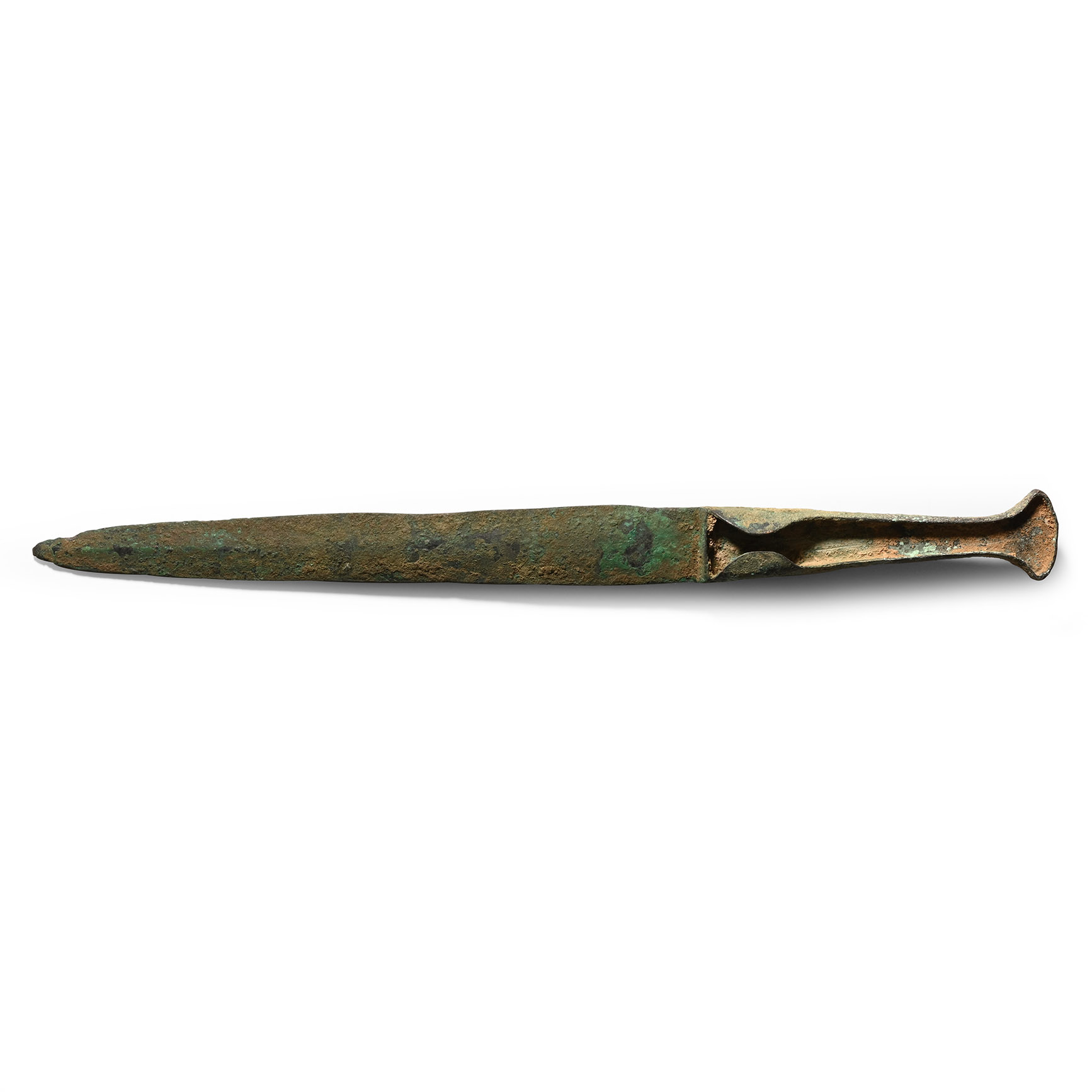
Luristan Bronze Short Sword
13TH CENTURY B.C.
13 1/8 in. (195 grams, 33.5 cm).
With lentoid-section blade, tongue-shaped in plan, with integral tapering hilt with flared finial, lateral flanges to accept a panel of bone to each face forming the grip.
ProvenanceAcquired 1980-2015.
Ex Abelita family collection.
Cf. Khorasani, M.M., Arms and Armour from Iran - The Bronze Age to the End of the Qajar Period, Tübingen, 2006, p.381, cat.13.
FootnotesThe art of Luristan can be described as the art of nomadic herdsmen and horsemen with an emphasis on the crafting of small, easily portable objects, among these a great number of bronze weapons. The rich and noble aristocrats of the Luristan, Elamites, Hurrians, Lullubians, Kutians, and Kassites, went to battle splendidly equipped and wore magnificent bronze armour, using maces, spears and daggers as offensive weapons, alongside spears, bows and arrows.
CONDITIONTimeLine Auctions follows a vetting process to ensure the authenticity and legality of all items, reinforcing our commitment to integrity and responsible trading. Each antiquity, antique, and coin lot undergoes thorough examination by a vetting committee of at least ten external specialists, professional trade association members, scientists, and archaeologists: Our Vetting Process
AUCTIONS:
TimeLine is a leading auction house specialising in antiquities, ancient art, collectables, natural history, coins, medals, and books. Our auctions offer museums, collectors, historians, and enthusiasts the opportunity to acquire unique and historically significant pieces.
-
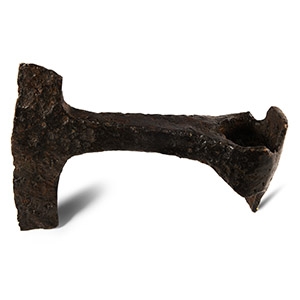
Viking Age Iron T-Shaped Axehead
10th-12th century A.D.Sold for (Inc. bp): £111
Narrow T-shaped blade with curved edge, large D-shaped socket with lateral triangular flanges and rectangular extension to the rear. 588 grams, 17 cm
From the private collection of a London gentleman, from his grandfather's collection formed before the early 1970s.
Slavic battle-axes also came into use in Scandinavia, especially in the Eastern part of Gotland, Denmark and Sweden. One of the types was a T-shaped axe with a broad blade. There were narrow-bladed types too, described as being very light. Another characteristic of some of the Eastern axes was an extra long hammer or more rarely a secondary blade protruding from the back of axehead. -
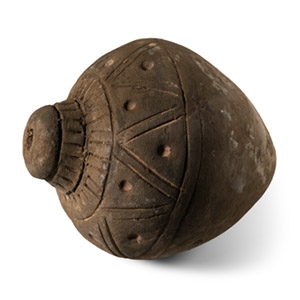
Byzantine 'Greek Fire' Ceramic Fire Bomb or Hand Grenade
9th-11th century A.D.Sold for (Inc. bp): £182
Small piriform ceramic missile, domed filler-hole, intended to be filled with explosive liquid and wick, used as a hand grenade. 437 grams, 11.1 cm
From a military inspired collection formed from the 1990s. Accompanied by an academic paper by military specialist Dr Raffaele D'Amato, dated 15 July 2019 and titled 'Eastern Roman Empire - Greek Fire Bomb or Hand Grenade (μεσαίον kακάβιον) 9th-11th century AD'.
Apart from the use of siphons or manual flame-throwers called cheirosiphona, special corps of Roman soldiers employed terracotta grenades, in the form of small jars, abundantly evidenced in archaeological excavations. They were called μεσαία kακαβιά or κυτροκακάβια where the former had a bulbous shape and the latter a more cylindrical form. -
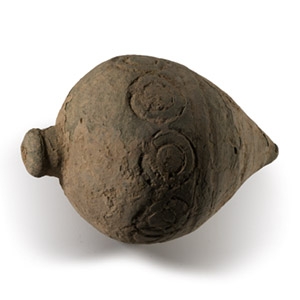
Byzantine 'Greek Fire' Ceramic Fire Bomb or Hand Grenade
9th-11th century A.D.Sold for (Inc. bp): £85
A piriform ceramic missile with band of impressed roundels to the shoulder, domed filler-hole, intended to be filled with explosive liquid and wick, used as a hand grenade. 367 grams, 12 cm
From a military inspired collection formed from the 1990s. Accompanied by an academic paper by military specialist Dr Raffaele D'Amato, dated 15 July 2019 and titled 'Eastern Roman Empire - Greek Fire Bomb or Hand Grenade (μεσαίον kακάβιον) 9th-11th century AD'.
Apart from the use of siphons or manual flame-throwers called cheirosiphona, special corps of Roman soldiers employed terracotta grenades, in the form of small jars, abundantly evidenced in archaeological excavations. They were called μεσαία kακαβιά or κυτροκακάβια where the former had a bulbous shape and the latter a more cylindrical form.
