
Loading, please wait...
LOT 0326
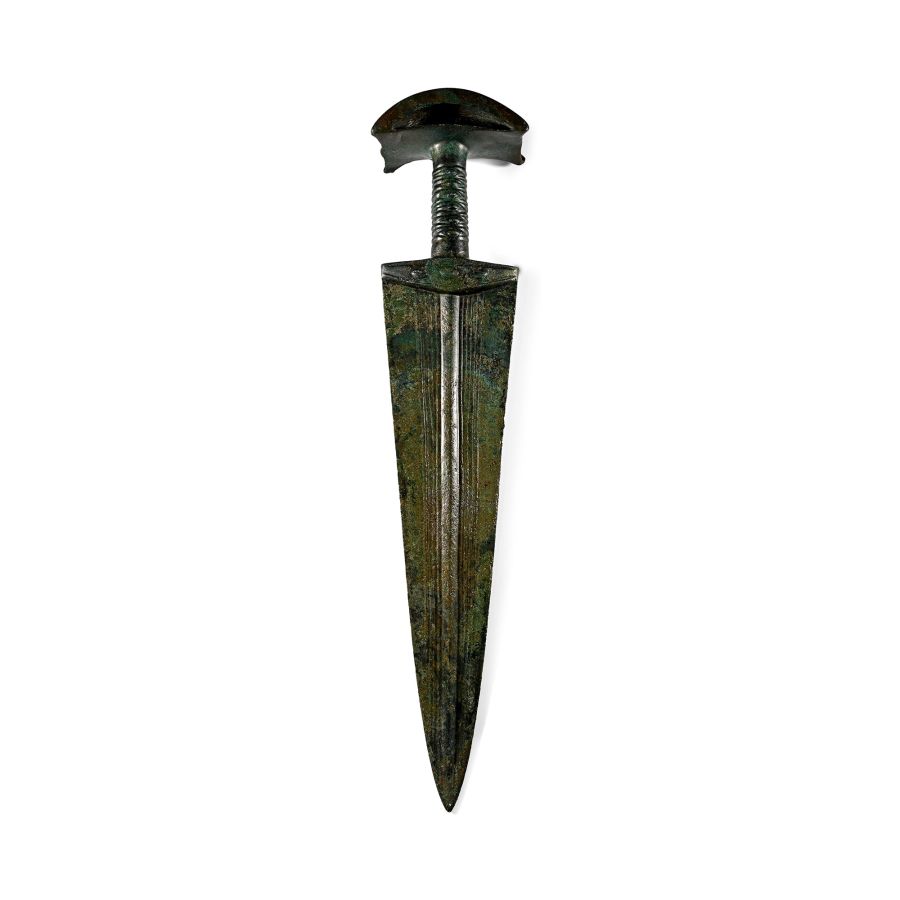
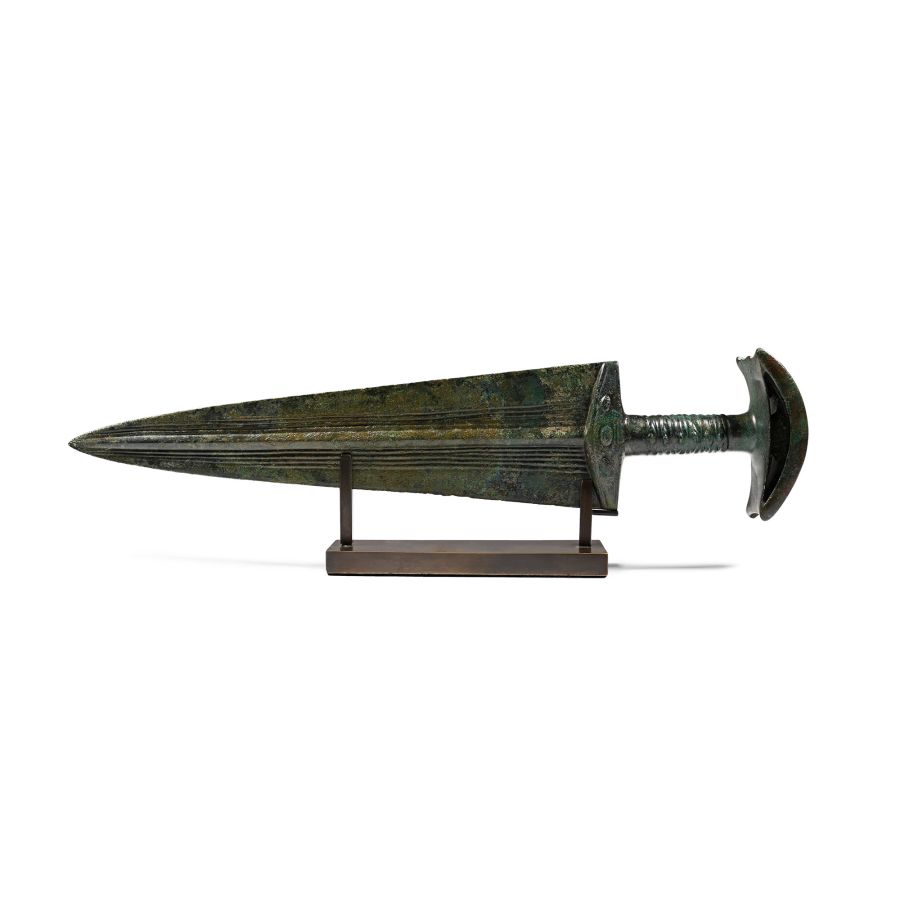
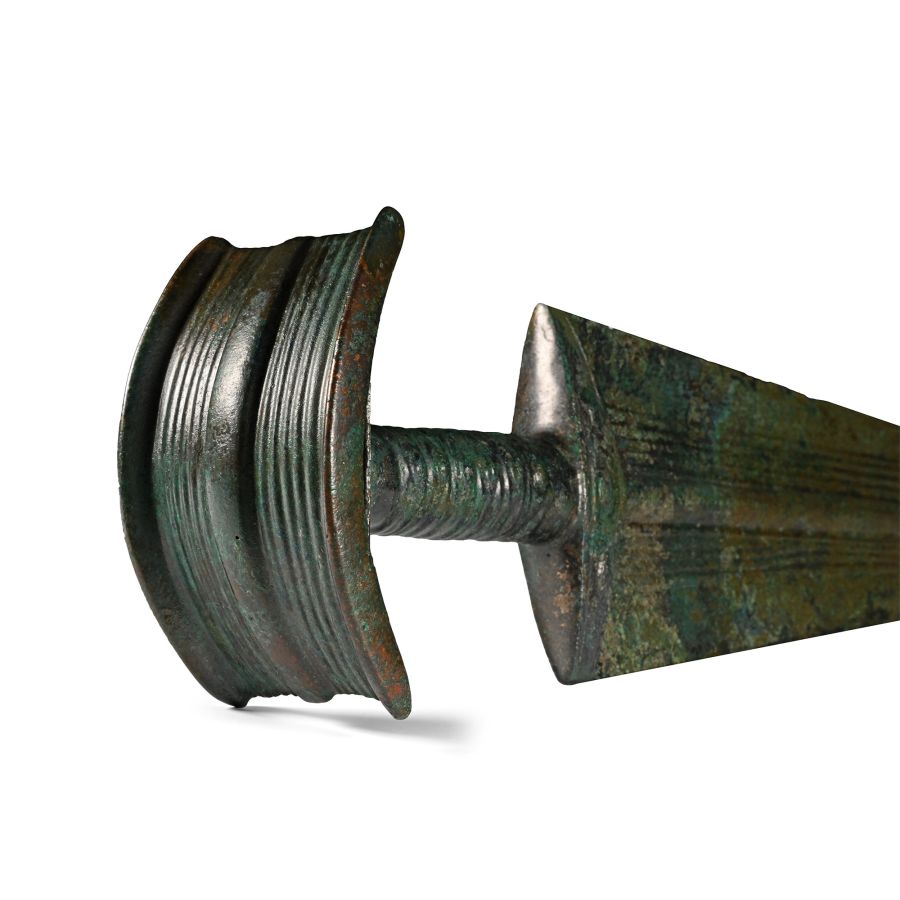
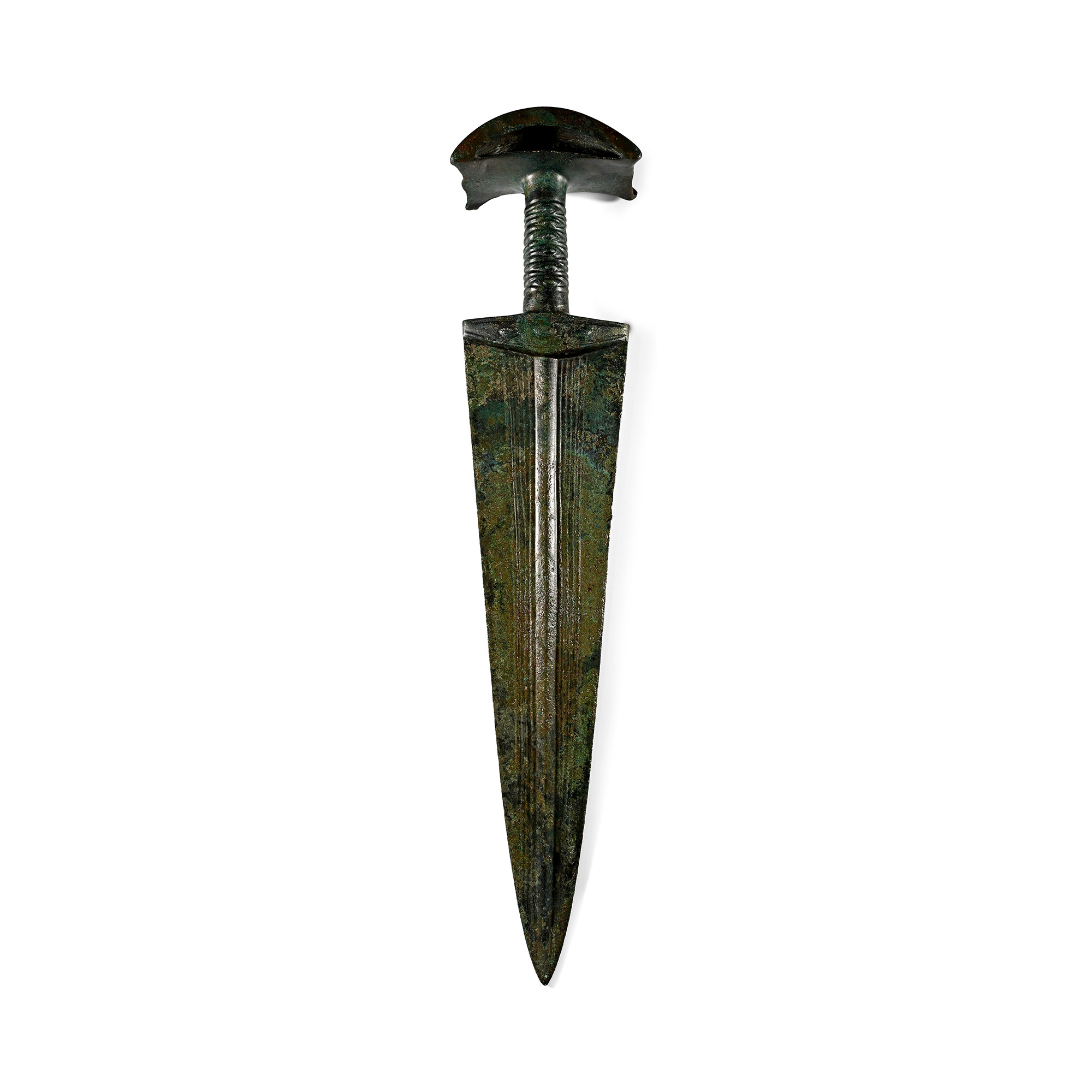
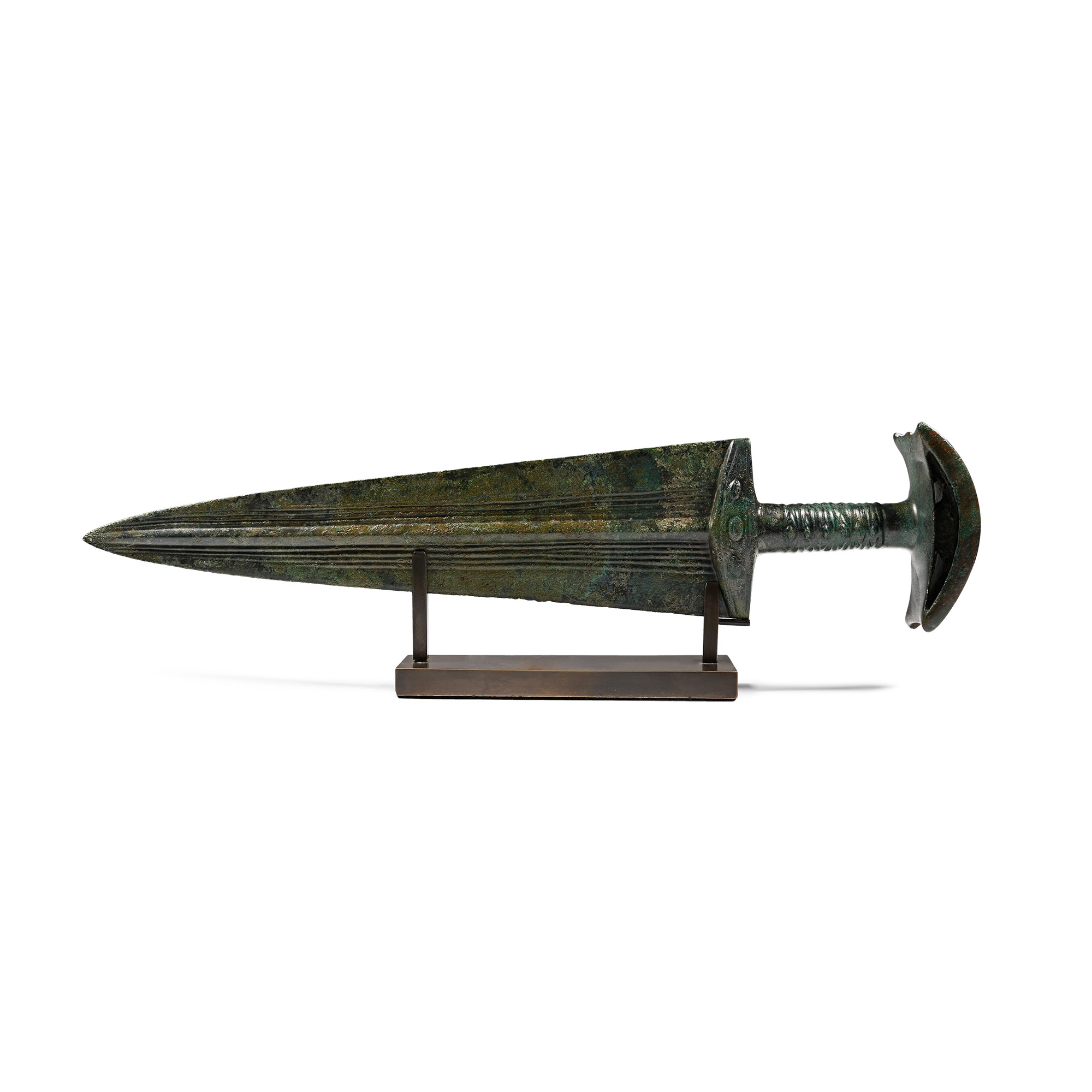
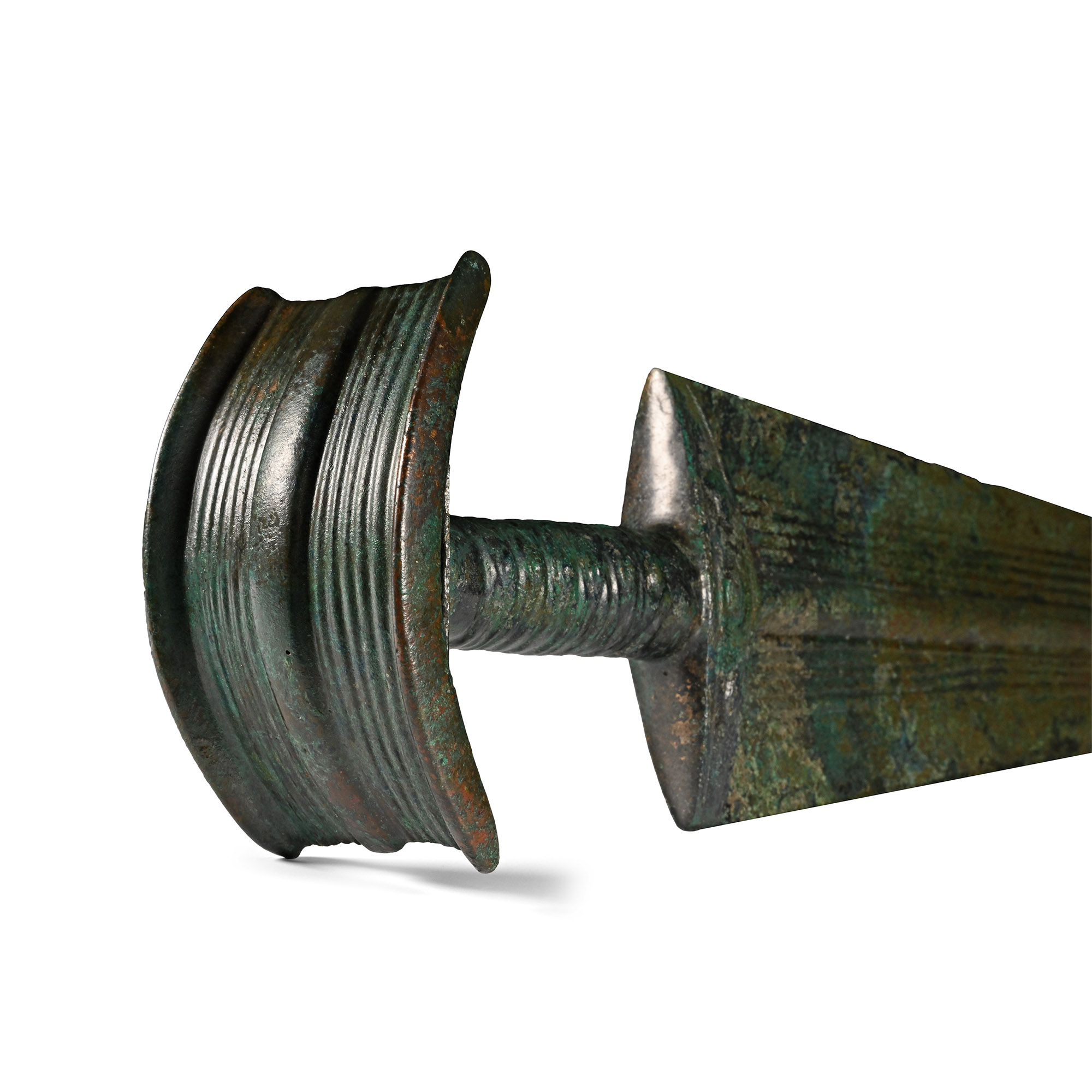
Luristan Bronze Short Sword with Blood Channels
14TH-10TH CENTURY B.C.
18 1/2 in. (1.31 kg total, sword: 47 cm long).
Triangular blade with raised midrib flanked by shallow grooves extending from the integral lower-guard to the tip; the lower guard with raised coffee bean-shaped bosses to both sides; grooved handle with raised ribs and a large openwork crescentic pommel bearing a similar decoration to the blade at the top; accompanied by a custom-made display stand.
ProvenanceEx Rabi Gallery, London, UK, 1980s.
From a private Surrey, UK, collection.
Accompanied by an academic report by Dr Raffaele D’Amato.
This lot has been checked against the Interpol Database of stolen works of art and is accompanied by search certificate number no.12606-234422.
This lot has been cleared against the Art Loss Register database, and is accompanied by an illustrated lot declaration signed by the Head of the Antiquities Department, Dr Raffaele D'Amato.
Cf. for similar examples, Christie's, The Axel Guttmann Collection of Ancient Arms and Armour, part 1, London, 2002, p.14, no.14; Gorelik, M., Weapons of Ancient East, IV millennium BC-IV century BC, Saint Petersburg (2003) in Russian, pl.VI, no.34, from Luristan; Christie's, The Axel Guttmann Collection of Ancient Arms and Armour, part 2, London, 2004, pp.23-24, no.23; Khorasani, M.M., Arms and Armour from Iran. The Bronze Age to the End of the Qajar Period, Tübingen, 2006, figs.43-44, for similar, from Marlik.
FootnotesThe now empty cavities of the handle were once filled with organic material.
CONDITIONTimeLine Auctions follows a vetting process to ensure the authenticity and legality of all items, reinforcing our commitment to integrity and responsible trading. Each antiquity, antique, and coin lot undergoes thorough examination by a vetting committee of at least ten external specialists, professional trade association members, scientists, and archaeologists: Our Vetting Process
AUCTIONS:
TimeLine is a leading auction house specialising in antiquities, ancient art, collectables, natural history, coins, medals, and books. Our auctions offer museums, collectors, historians, and enthusiasts the opportunity to acquire unique and historically significant pieces.
-
.jpg)
Achaemenid Akinakes with Horse-Head Hilt and Gold Chain
6th-4th century B.C.Sold for (Inc. bp): £9,100
The upper part of the hilt shaped as a horse-head with an applied sheet-gold mane, wearing a gold bridle of Greek typology adorned with rosettes, mouthpiece formed of wire with garnet beads, and a large garnet cabochon set at the front of the bridle; the upper hilt connected to the straight blade with a restored grip; accompanied by a perspex scabbard with original gold sheet attached; possibly a marriage; mounted on a custom-made display stand. 392 grams, 36.5 cm (473 grams total, 37.6 cm high including stand)
Private collection of a London gentleman, acquired between 1965–2020. This lot has been checked against the Interpol Database of stolen works of art and is accompanied by search certificate number no.12619-235454. This lot has been cleared against the Art Loss Register database, and is accompanied by an illustrated lot declaration signed by the Head of the Antiquities Department, Dr Raffaele D'Amato.
The akinakes was the short dagger of the Scythians and the Achaemenid Persians. Many examples of this characteristic weapon have been found in every corner of the Persian Empire. The hilt was often made of bronze, gold or gilded. It is visible in the hands of the Medes and Persians in the reliefs of Persepolis. These weapons, straight and double-edged, were about 35 cm long. The scabbards could be covered with gold, hung from the belt at the waist and, according to Herodotus, attached to the right thigh with a thong. -
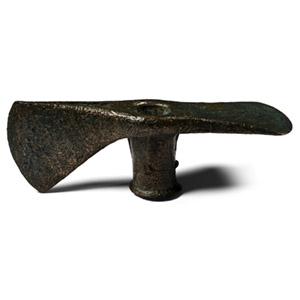
Large Luristan Socketted Bronze Adze
2nd-early 1st millennium B.C.Sold for (Inc. bp): £468
An adze-axe head with central shaft hole and curved blades, flange to socket. 570 grams, 16.5 cm
Acquired in the 1990s. Ex Abelita family collection. This lot is accompanied by an illustrated lot declaration signed by the Head of the Antiquities Department, Dr Raffaele D'Amato.
The adze-axe was a fundamental weapon of many Bronze Age cultures around the world. The form lends itself to dual purposes - for war and peace. As a tool, it functions in fabricating wood and as a weapon, its heavy mass and compact form make it a deadly striking and chopping weapon, even able to defeat light armour. -
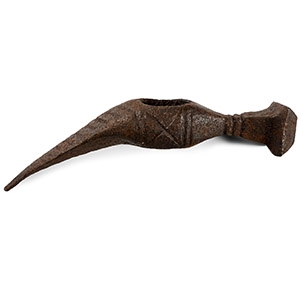
Tudor Period Renaissance Iron War Hammer
Western Europe, late 16th century A.D.Sold for (Inc. bp): £169
A (reiterhammer) head made as a single solid iron bar, one end shaped as a squared hammer and the other as a pointed curved spike; the head showing a strong quadrangular outline; the spike is a 'raven beak' shape of pointed section, oval socket with saltire cross flanked by two vertical lines on either side. 174 grams, 14.2 cm
From a North American collection formed in the 1970s-1990s. This lot is accompanied by an illustrated lot declaration signed by the Head of the Antiquities Department, Dr Raffaele D'Amato.
This war hammer is of the type used by European cavalry in the 16th century, represented in iconography (battle of San Romano, painting by Paolo Uccello of 1455 AD; portrait of Maurice of Saxony made in 1578 AD by Lucas Cranach the Younger) and showing parallels with similar examples in the Deutsches Historisches Museum in Berlin. Reiterhammers of this type are called ‘raven’s beak’ (bec de courbin) in the sources; the shaft was originally a wooden shank reinforced by metal shafts with one-handed handle, but in the later models, like our specimen, the astile could be entirely in metal, thinner than the wooden one, with guard and knob to better ensure the grip on the handle for a user wearing a glove. The war hammer was developed to counter the protection offered by plate armour, which made simple cutting weapons useless. In a military context dominated by the figure of the knight in plate armour, the sword lost its status as a weapon par excellence. The evolution of this offensive weapon ran in parallel with that of complete armour. When the latter developed ridges to limit the damage from thrusting hits, the war hammer gained prominence as a penetrating weapon. Weapons capable of concentrating a considerable force on a narrow target, a joint or a precise point of the armour proved to be more effective in the fray. As much as the mace of arms and the archer’s axe, the war-hammer became a decisive melee weapon for the knight. The weapon, descended from the East-Roman akouphion, began to be used by armoured knights in the 14th century, due to the need to better the axe and the mace of arms with a piece of equipment capable of inflicting injuries through armour. It reached its full development only at the end of the 15th century, but its wide use in the 16th century is widely documented by archaeological artefacts and iconography, like the one representing the battle of Dreux, in an engraving of 1588 AD, one of the first clashes of the Wars of Religion in France, where knights are visible fighting on horseback with such weapons in their hands. The war hammer was often visible in tournaments, and, much like sword hilts, war hammers became richly decorated with etching and gilding, often appearing to be works of art. However, they never lost their primary function as dangerous weapons (Edge-Miles Paddock, 1988, p.149). With the seventeenth century and the establishment of portable firearms (pistol and petronel) as weapons of the new heavy cavalry (Cuirassiers and Reiters) the war hammer disappeared from western battlefields. In Eastern Europe, its variants, such as the Polish nazdiak, remained in use among cavalry forces until the 18th century, when it finally fell into disuse along with the axe and mace, starting from the Napoleonic Wars, when the model of the horseman armed only with sabre and pistol became dominant.
