
Loading, please wait...
LOT 1114
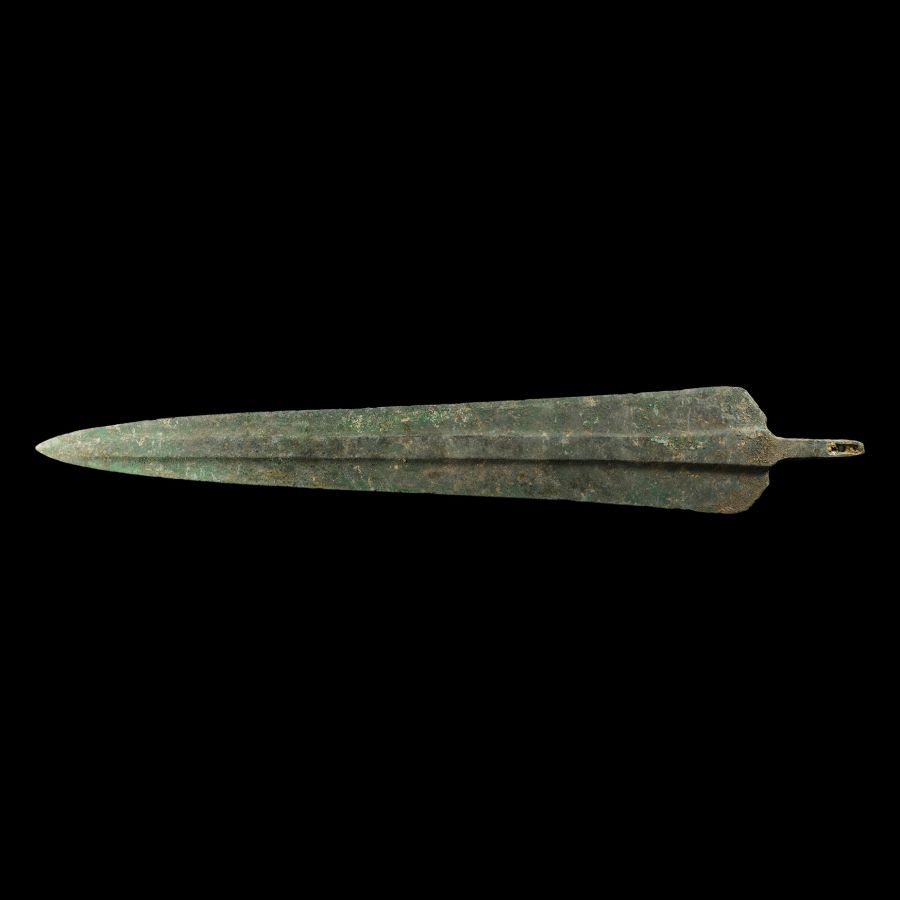
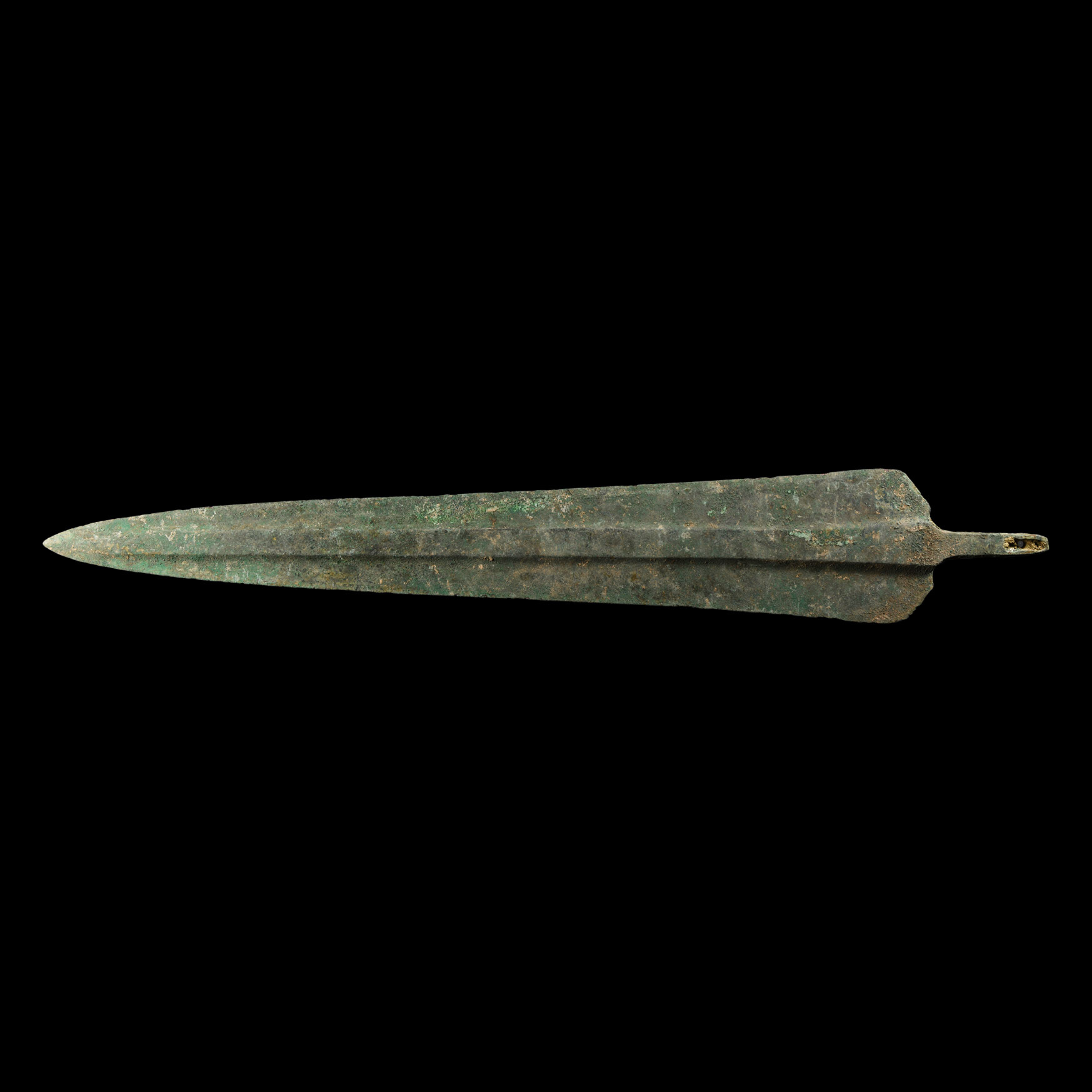
Luristan Bronze Short Sword Blade
EARLY 1ST MILLENNIUM B.C.
16 5/8 in. (472 grams, 42.2 cm).
Triangular with thick rectangular-section midrib, rounded shoulders, narrow tip, short tang with inserted fixing pin for the organic grip.
ProvenanceEx German collection, Cologne, 1980-1990s.
LiteratureCf. Christie's, The Axel Guttmann Collection of Ancient Arms and Armour, part 1, London, 2002, p.34, no.31.
FootnotesThis tanged bronze blade from Luristan belongs to a category of Luristan swords still in use in Achaemenid Period, as proved from a blade with a perished handle (probably bone or wood) of the same type, in the National Museum of Iran (2694/15633). Examples without inscriptions like our model have been classified by Grotkamp-Schepers in the Solingen Museum as pieces from Luristan.
CONDITIONTimeLine Auctions follows a vetting process to ensure the authenticity and legality of all items, reinforcing our commitment to integrity and responsible trading. Each antiquity, antique, and coin lot undergoes thorough examination by a vetting committee of at least ten external specialists, professional trade association members, scientists, and archaeologists: Our Vetting Process
AUCTIONS:
TimeLine is a leading auction house specialising in antiquities, ancient art, collectables, natural history, coins, medals, and books. Our auctions offer museums, collectors, historians, and enthusiasts the opportunity to acquire unique and historically significant pieces.
-
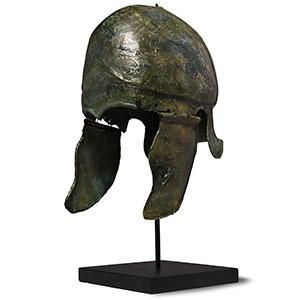
Greek Bronze Chalcidian Helmet
5th-4th century B.C.Estimate: £4,000 - 6,000 (+bp*)
Opening Bid: £1,667
Of Kunze Group VII, formed from two curved segments, each with a flared rim, nasal, raised panels to the upper section of the bowl, repoussé ridge forming curved brows, a recess for the ear to each side; star-shaped attachment to the top with slot for plumes; restored and with replica cheek pieces. 2.7 kg total, 42.5 cm high including stand
Restored, but in general good condition, rare details
Acquired in the 1970s. Ex private Austrian collection. The Kusmirek Collection, UK Accompanied by an academic report by Dr Raffaele D'Amato. Accompanied by a report of metallurgical analytical results, written by metallurgist Dr Brian Gilmour of the Research Laboratory for Archaeology and History of Art, University of Oxford. This lot has been checked against the Interpol Database of stolen works of art and is accompanied by search certificate number no.11763-203979.
Among the Chalcidian helmet types, the fifth and last typology, corresponding to the Kunze group VII (Pflug, 1988, p.138), was characterised by the presence of detached cheek-guards. By the end of the 5th century BC, the fixed cheek-pieces had been entirely abandoned on the Chalcidian helmets for the more versatile hinged cheek pieces. As is the case with most of the Greek helmets in 5th and 4th century B.C., very few originals have been found on the Greek continent. Several district regional workshops produced such helmets by the 5th century B.C.: mainland Greece, the Black Sea Coast, Thrace, Southern Italy and Iberia. -
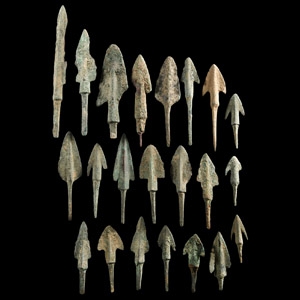
Luristan Bronze Arrowhead Group
2nd-1st millennium B.C.Sold for (Inc. bp): £208
Mainly composed of tanged arrowheads of barbed and leaf-shaped types, many with midribs. 178 grams total, 3.8-10.2 cm
Acquired 1990s. From the collection of a late Japanese weaponry collector. -
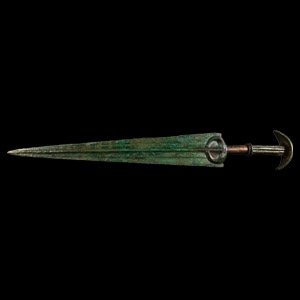
Marlik Bronze Short Sword with Crescentic Pommel
14th-10th century B.C.Sold for (Inc. bp): £1,300
Formed with a slender triangular blade, raised midrib with flat upper face, penannular guard and scooped shoulders, columnar grip with two gusseted hoops, the upper half of the grip is decorated with vertical lines, the lower part with horizontal grooves, crescent pommel; short sword or dagger. 430 grams, 44 cm
Ex Alexander Cotton collection, Hampshire, UK 1980s.
This short sword or dagger belongs to the category of blades with pennanular guard, with hilt and guard cast in one piece with the grip. This solid weapon has separate sets of encircling ribs on the grip. Negahban excavated similar weapons from the Marlik cemeteries, although sometimes the type combines grip and penannular guard with flanged hilts open to accept inlays.
