
Loading, please wait...
LOT 1062
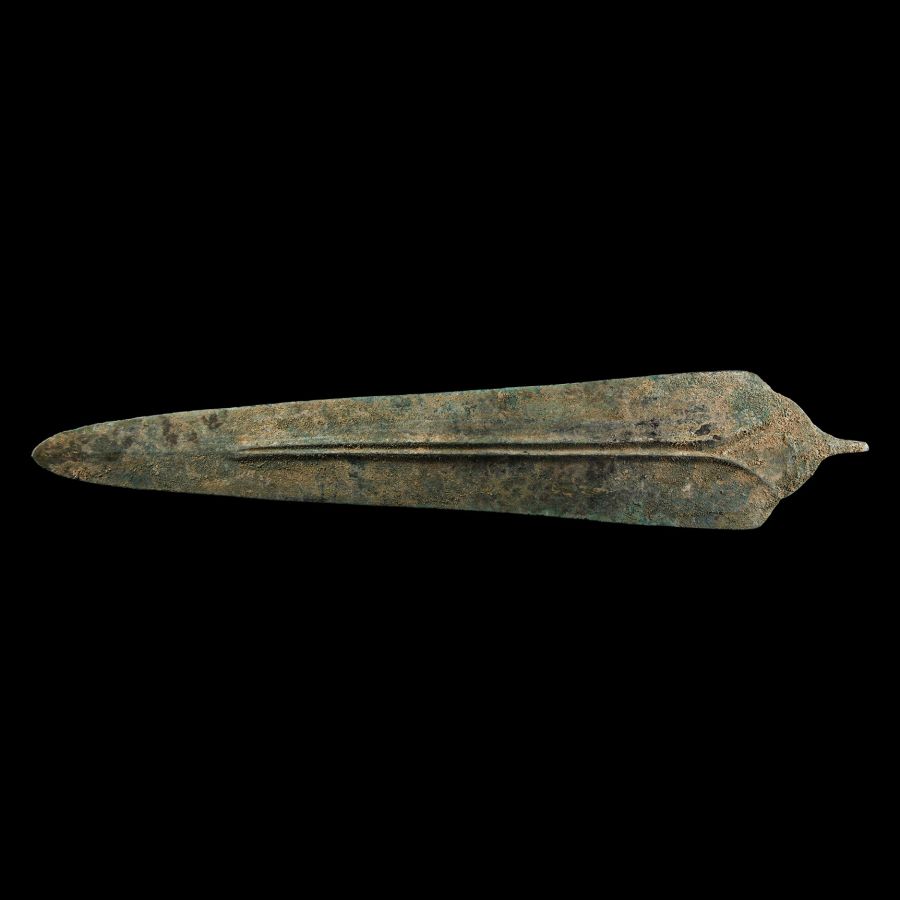
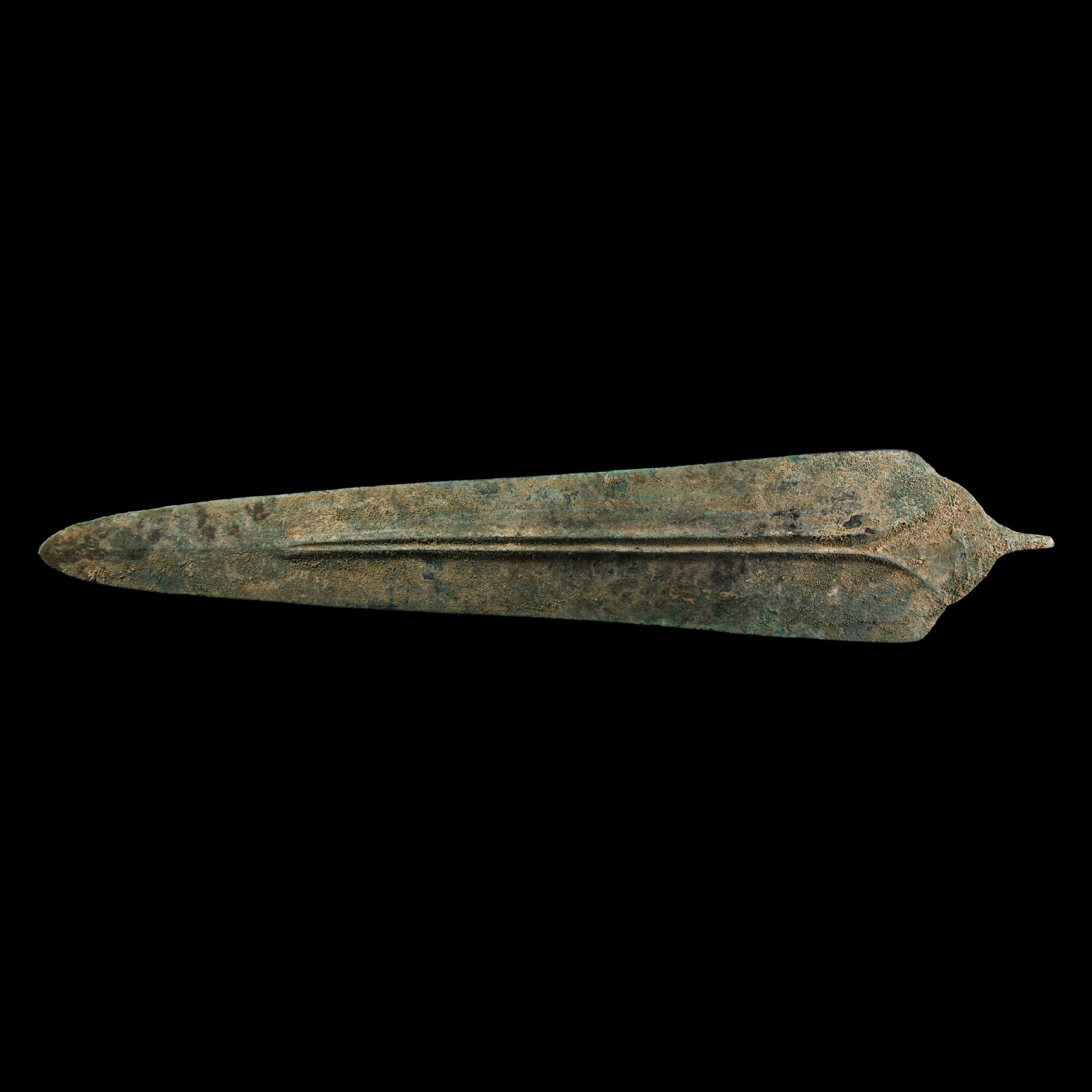
Luristan Bronze Short Sword Blade
1ST MILLENNIUM B.C.
12 in. (194 grams, 30.7 cm).
Triangular profile with two parallel fullers tapering to a rounded tip, the tang forming an extension of the midrib.
ProvenanceEx German collection, Cologne, 1980-1990s.
LiteratureCf. Christie's, The Axel Guttmann Collection of Ancient Arms and Armour, part 2, London, 2004, p.33, no.36.
FootnotesThe metalworking techniques used in making bronze weapons in Luristan were very complex. Surfaces were often finished in repoussé work, and some of the weapons were chased, others engraved.
CONDITIONTimeLine Auctions follows a vetting process to ensure the authenticity and legality of all items, reinforcing our commitment to integrity and responsible trading. Each antiquity, antique, and coin lot undergoes thorough examination by a vetting committee of at least ten external specialists, professional trade association members, scientists, and archaeologists: Our Vetting Process
AUCTIONS:
TimeLine is a leading auction house specialising in antiquities, ancient art, collectables, natural history, coins, medals, and books. Our auctions offer museums, collectors, historians, and enthusiasts the opportunity to acquire unique and historically significant pieces.
-
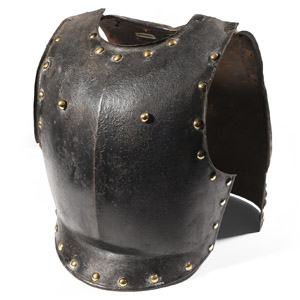
Post Medieval Spanish 'Conquistador' Cuirass Set
17th century A.D.Sold for (Inc. bp): £3,510
The breastplate with pronounced vertical rib and two rivets to front, roll at neck and splay at base with rivets to full perimeter, with inked accession numbers '21238A' (crossed through) and 'SDM - EW1' above '1931 - 30 - 6, a' and inked handwritten paper label reading 'Old Spanish Armour (Conquistador) / Found with remains of Spanish Galleon on / the estate of Leakin family (Georgia) coast. / about 1870. Refer to Trinity College Hertford Ct. / for information in Leakin family. / Given originally to Mrs Mark Howden (Hartford Ct.) / [ ] when I was 7 years old. / Luke W Lee 1944' in eight lines and also with chalked 'Old Spanish Armour / from Georgia 1944' inscription in two lines; the backplate generally matching but with vertical groove at centre and no splay at base, with inked accession numbers '31238B' (crossed through) and 'SDM - EW1' above '1951 - 30 - 6, b'. 3.3 kg, 42.5 cm high
From a Southern Californian museum, with accession numbers. Ex American collector. Acquired from TimeLine Auctions, UK, 2018, lot 181. The Kusmirek Collection, UK. This lot has been checked against the Interpol Database of stolen works of art and is accompanied by search certificate no.204020.
Trinity College, Hartford was founded in 1823; further research in their archives could provide more information on this cuirass set and the site of the 'Spanish galleon' shipwreck discovered in about 1870. -
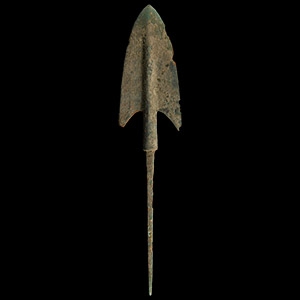
Luristan Bronze Barbed Arrowhead
2nd-1st millennium B.C.Sold for (Inc. bp): £46
Formed with a midrib and tapering rectangular-section tang. 31 grams, 15.5 cm
Acquired 1980-2015. Ex Abelita family collection. -
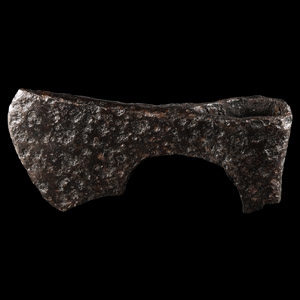
Viking Age Iron Bearded Axehead
9th-13th century A.D.Sold for (Inc. bp): £208
Finno-Ugrian with triangular-section blade widening to a broad bevelled edge with spur to the underside, socket with extended lower sleeve. 779 grams, 17.5 cm
Acquired 1971-1972. From the collection of the vendor's father. Property of a London, UK, collector.
During their struggles against Germans and Teutonic Knights, deceased pagans were often cremated along with damaged or ceremonially sacrificed weaponry. If swords were generally reserved for the military elite, the side axe was one of the most commonly used weapons.
