
Loading, please wait...


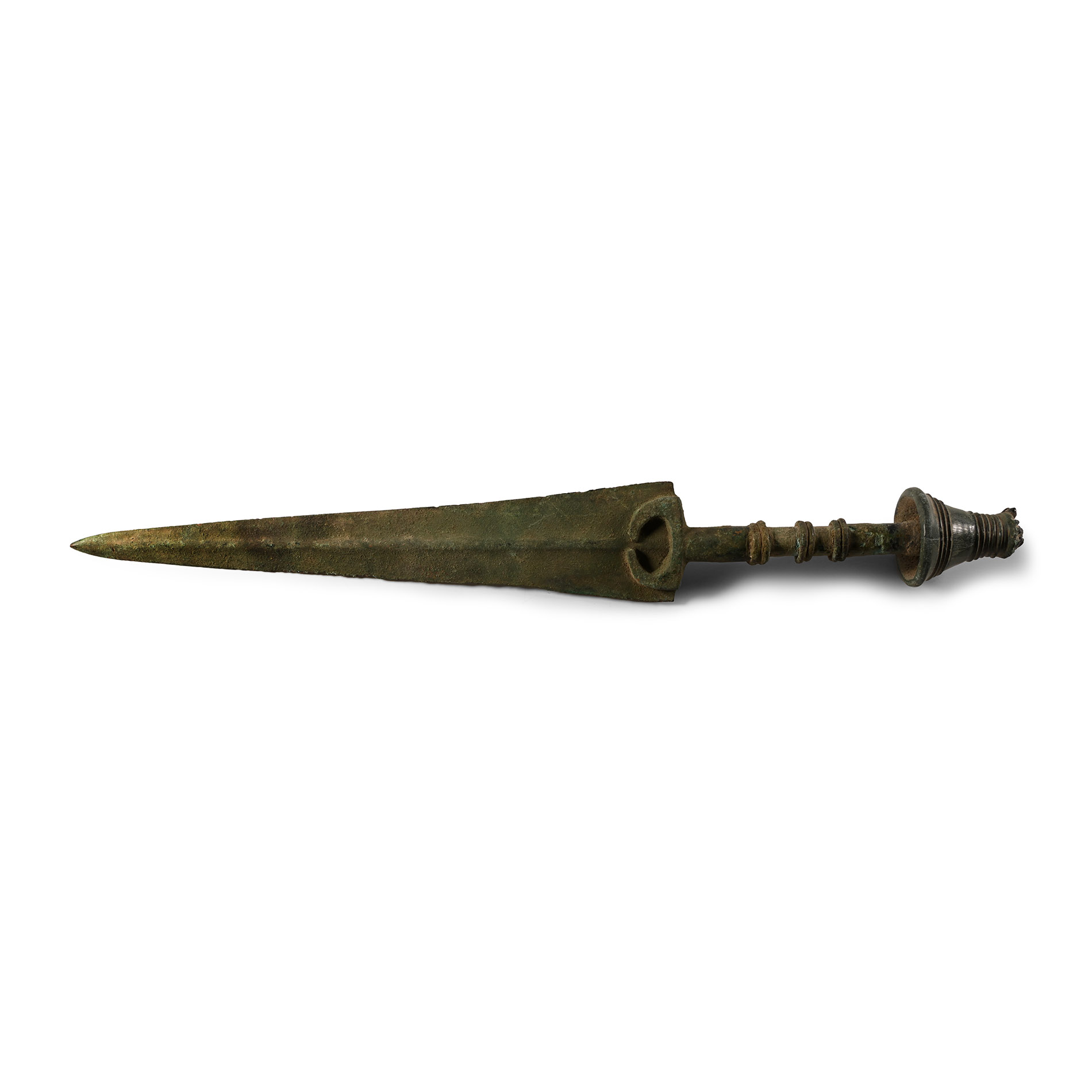
LOT 0301
Luristan Bronze Short Dagger with Integral Hilt
14TH-10TH CENTURY B.C.
16 3/4 in. (477 grams, 42.5 cm).
A short sword or dagger with slender triangular blade, low round midrib, penannular guard, scooped shoulders, columnar grip with three gusseted hoops, truncated-conical pommel decorated with parallel horizontal circles.
ProvenanceAcquired 1980-2015.
Ex Abelita family collection.
Cf. Khorasani, M.M., Arms and Armour from Iran. The Bronze Age to the End of the Qajar Period, Tübingen, 2006, items 42 and 43, for similar.
FootnotesThese kind of bronze daggers or dirks, typical of Marlik culture, were cast in a one piece mould according to Negahban, although in some specimens the penannular guard was later cast into the blade. The separate sets of encircling ribs on the grips are again typical of swords from the Marlik area.
CONDITIONTimeLine Auctions follows a vetting process to ensure the authenticity and legality of all items, reinforcing our commitment to integrity and responsible trading. Each antiquity, antique, and coin lot undergoes thorough examination by a vetting committee of at least ten external specialists, professional trade association members, scientists, and archaeologists: Our Vetting Process
AUCTIONS:
TimeLine is a leading auction house specialising in antiquities, ancient art, collectables, natural history, coins, medals, and books. Our auctions offer museums, collectors, historians, and enthusiasts the opportunity to acquire unique and historically significant pieces.
-
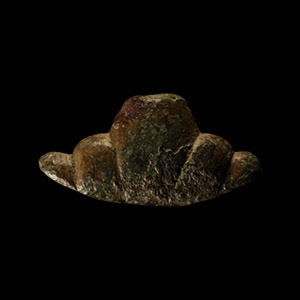
Anglo-Scandinavian Viking Bronze Five-Lobed Sword Pommel
Late 10th-early 11th century A.D.Sold for (Inc. bp): £442
Of Petersen's Type S (Wheeler Type III) with five graduated lobes; the lower face a swept arc; pierced through the tallest lobe to accept the tang of the sword's blade. 67 grams, 54 mm
Found Market Rasen, Lincolnshire Wolds, UK, 1970s. Property of Mr A.B., an American collector. -
.jpg)
Medieval Iron Axehead
15th-16th century A.D.Sold for (Inc. bp): £33
With square butt, scooped underside and a flared blade. 1.04 kg, 16 cm
Acquired on the UK market before 1992. Ex property of a North London gentleman. -
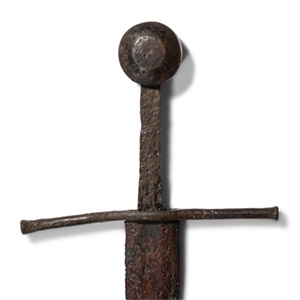
Medieval Iron Single-Handed Sword
Late 11th-13th century A.D.Sold for (Inc. bp): £1,950
Double-edged tapering blade with rounded point, shallow fuller and a parallel-sided lower guard (cross style 2), the grip gently tapering, discoid pommel of type I with chamfered sides. 1.2 kg, 1.01 m
From the private collection of a London gentleman, from his grandfather's collection formed before the early 1970s. Accompanied by an academic report by Dr Raffaele D'Amato. This lot has been checked against the Interpol Database of stolen works of art and is accompanied by search certificate number no.12177-221435.
The sword belongs to the type of ‘war swords’, although it is challenging to establish if it belongs to the type XI or type XII of Oakeshott's classification. It corresponds well with an English sword of type XI kept in the Tower Armoury (Dufty, 1974, plate 2, letter a), found in a peat bog near Newbury; but it also presents many characteristics of swords of type XII: it presents similarity to two swords excavated by Dr Jorma Leppaaho in 1950, from late Viking graves, one having a cross guard identical to our specimen and the other an identical pommel (Oakeshott, 1991, p.69, lett. V and VI); and another similar specimen is (a water find from Denmark) preserved in the Nationalmuseet of Copenhagen. In general the taper of the blade points more to the nature of the XII typology.
