
Loading, please wait...
LOT 0186
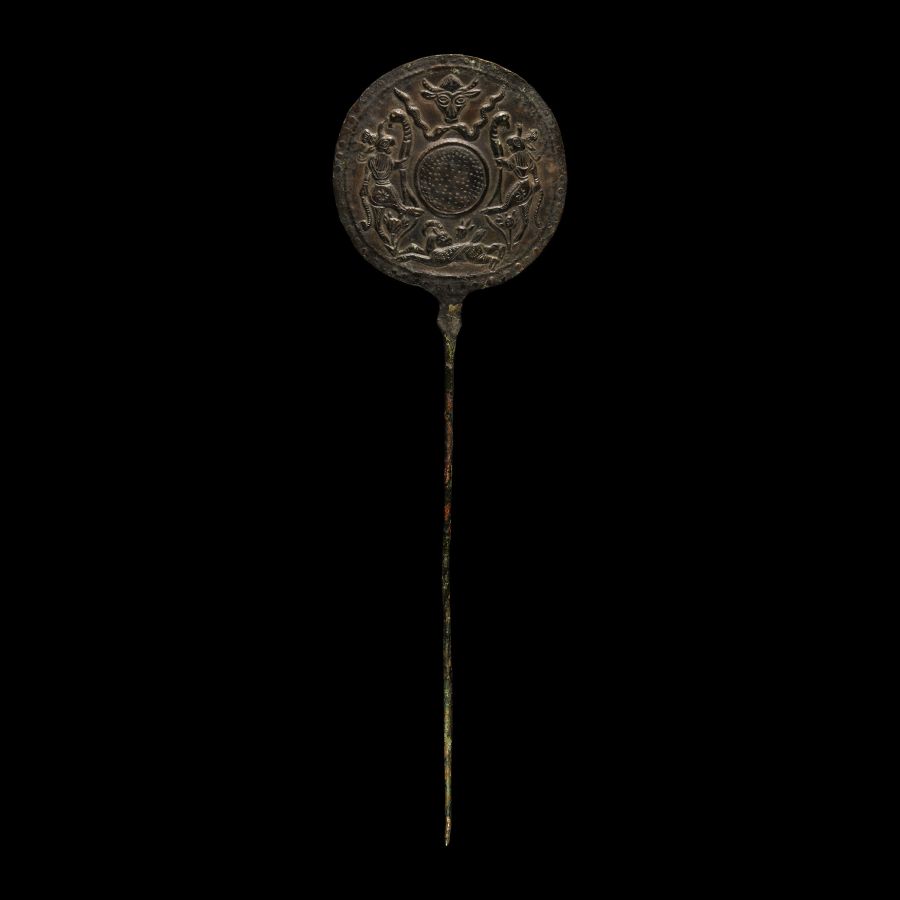
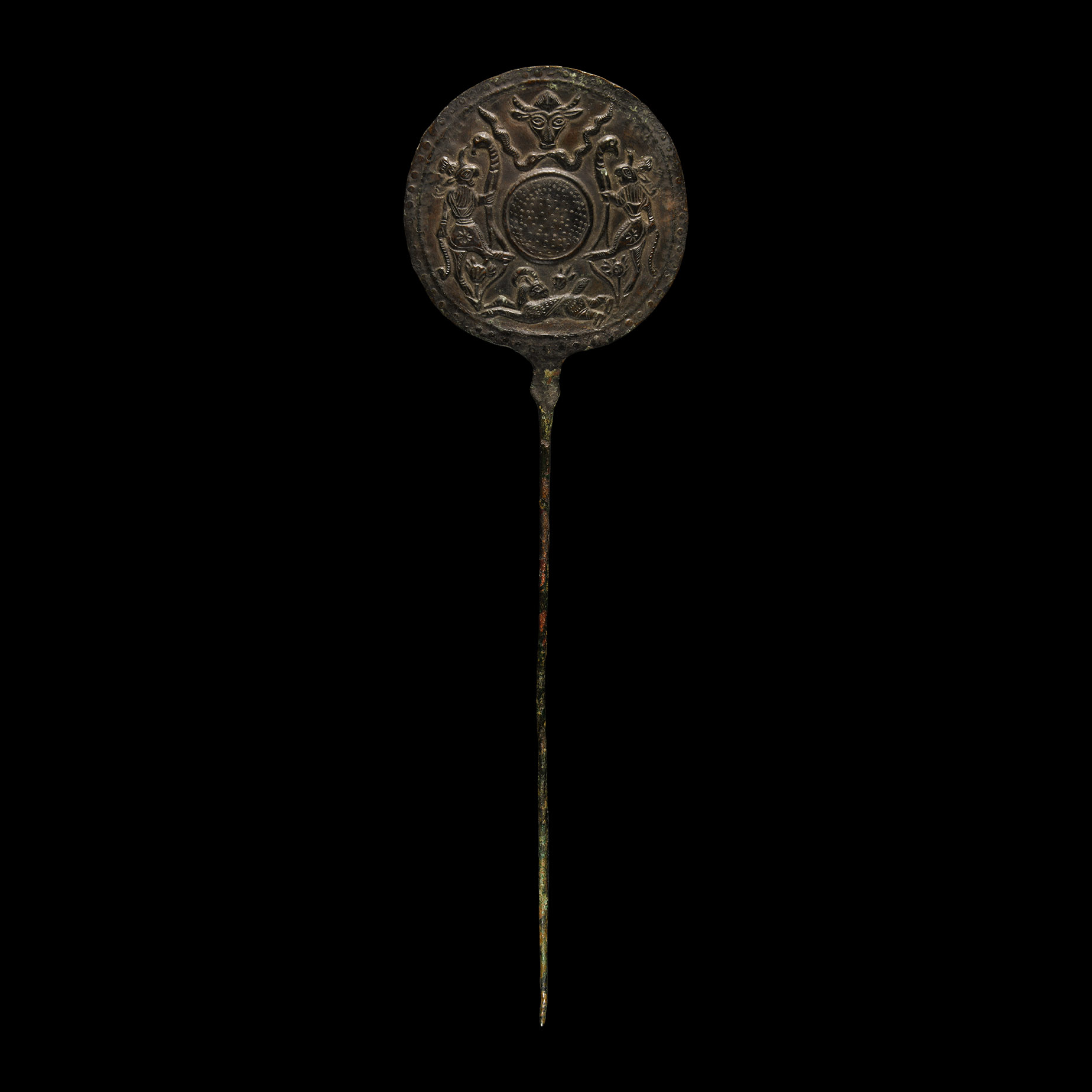
Luristan Bronze Pin with Sacrificial Scene
1ST MILLENNIUM B.C.
14 3/4 in. (157 grams, 37.5 cm).
Formed with a tapering round-section shaft and discoid head displaying a repoussé scene composed of a horned animal head over a pair of serpents, mythical hybrid creatures with bird heads and goat legs grappling with serpent-like birds, leaping goat at base, all framed by a pelletted roundel; mounted on a custom-made backing board with fabric covering.
ProvenanceFrom a London, UK, gallery, 1980s.
LiteratureSee Delanoe, B. et al., Bronzes du Luristan, Paris, 2008, pp.148-167, for type and discussion.
CONDITIONTimeLine Auctions follows a vetting process to ensure the authenticity and legality of all items, reinforcing our commitment to integrity and responsible trading. Each antiquity, antique, and coin lot undergoes thorough examination by a vetting committee of at least ten external specialists, professional trade association members, scientists, and archaeologists: Our Vetting Process
AUCTIONS:
TimeLine is a leading auction house specialising in antiquities, ancient art, collectables, natural history, coins, medals, and books. Our auctions offer museums, collectors, historians, and enthusiasts the opportunity to acquire unique and historically significant pieces.
-

Trans-Jordan Alabaster Astarte Figure
1st millennium B.C.Sold for (Inc. bp): £650
Carved in the round with semi-naturalistic features, standing nude with her hands clasped together below her bust, hair dressed on top and flowing down her back. 36.1 grams, 79 mm high
From an important collection formed pre 1988, Geneva and London, by descent. -
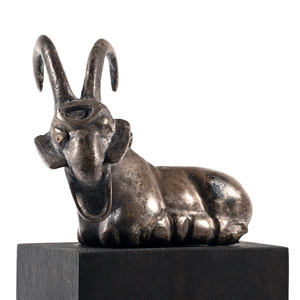
Proto-Elamite Silver Ibex Figurine
3rd millennium B.C.Sold for (Inc. bp): £7,800
Modelled in the round in a resting position with its legs folded underneath the body; the head turned to the left, large curving horns, applied glass paste for the eyes; small loop to the back; repaired and mounted on a custom-made display stand. 222 grams total, 14 cm (including base)
Ex private collection, 1960s-1970s. Accompanied by an academic report by Dr Raffaele D’Amato. Accompanied by a copy of metallurgic analytical results, written by metallurgist Dr Peter Northover (ex Department of Materials, Materials Science-Based Archaeology Group & Department of Materials, University of Oxford). This lot has been checked against the Interpol Database of stolen works of art and is accompanied by search certificate number no.11743-202215.
Like the silver-gilt mountain goat in the Boston Museum, it is possible that this figure originally had applied gilded elements. -
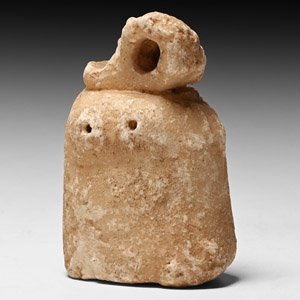
Tel Brak Type Alabaster Eye Idol
Circa 3rd millennium B.C.Sold for (Inc. bp): £234
Anthropomorphic eye idol, possibly of figurative female form, carved with a bell-shaped body, two 'breasts', remains of openwork 'eyes' above. 33.5 grams, 43 mm
Acquired 1969-1999. London collection of the late Mr S.M., thence by descent.
A classic artefact type from ancient Mesopotamia. Likely hand-carved using drills and string cutting. Eye idols were so named in the 1930s by the British archaeologist Max Mallowan. Whilst excavating a mound called Tel Brak, he discovered hundreds of anthropomorphic items of similar form, thus naming the mound 'Temple of the Eyes'.
