
Loading, please wait...
LOT 1407
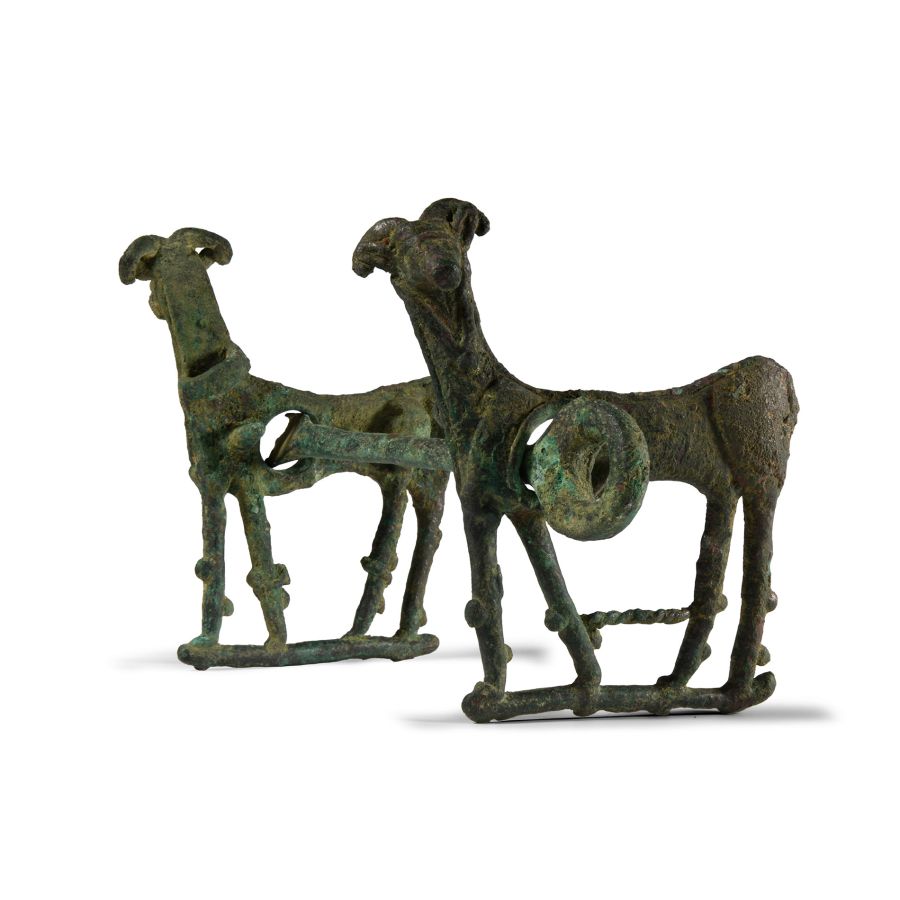
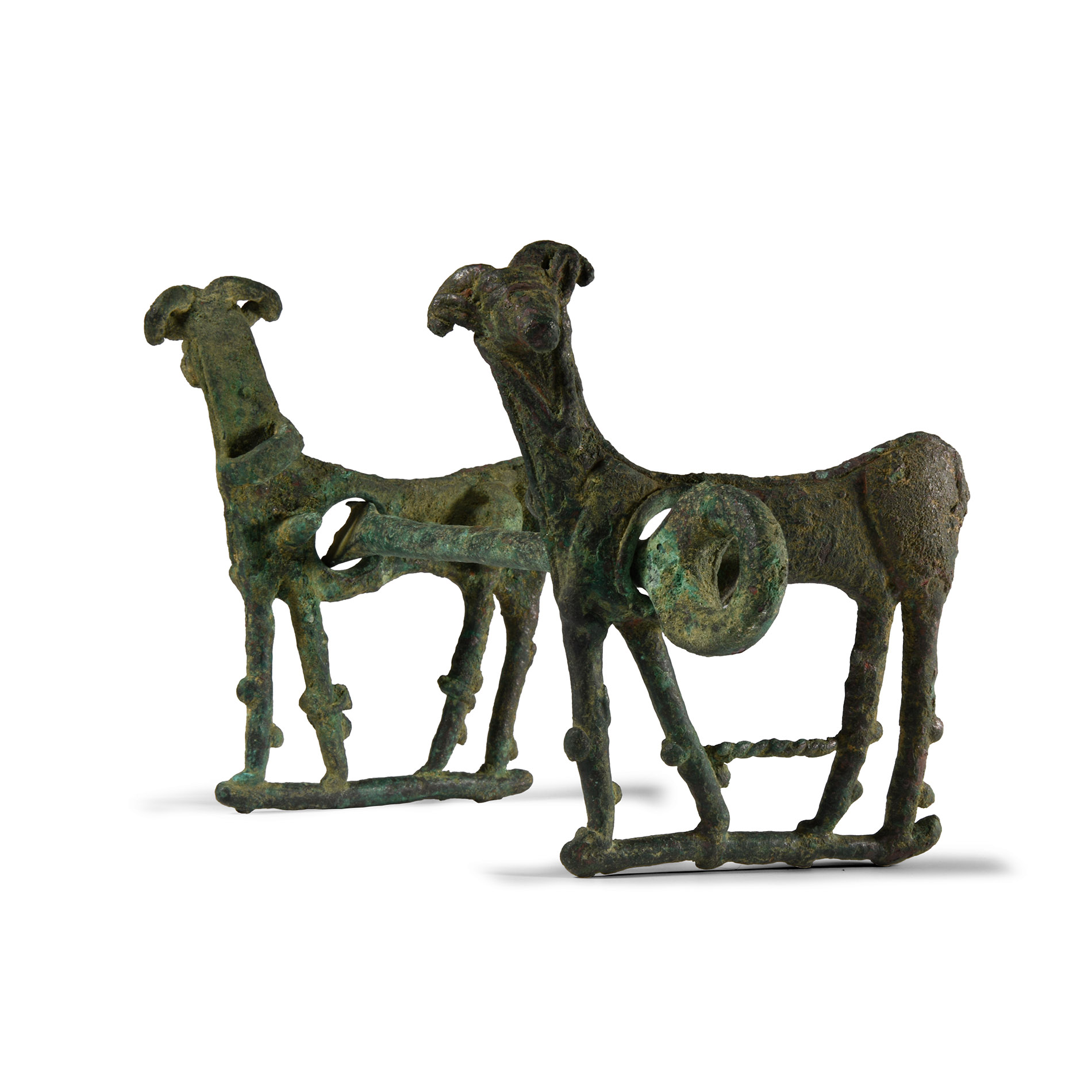
Luristan Bronze Horse Bit with Animals
CIRCA 11TH-7TH CENTURY B.C.
6 7/8 in. (690 grams, 17.5 cm wide).
Comprising a pair of ram-shaped cheek-pieces with a hole through the body for the straight mouthpiece with looped terminals.
ProvenanceFrom a collection formed in Paris in the 1990s.
LiteratureCf. similar horsebits in Moorey, P.R.S., Ancient Bronzes from Luristan, London, 1974, pls.VI-VII; Musee' Cernuschi, Bronzes de Luristan, enigmes de l'Iran Ancien, IIIe-Ier millenaire av. J.C., Paris, 2008, pp.110ff, nos.68ff, for similar types.
FootnotesThe horse bits were transformed by Luristan people in to expressions of applied art. Metalworkers employed animal motifs, both realistic and imaginary, for their cheek-pieces. The question of whether these horse bits were for real use or only for use in a funerary context is superfluous, as signs of wear have been documented, and the goads and loops on interiors are functionally designed. The use of such horse bits is clearly documented in Assyrian reliefs of the time of Sennacherib (705-681 B.C.).
CONDITIONTimeLine Auctions follows a vetting process to ensure the authenticity and legality of all items, reinforcing our commitment to integrity and responsible trading. Each antiquity, antique, and coin lot undergoes thorough examination by a vetting committee of at least ten external specialists, professional trade association members, scientists, and archaeologists: Our Vetting Process
AUCTIONS:
TimeLine is a leading auction house specialising in antiquities, ancient art, collectables, natural history, coins, medals, and books. Our auctions offer museums, collectors, historians, and enthusiasts the opportunity to acquire unique and historically significant pieces.
LOT 1407
Luristan Bronze Horse Bit with Animals
Estimate £1,000 - 1,400€1,160 - 1,620 (for guidance only)$1,350 - 1,890 (for guidance only)
-
.jpg)
Medieval 'Thames' Iron Dagger with Wood Handle
Circa 15th century A.D.Sold for (Inc. bp): £260
Sturdy single-edged triangular whittle-tang blade with thick back; with reproduction wooden handle. 137 grams, 34 cm
Found Billingsgate spoil from the Thames foreshore, London, UK, circa 1984. Property of an Essex collector. -
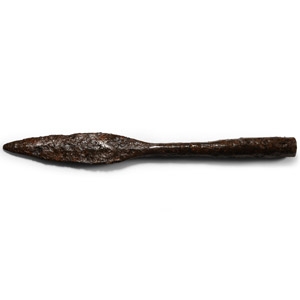
Anglo-Saxon Iron Socketted Spearhead
5th-7th century A.D.Sold for (Inc. bp): £208
Lentoid-section leaf-shaped blade with slender neck and long closed socket; Swanton's Group D1. 190 grams, 26 cm
Found near Wetwang, East Yorkshire, UK. Acquired circa 2005. Ian Wilkinson collection, Nottinghamshire, UK.
A small number of leaf-shaped blades measuring between some 16 and 28 cm in length are similar to the smaller leaf-shaped pieces of the Swanton series C, except that they tend to be more slender overall. The socket is always narrowly split up its entire length. -
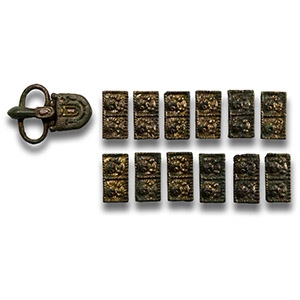
Byzantine Bronze Belt Fitting Set
6th-7th century A.D.Sold for (Inc. bp): £585
Comprising twelve rectangular plaques and a garnet inlaid buckle, each of the plaques with a pair of low-relief emperor's busts within a pelletted frame. 150 grams total, 35-61 mm
From the private collection of a London gentleman, from his grandfather's collection formed before the early 1970s.
