
Loading, please wait...
LOT 0301
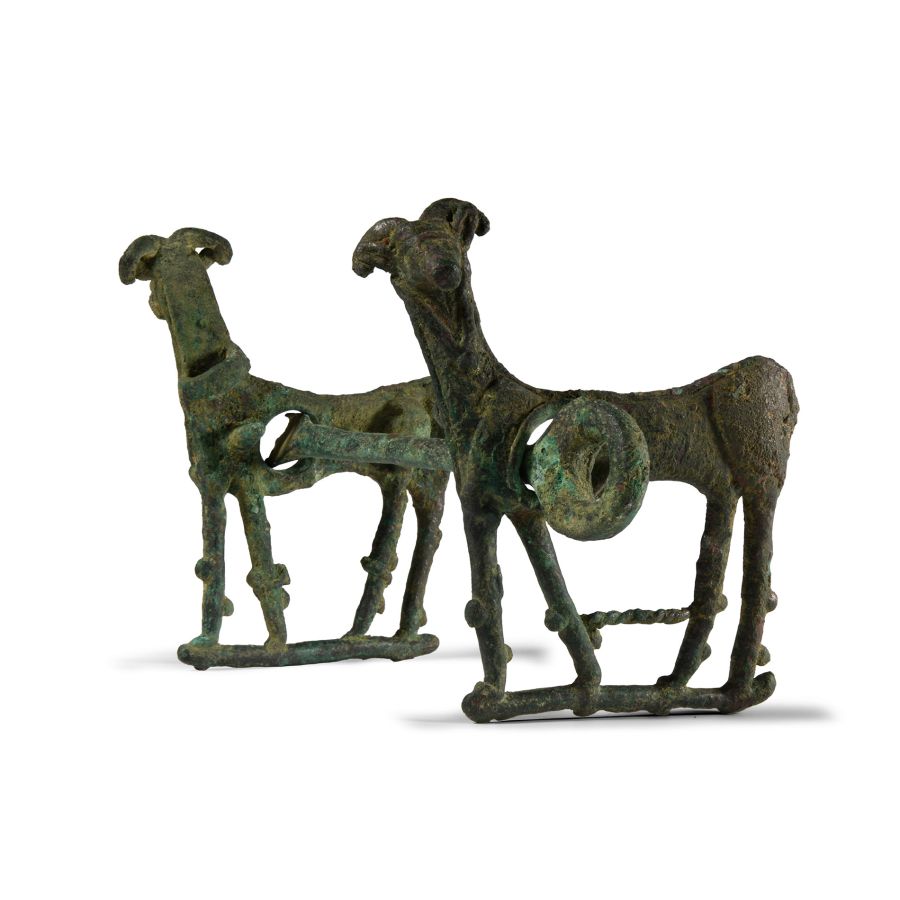
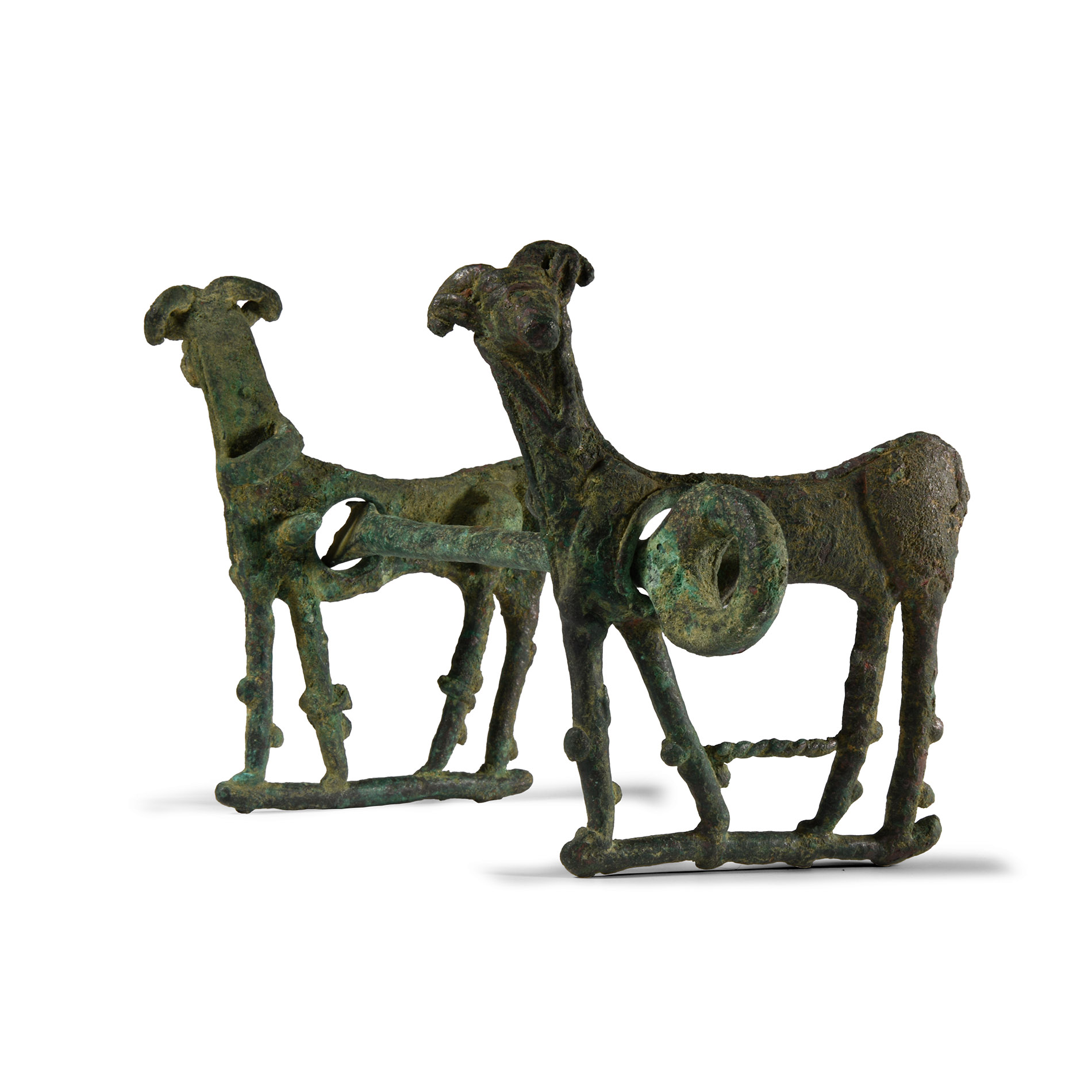
Luristan Bronze Horse Bit with Animals
CIRCA 11TH-7TH CENTURY B.C.
6 7/8 in. (690 grams, 17.5 cm wide).
Comprising a pair of ram-shaped cheek-pieces with a hole through the body for the straight mouthpiece with looped terminals.
ProvenanceFrom a collection formed in Paris in the 1990s.
LiteratureCf. similar horsebits in Moorey, P.R.S., Ancient Bronzes from Luristan, London, 1974, pls.VI-VII; Musee' Cernuschi, Bronzes de Luristan, enigmes de l'Iran Ancien, IIIe-Ier millenaire av. J.C., Paris, 2008, pp.110ff, nos.68ff, for similar types.
FootnotesThe horse bits were transformed by Luristan people in to expressions of applied art. Metalworkers employed animal motifs, both realistic and imaginary, for their cheek-pieces. The question of whether these horse bits were for real use or only for use in a funerary context is superfluous, as signs of wear have been documented, and the goads and loops on interiors are functionally designed. The use of such horse bits is clearly documented in Assyrian reliefs of the time of Sennacherib (705-681 B.C.).
CONDITIONTimeLine Auctions follows a vetting process to ensure the authenticity and legality of all items, reinforcing our commitment to integrity and responsible trading. Each antiquity, antique, and coin lot undergoes thorough examination by a vetting committee of at least ten external specialists, professional trade association members, scientists, and archaeologists: Our Vetting Process
AUCTIONS:
TimeLine is a leading auction house specialising in antiquities, ancient art, collectables, natural history, coins, medals, and books. Our auctions offer museums, collectors, historians, and enthusiasts the opportunity to acquire unique and historically significant pieces.
LOT 0301
Luristan Bronze Horse Bit with Animals
Estimate £1,500 - 2,000€1,740 - 2,320 (for guidance only)$2,030 - 2,700 (for guidance only)
-
Turco-Mongol Ceramic Fire Bomb or Hand Grenade
13th-15th century A.D.Sold for (Inc. bp): £182
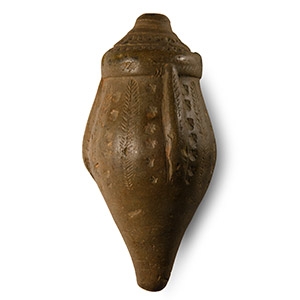
A hollow ceramic vessel with cylindrical body, carinated shoulder, short neck and domed mouth, bands of impressed herringbone patterns to the shoulder, waist and body, alternated with floral pattern around a groove; intended to be filled with explosive liquid and a wick, and used as a hand grenade. 520 grams, 17 cm
Acquired 1980-2015. Ex Abelita family collection. Accompanied by an academic paper by military specialist Dr Raffaele D'Amato, dated 15 July 2019 and titled 'Eastern Roman Empire - Greek Fire Bomb or Hand Grenade (μεσαίον kακάβιον) 9th-11th century AD'.
This piece was a sort of ceramic fire grenade, similar to the ones used by the Eastern Romans but of Turco-Mongol type. Apart from the use of manual flame-throwers, special corps of soldiers employed terracotta grenades, in the form of small jars, abundantly evidenced in archaeological excavations. -
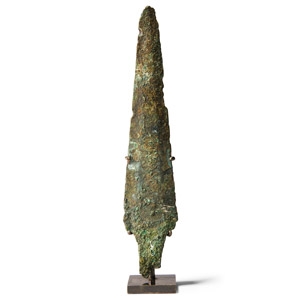
Western Asiatic Bronze Dagger
2nd millennium B.C.Estimate: £100 - 140 (‡+bp*)
Opening Bid: £50
With a narrow pointed blade and wide raised flange down centre, straight sides, well marked shoulders with narrow tang, one hole for rivet. 128 grams total, 17.6 cm high including stand
From the possessions of a member of a German princely family, gathered in the late 19th century, until the 1930s. with Auction House CUSP, Vienna, Auction Antique Art from Asia and from the Eastern Mediterranean, 16 June 2012, lot 75 [Part].
The type was technically more advanced than previous types of blades in the Near East, owing to the shape of the weapon, with its slightly convex sides widening out near the point, which combined the advantages of the leaf-shaped and straight-sided forms. -
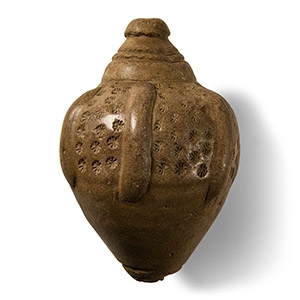
Byzantine 'Greek Fire' Ceramic Fire Bomb or Hand Grenade
9th-11th century A.D.Sold for (Inc. bp): £176
Piriform body with thick ribs to the shoulder and impressed panels between, domed filler-hole, intended to be filled with explosive liquid and wick, used as a hand grenade. 708 grams, 15 cm
Acquired 1980-2015. Ex Abelita family collection. Accompanied by an academic paper by military specialist Dr Raffaele D'Amato, dated 15 July 2019 and titled 'Eastern Roman Empire - Greek Fire Bomb or Hand Grenade (μεσαίον kακάβιον) 9th-11th century AD'.
Apart from the use of siphons or manual flame-throwers called cheirosiphona, special corps of Roman soldiers employed terracotta grenades, in the form of small jars, abundantly evidenced in archaeological excavations. They were called μεσαία kακαβιά or κυτροκακάβια where the former had a bulbous shape and the latter a more cylindrical form.
