
Loading, please wait...
LOT 0220
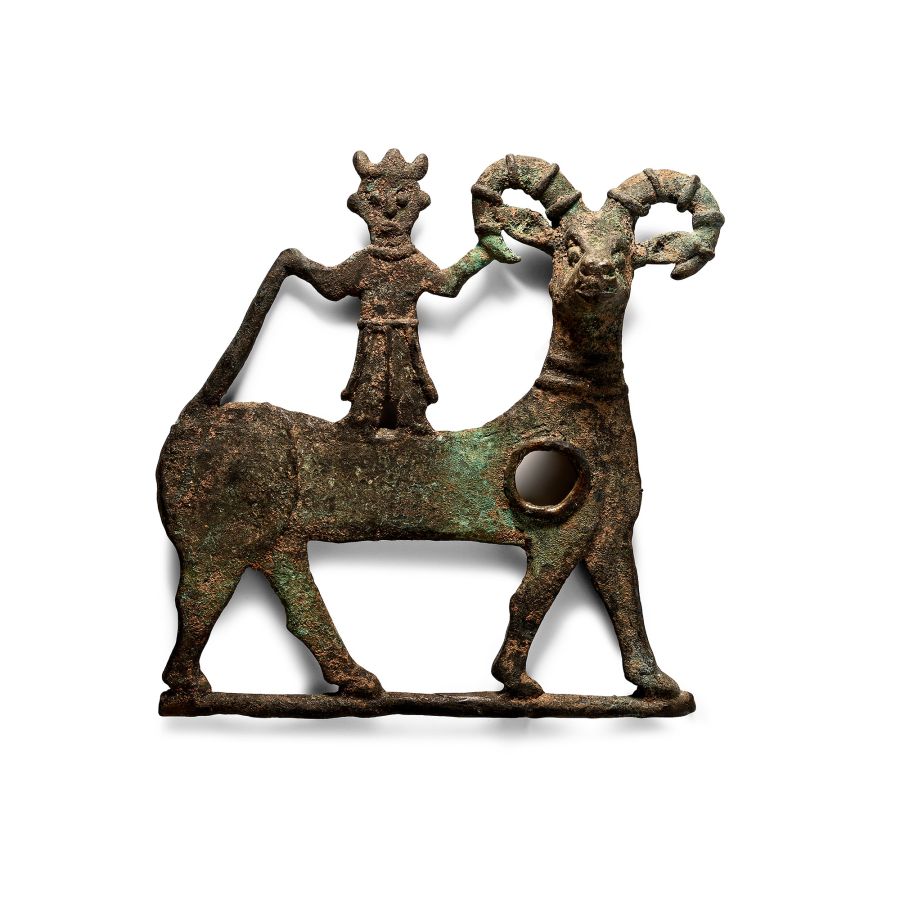
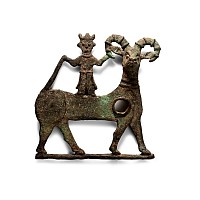
Luristan Bronze Horse Bit Cheek-Piece with Master of Animals
8TH–7TH CENTURY B.C.
5 in. (7 1/4 in.) (212 grams, 12.7 cm (601 grams total, 18.4 cm including stand)).
Formed as an advancing ram on a baseline with head turned to face the viewer, applied collar, standing human figure holding the tail; circular hole to the shoulder to accept the bit; mounted on a display stand.
ProvenanceA.P. family collection, Europe, from 1969, partly transferred to the United Kingdom in 1981.
London art market, after 2000.
This lot has been checked against the Interpol Database of stolen works of art and is accompanied by search certificate number no.12974-245211.
Cf. similar in Moorey, P.R.S., Ancient Bronzes from Luristan, London, 1974, pls.VI-VII.
FootnotesHorse equipment was an important symbol of status and power in the Iron Age Near East. Elaborate bits with decorated cheek-pieces were not only practical items for controlling horses but also served a display function, reflecting the wealth and rank of their owners.
CONDITIONTimeLine Auctions follows a vetting process to ensure the authenticity and legality of all items, reinforcing our commitment to integrity and responsible trading. Each antiquity, antique, and coin lot undergoes thorough examination by a vetting committee of at least ten external specialists, professional trade association members, scientists, and archaeologists: Our Vetting Process
AUCTIONS:
TimeLine is a leading auction house specialising in antiquities, ancient art, collectables, natural history, coins, medals, and books. Our auctions offer museums, collectors, historians, and enthusiasts the opportunity to acquire unique and historically significant pieces.
LOT 0220
Luristan Bronze Horse Bit Cheek-Piece with Master of Animals
Estimate £2,000 - 3,000€2,320 - 3,480 (for guidance only)$2,700 - 4,050 (for guidance only)
-
.jpg)
Sasanian Chalcedony Stamp Seal with an Ibex
5th century A.D.Sold for (Inc. bp): £117
Domed body with a large suspension hole to the centre, underside with a reclining ibex, long curving horns extending to the rump. 14.9 grams, 26 mm
UK private collection before 2000. Acquired on the UK art market. Ex property of a London gentleman. -
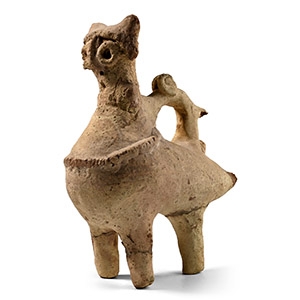
Western Asiatic Painted Bird Vessel
8th-9th century A.D.Estimate: £200 - 300 (+bp*)
Opening Bid: £100
Hollow-formed piriform body with three columnar legs, strap handle with applied detailing and applied collar, tapering neck and strigine head with applied loops to the eyes. 442 grams, 17 cm high
UK collection, 1990s. Acquired on the UK art market, before 2000. Private collection, Mr M.V., a London-based businessman. -
.jpg)
Western Asiatic Mixed Bead Necklace String
1st millennium B.C. and laterSold for (Inc. bp): £39
Restrung designer necklace string of ceramic and stone beads of mainly oblate form, central feature a large cylindrical and annular bead; restrung. 27.7 grams, 30 cm
Acquired 1980-2015. Ex Abelita family collection.
