
Loading, please wait...
LOT 0242
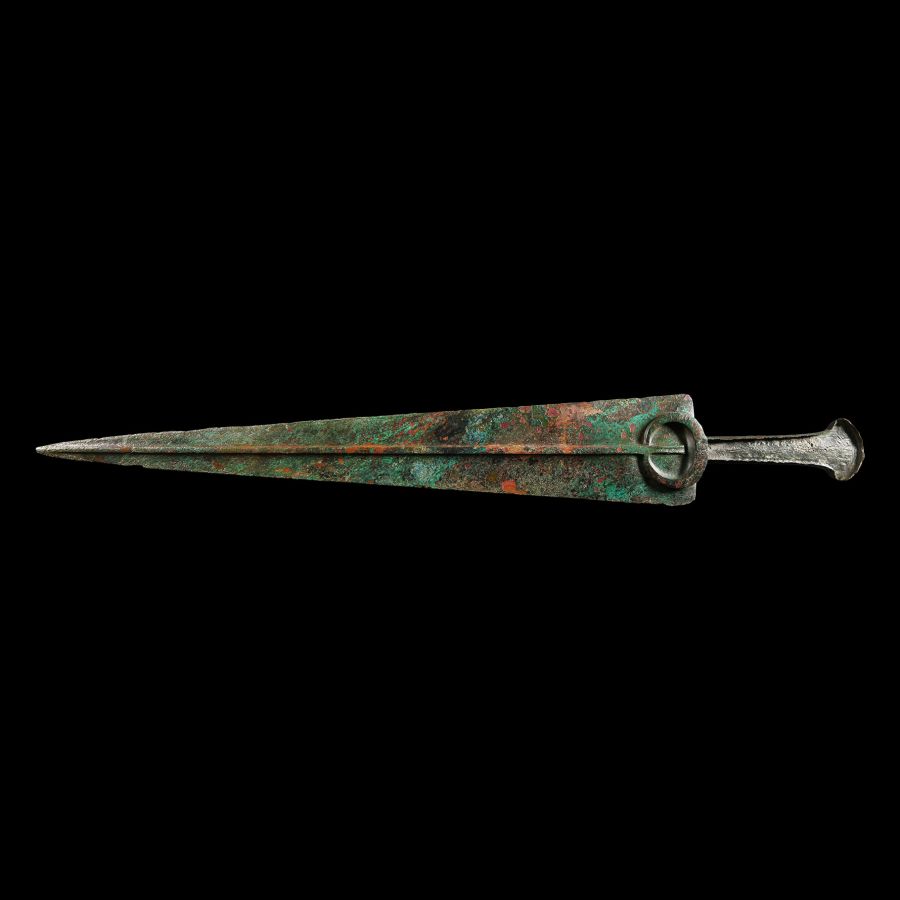
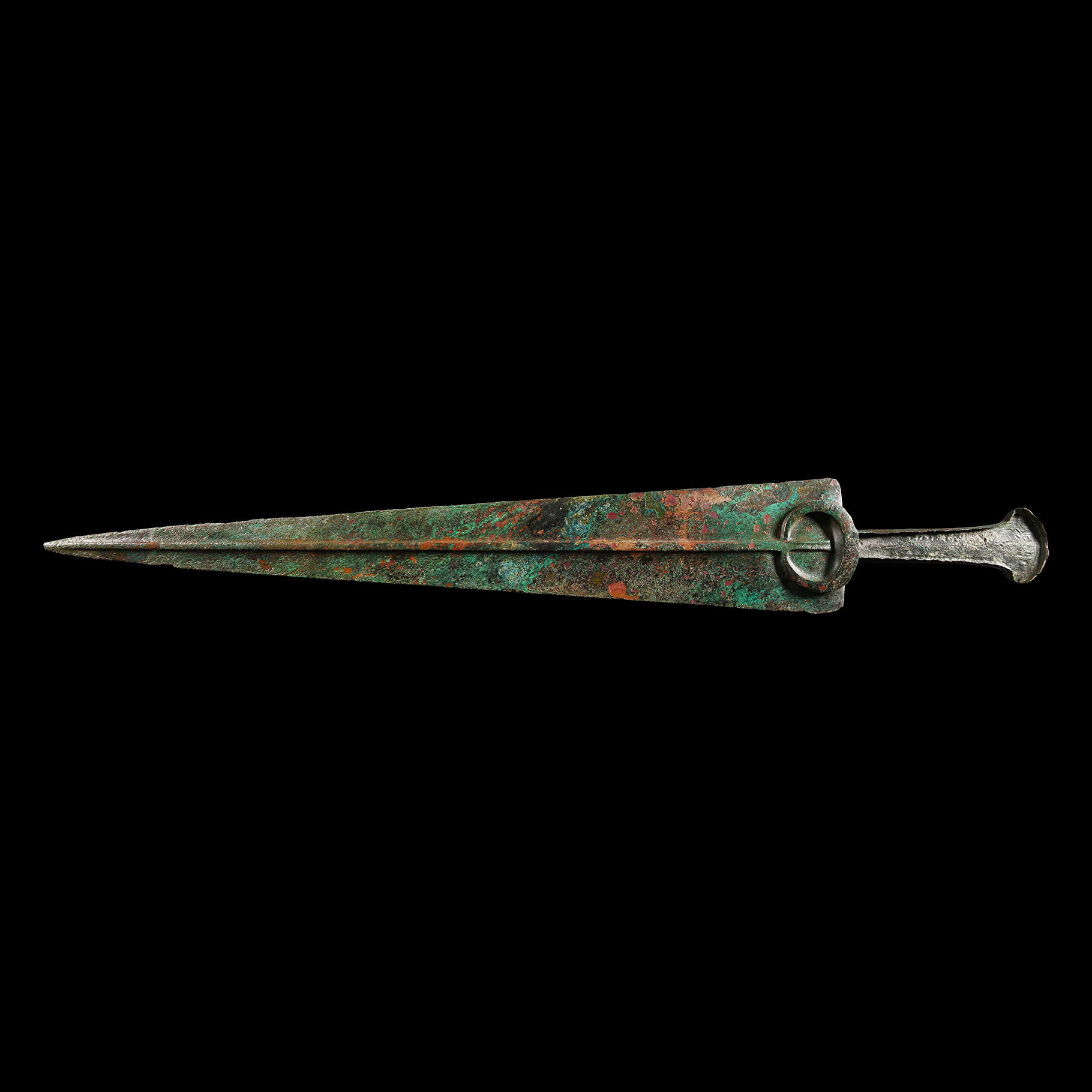
Luristan Bronze Hilted Dirk
CIRCA 1000 B.C.
18 3/4 in. (363 grams, 47.5 cm).
The blade with a tapering profile, triangular in overall form, with square shoulders, penannular guard with strong midrib, flanged hilt with straight grip, widening slightly into a fan-shaped pommel.
ProvenanceAcquired from Alan Cherry, Bournemouth, UK.
Ex Alexander Cotton collection, Hampshire, UK 1980s.
Cf. similar sword in Khorasani, M.M., Arms and Armour of Iran, Germany, 2006, cat.12, for similar example in the National Museum of Iran in Tehran.
FootnotesThese types of short sword or dirks were usually cast in one piece, and the penannular rib in relief was cast on at the same time with the handle of the blade. In some cases, however, the penannular rib was later cast on the dagger, possibly to strengthen a weak point at the junction of hilt and blade. The flanged hilt was originally filled with organic material like bone.
CONDITIONTimeLine Auctions follows a vetting process to ensure the authenticity and legality of all items, reinforcing our commitment to integrity and responsible trading. Each antiquity, antique, and coin lot undergoes thorough examination by a vetting committee of at least ten external specialists, professional trade association members, scientists, and archaeologists: Our Vetting Process
AUCTIONS:
TimeLine is a leading auction house specialising in antiquities, ancient art, collectables, natural history, coins, medals, and books. Our auctions offer museums, collectors, historians, and enthusiasts the opportunity to acquire unique and historically significant pieces.
-
.jpg)
Large Byzantine Silver Archer's Ring
14th-15th century A.D.Estimate: £600 - 800 (+bp*)
Opening Bid: £240
Comprising a hoop with reserved triangular ornament on the edges and triangular plaque with foliage motifs, raised central panel with frond motif. 22.61 grams, 34.77 mm overall, 25.16 mm internal diameter
Acquired in the 1990s. Ex Cambridgeshire, UK, collection.
Archer rings in Late Byzantium and the medieval Balkans were connected with the employment of the powerful composite bow, but very often, in the 14th century they served as insignia of rank for aristocratic noblemen. Archaeological findings of archers’ rings originate mainly from fortified towns, including mining centres. Many were made in bone, simple in design and undecorated. In contrast, the ones made in bronze and silver were usually decorated in rather uniform style, consisting of floral motifs on the head, mostly tulip and foliage, and linear motifs around the edges. This decoration combined Turkish, Central European and Eastern Roman traditional patterns. -
.jpg)
French WWII 'Donkey Ears' Trench Periscope
1940s A.D.Sold for (Inc. bp): £143
Aluminium bodied binocular trench periscope with green finish, fitted with folding handle and leather neck strap; with original leather case fitted with shoulder strap and belt/webbing loop. 1.69 kg, 29.5 cm
The Kusmirek Collection, UK. -
Roman Provincial Iron Spur Group
2nd-3rd century A.D.Sold for (Inc. bp): £143
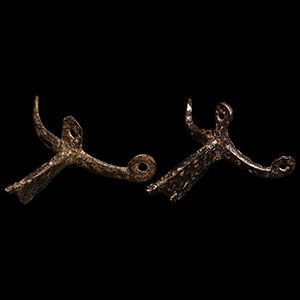
With central barbed spike positioned under the pierced central hole, fitted on both sides with arms having circular shaped eyelet-like protuberances. 29.6 grams total, 54-62 mm
Acquired on the German art market around 2000. From the collection of a South African gentleman.
The prick spur was the first type of spur to be invented, and it consists of a goad or prick, more or less pointed, connected to side arms or a heel plate. They went around the rider’s heel and had a straight post on the back that was used to cue the horse. Often this was sharp, obviously intended to prick the horse, The type here represented seems to be a provincial variant of Roman Imperial prick spur fitted with three eyelets.
