
Loading, please wait...
LOT 0244
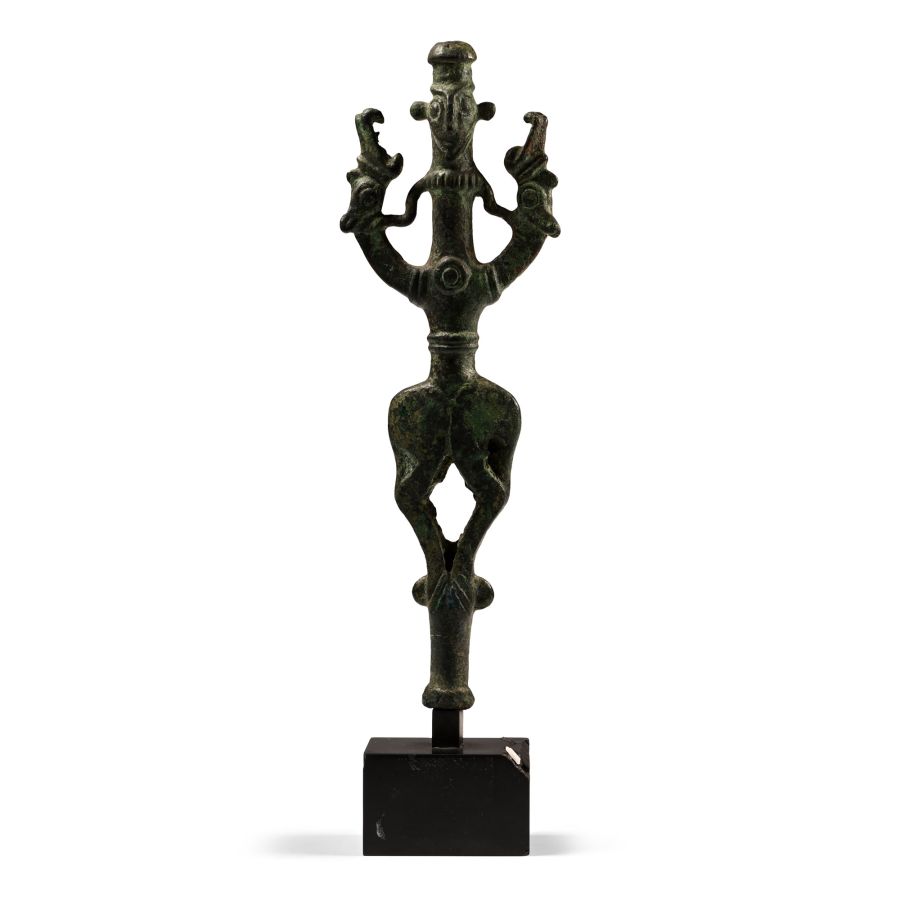
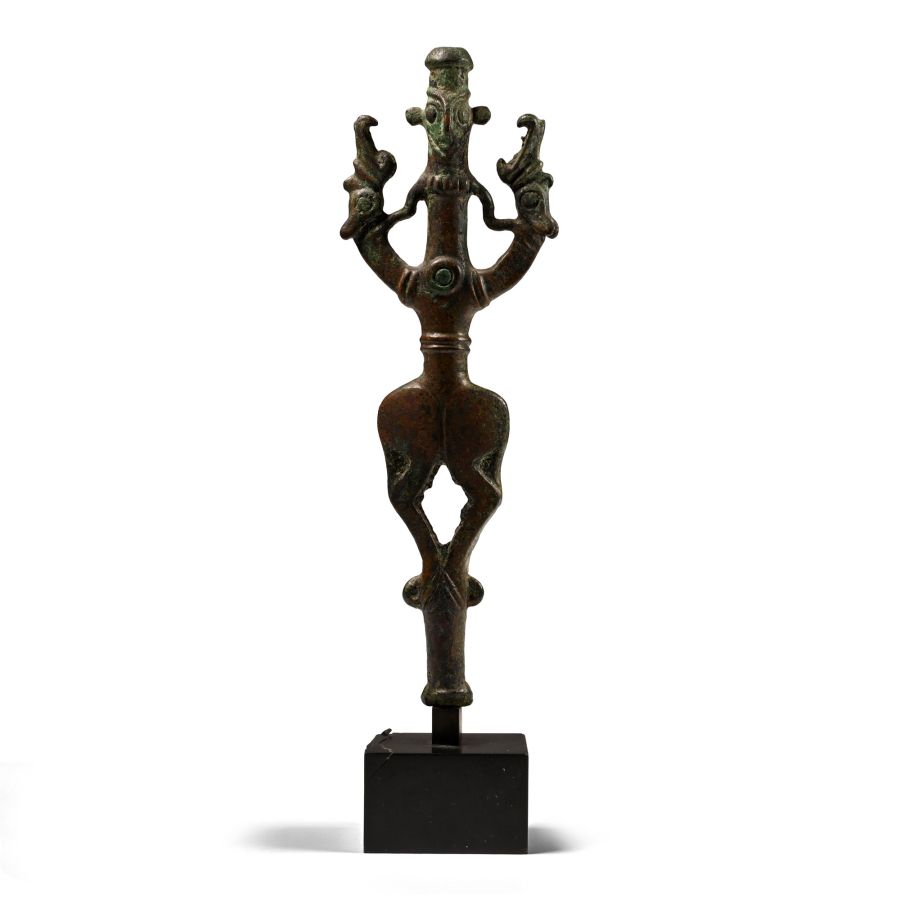
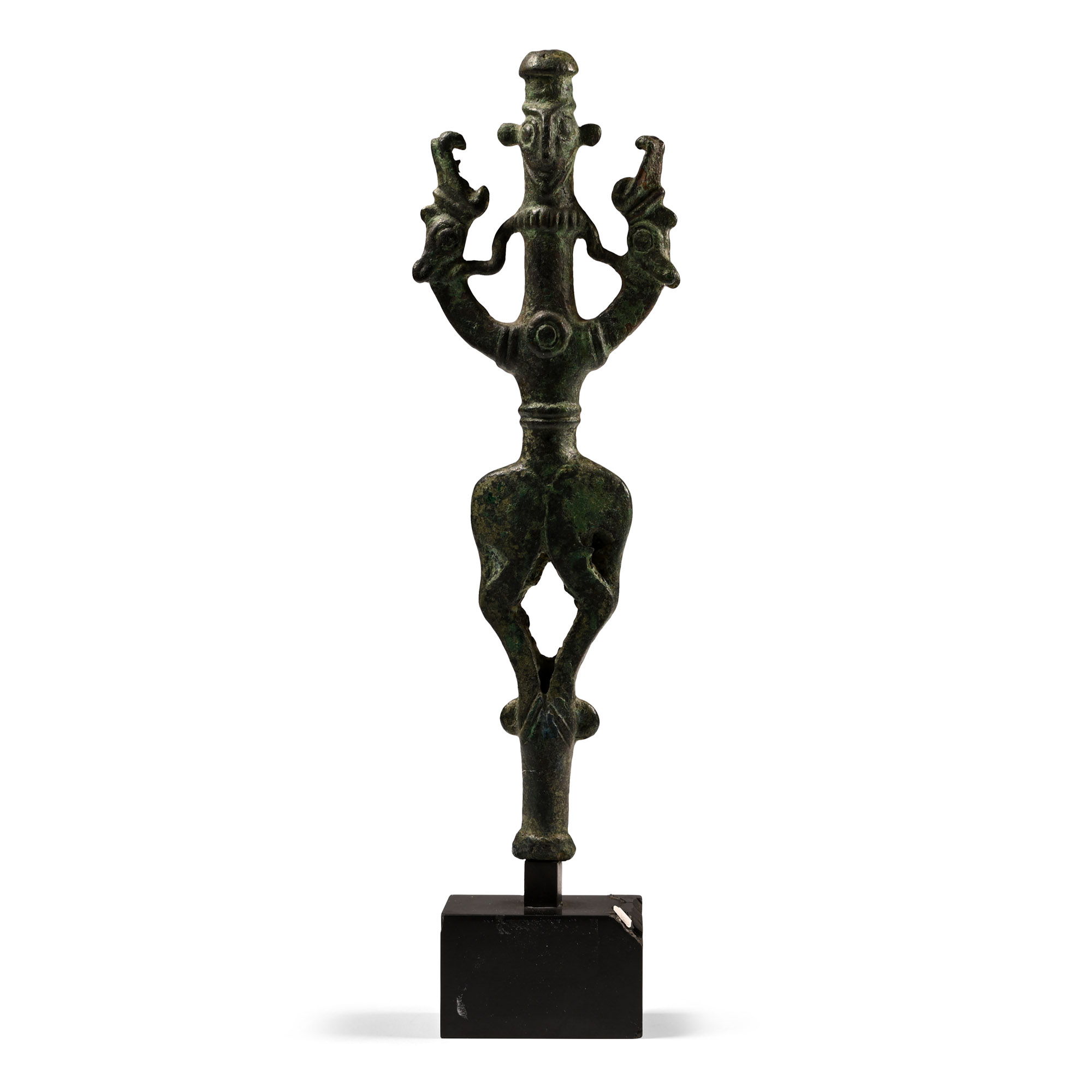
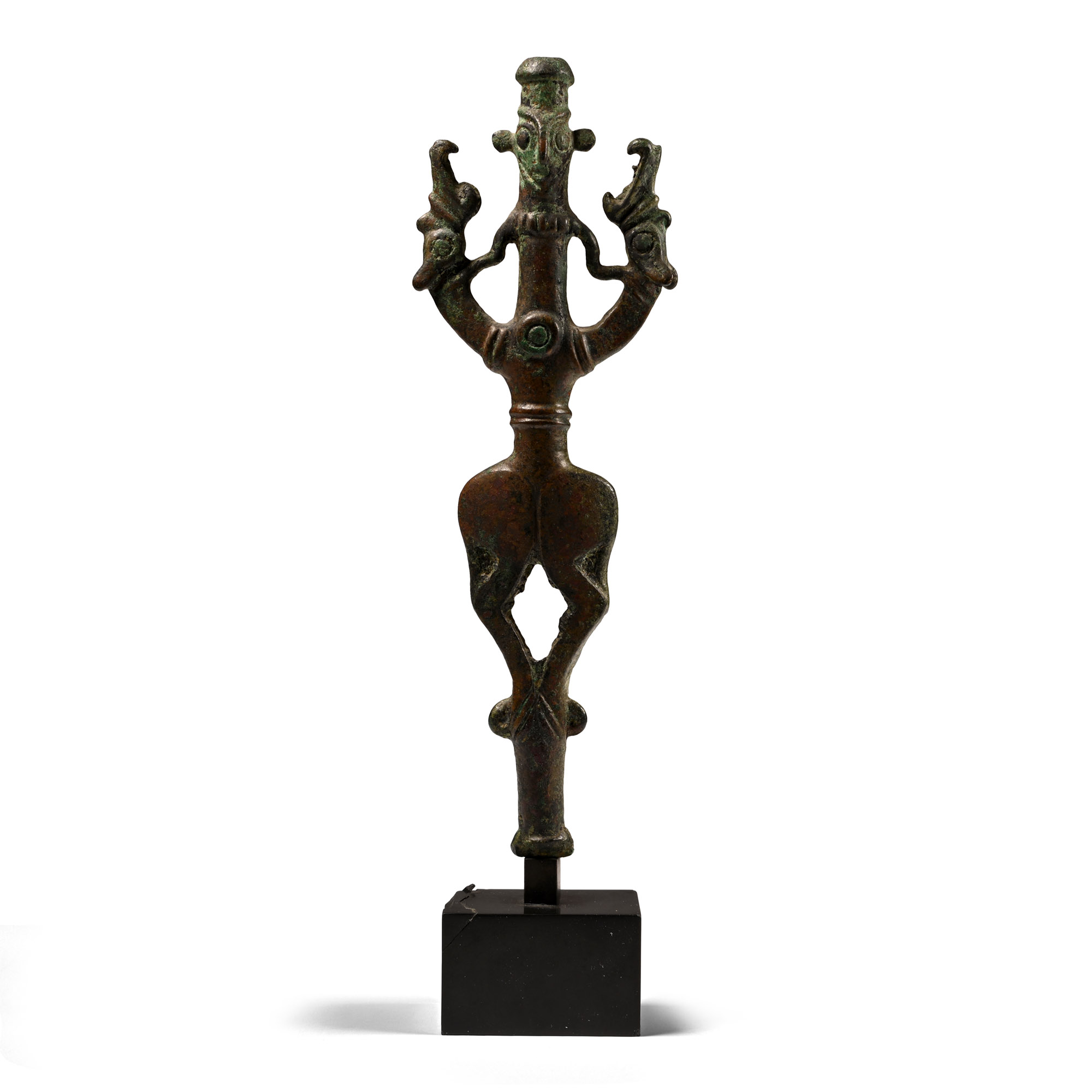
Luristan Bronze Finial with Master of Animals
8TH-7TH CENTURY B.C.
7 3/4 in. (213 grams total, 19.7 cm including stand).
A bifacial sceptre head formed as a 'Master of Animals' atop a collared tubular stem, comprising two slender crescentic arms representing slender beasts with ridged backs and roaring mouths, each in the grip of the Master standing crowned between them; the Master with tubular body, animal-like ears, prominent nose above a small mouth and wearing a neck ring and domed headdress; mounted on a display stand.
ProvenanceEx Capitaine Patrick Pakenham, Geneva, Switzerland, acquired in the 1960s-1970s, thence by succession.
Private collection.
This lot has been cleared against the Art Loss Register database, and is accompanied by an illustrated lot declaration signed by the Head of the Antiquities Department, Dr Raffaele D'Amato.
Cf. Godard, F., The Art of Iran, London, 1965, fig.19, for similar.
CONDITIONTimeLine Auctions follows a vetting process to ensure the authenticity and legality of all items, reinforcing our commitment to integrity and responsible trading. Each antiquity, antique, and coin lot undergoes thorough examination by a vetting committee of at least ten external specialists, professional trade association members, scientists, and archaeologists: Our Vetting Process
AUCTIONS:
TimeLine is a leading auction house specialising in antiquities, ancient art, collectables, natural history, coins, medals, and books. Our auctions offer museums, collectors, historians, and enthusiasts the opportunity to acquire unique and historically significant pieces.
LOT 0244
Luristan Bronze Finial with Master of Animals
Estimate £1,500 - 2,000€1,740 - 2,320 (for guidance only)$2,030 - 2,700 (for guidance only)
-
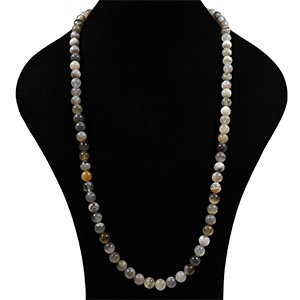
Western Asiatic Agate Bead Necklace String
20th century A.D.Sold for (Inc. bp): £65
A long restrung string composed of spherical beads. 115 grams, 82 cm
Ex collection of a late London, UK, collector, 1970s. This lot has been cleared against the Art Loss Register database, and is accompanied by an illustrated lot declaration signed by the Head of the Antiquities Department, Dr Raffaele D'Amato. -
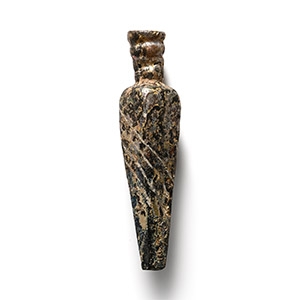
Western Asiatic Iridescent Green Glass Phial
8th-10th century A.D.Sold for (Inc. bp): £59
Comprising a tapering square-section body with narrow shoulder and balustered flared neck. 22.71 grams, 97 mm
Ex important Middle Eastern Royal Family London collection, 1990s. This lot has been cleared against the Art Loss Register database, and is accompanied by an illustrated lot declaration signed by the Head of the Antiquities Department, Dr Raffaele D'Amato. -
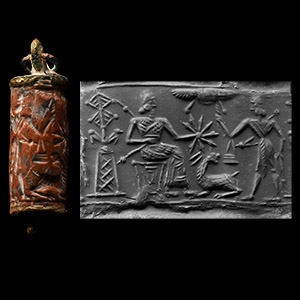
Levantine Jasper Cylinder Seal with Figures
Circa 1000-500 B.C.Sold for (Inc. bp): £1,430
Accompanied by a copy of an old scholarly note, typed and signed by W.G. Lambert, late Professor of Assyriology, University of Birmingham, 1970-1993, which states: 'Cylinder Seal of Red Stone with some Black and White Patches, 36 x15 mm., held in Ancient Bronze Mount with Ring, Total Height: 53 mm. The design shows two figures, the one on the left seated on a stool narrower at floor level than at the seat, he has a bare head, wears clothing down to his ankles, holds a mace in the right hand, a second mace projects above his shoulders, while in his left hand there is a revolving weapon (a sling?). Facing him is a standing figure with clothes to the knees, holding up an unidentified small object in his right hand, holding down a mace in the left hand. Something is suspended by a cord from his extended elbow, and a bow is attached to his shoulders. Between the two figures is a recumbent feline with head turned back. In the sky there is a winged solar disc. For a terminal there is an elaborate stand supporting what is apparently a divine standard. The whole design is put between upper and lower rules. This is a Levantine seal dating to c. 1000-500 B.C. of an extremely rare type. The closest parallel is a cylinder seal in the Louvre, L. Delaporte, Musee du Louvre, Catalogue des Cylindres Orientaux II (1923) A 958, found at Neirab, near Aleppo. The two figures owe something to Old Babylonian seals, the revolving weapon and the dress of the standing figure. The feline, however, and the general 'feel' of the piece are clearly of later and more westerly origin. This is an important piece for its size and rarity; supplied with a museum-quality impression. 20.4 grams, 58 mm
From the private collection of a North American lady, formed 1970s-early 1990s, with collection reference no.P9. Accompanied by a copy of a scholarly note, typed and signed by Professor Wilfrid George Lambert dated June 1992. This lot has been cleared against the Art Loss Register database, and is accompanied by an illustrated lot declaration signed by the Head of the Antiquities Department, Dr Raffaele D'Amato.
