
Loading, please wait...
LOT 1446
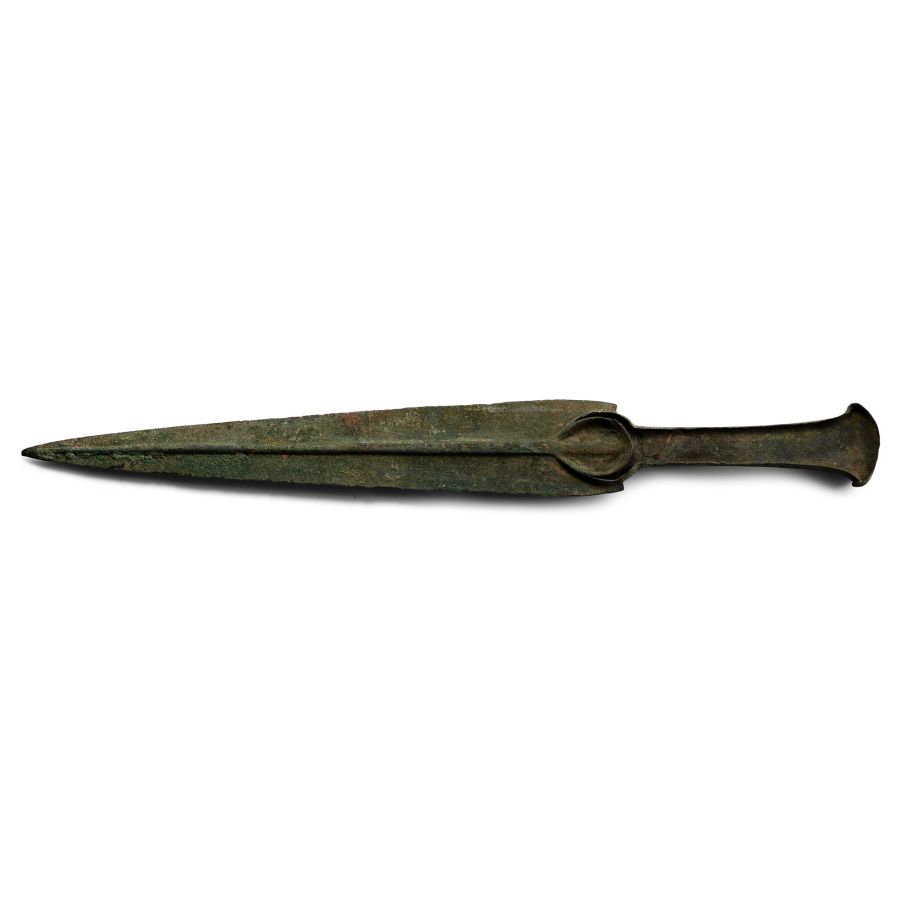
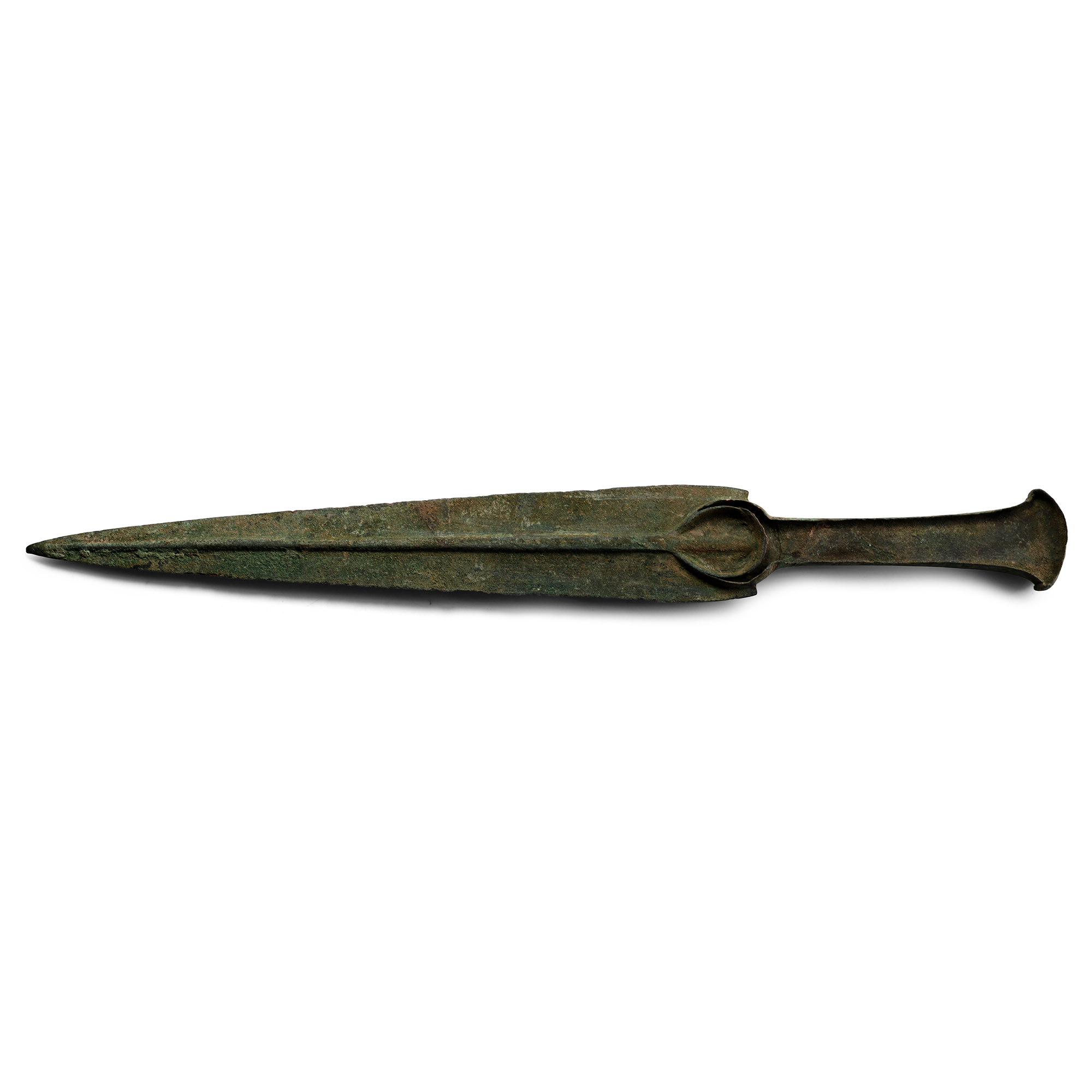
Luristan Bronze Dagger
2ND-1ST MILLENNIUM B.C.
11 5/8 in. (138 grams, 29.5 cm).
With lentoid-section blade, tongue-shaped in plan, with integral tapering hilt with flared finial, lateral flanges to accept a panel of bone to each face forming the grip.
ProvenanceEx London, UK, collection, early 2000s.
LiteratureCf. Khorasani, M.M., Arms and Armour from Iran - The Bronze Age to the End of the Qajar Period, Tübingen, 2006, p.381, cat.13.
FootnotesThe art of Luristan can be described as the art of nomadic herdsmen and horsemen with an emphasis on the crafting of small, easily portable objects, among these a great number of bronze weapons. The rich and noble aristocrats of the Luristan, Elamites, Hurrians, Lullubians, Kutians, and Kassites, went to battle splendidly equipped and wore magnificent bronze armour, using maces, spears and daggers as offensive weapons, alongside spears, bows and arrows.
CONDITIONTimeLine Auctions follows a vetting process to ensure the authenticity and legality of all items, reinforcing our commitment to integrity and responsible trading. Each antiquity, antique, and coin lot undergoes thorough examination by a vetting committee of at least ten external specialists, professional trade association members, scientists, and archaeologists: Our Vetting Process
AUCTIONS:
TimeLine is a leading auction house specialising in antiquities, ancient art, collectables, natural history, coins, medals, and books. Our auctions offer museums, collectors, historians, and enthusiasts the opportunity to acquire unique and historically significant pieces.
-
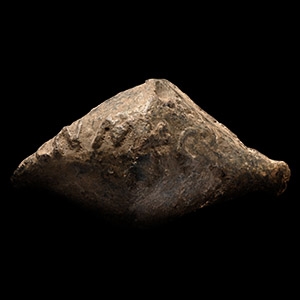
Roman Lead Cnaeus Pompey Battle of Munda Slingshot
1st century B.C.Sold for (Inc. bp): £247
A facetted lentoid-section sling shot (glans) with inscription in Latin letters 'CN' (Cneius) 'MAG' (Magnus) on one side, and 'IMP' for 'IMPERATOR' (victorious general) to the other side, i.e Gnaeus Pompeius Magnus Imperator (Pompey the Great the victorious general). 79.57 grams, 44 mm
From a private Tyneside collection, formed since the early 2000s.
The shot (Völling type 1C) is marked with the abbreviated name of Gnaeus Pompey; it was used in quantity at the Battle of Monda (or Munda) against Julius Caesar, 17th March 45 BC. The projectiles could be of different material: in lead (glandes) or in pottery or stone (lapides missiles). Sometimes they were signed with the name of the general, as is our specimen. -
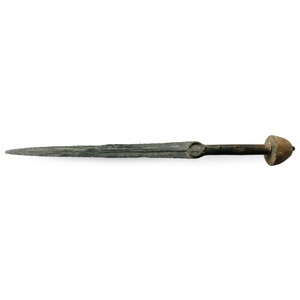
Luristan Bronze Short Sword
2nd-1st millennium B.C. and laterSold for (Inc. bp): £442
With leaf-shaped two-edged blade, crescent guard; restored hilt with columnar grip and stone pommel. 521 grams, 58 cm
From a North West London collection; previously acquired in the 1980s. -
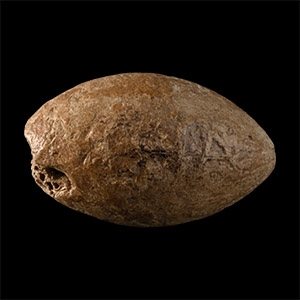
Greek Macedonian Lead Inscribed Slingshot
3rd-1st century B.C.Sold for (Inc. bp): £78
Biconical in profile with casting seam and reserved legend 'ΥΔΑ'. 36.6 grams, 30 mm
Ex German art market, 2000s. Acquired from an EU collector living in London. From the collection of a Surrey, UK, gentleman.
The leaden bullets, which were thrown from slings, were called molivdainai (μολύβδαιναι) in Greek, and in Latin glandes; the former indicating the material ‘lead’, the latter the shape ‘acorns’. These bullets were cast in a mould and bore letters or devices, or both. In form they were more like an almond than an acorn, but many were pointed at both ends; in size, they are generally about 1.5 inches in maximum length, and under 1 inch in maximum width.
