
Loading, please wait...
LOT 1102
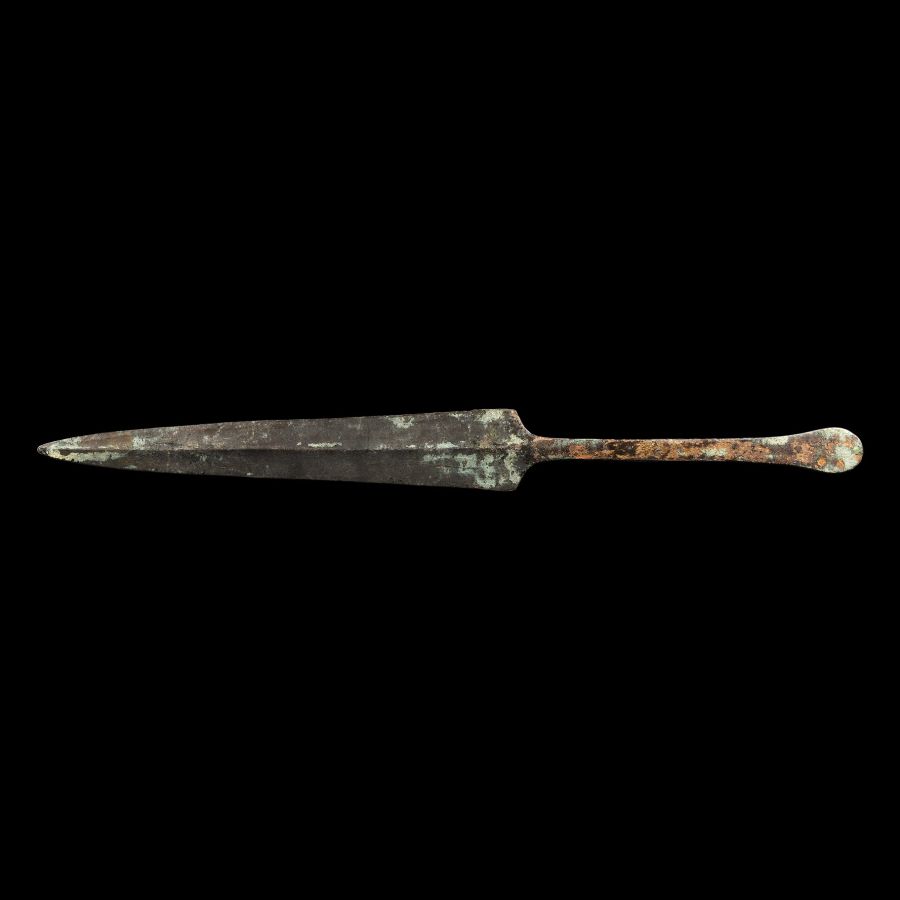
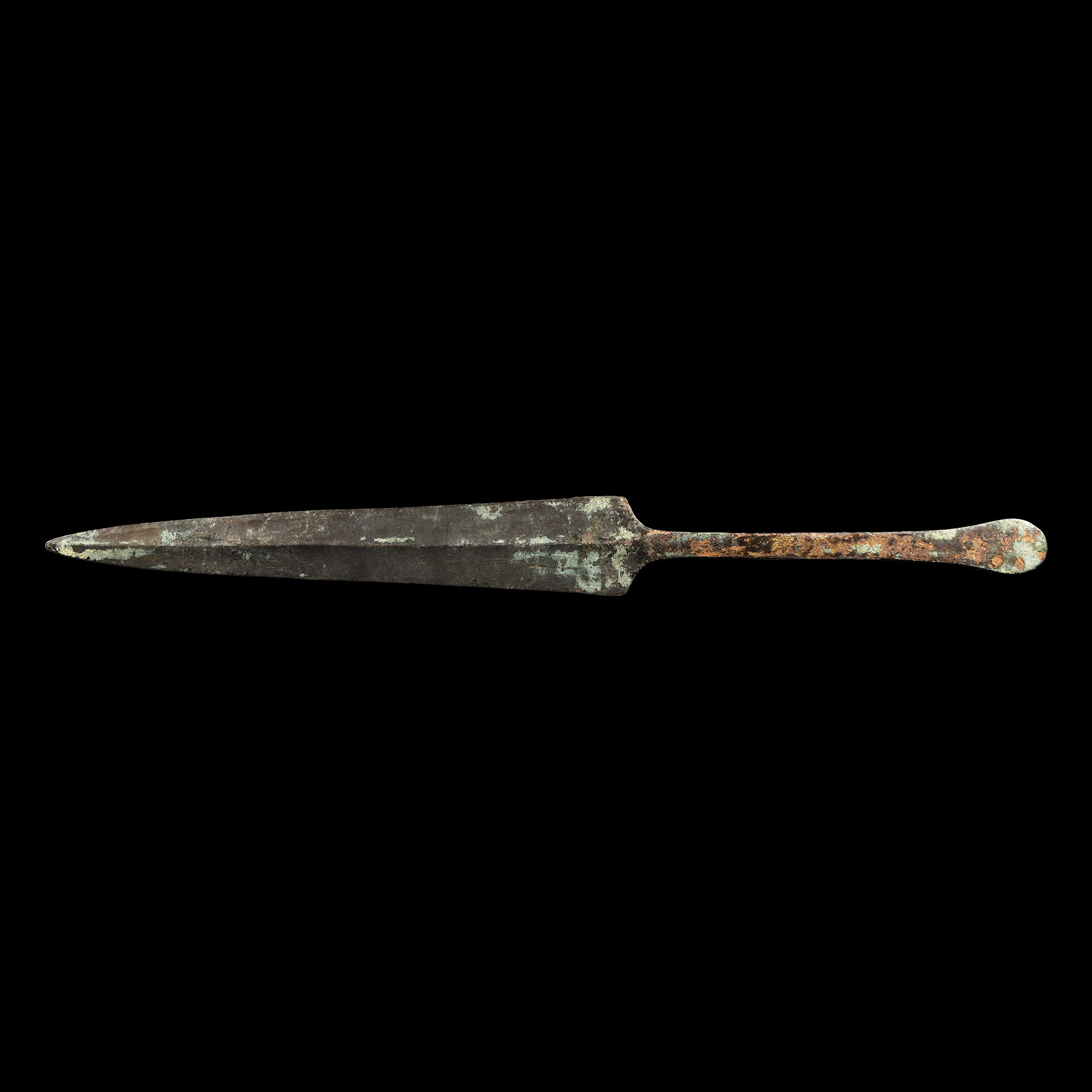
Luristan Bronze Dagger
CIRCA 1000 B.C.
14 1/8 in. (129 grams, 36 cm).
Narrow triangular casting with gentle midrib and narrow point, scooped shoulders, long flat-section tang with lobe finial.
ProvenanceEx German collection, Cologne, 1980-1990s.
LiteratureCf. Khorasani, M.M., Arms and Armour from Iran - The Bronze Age to the End of the Qajar Period, Tübingen, 2006, p.381, cat.3, p.376, for type.
FootnotesThe type of the present dirk or dagger corresponds to type IX of Medvedskaya classification. The type consists of a bronze blade with organic handle, possibly made of bone or wood, and a long tang, which was usually bent at the extremity. According to Moorey, the exact dating of these pieces is uncertain.
CONDITIONTimeLine Auctions follows a vetting process to ensure the authenticity and legality of all items, reinforcing our commitment to integrity and responsible trading. Each antiquity, antique, and coin lot undergoes thorough examination by a vetting committee of at least ten external specialists, professional trade association members, scientists, and archaeologists: Our Vetting Process
AUCTIONS:
TimeLine is a leading auction house specialising in antiquities, ancient art, collectables, natural history, coins, medals, and books. Our auctions offer museums, collectors, historians, and enthusiasts the opportunity to acquire unique and historically significant pieces.
-
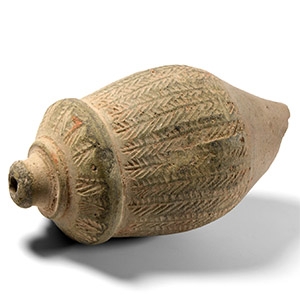
Byzantine Ceramic 'Greek Fire' Fire Bomb or Hand Grenade
9th-11th century A.D.Sold for (Inc. bp): £163
Composed of a piriform body with 'feather' design and eccentrically placed domed mouth; intended to be filled with explosive liquid and wick, and used as a hand grenade; chipped foot. 613 grams, 17 cm
Collected before 1970. Ex gallery of C.M., UK. Accompanied by an academic paper by military specialist Dr Raffaele D'Amato, dated 15 July 2019 and titled 'Eastern Roman Empire - Greek Fire Bomb or Hand Grenade (μεσαίον kακάβιον) 9th-11th century AD'.
Apart from the use of siphons or manual flame-throwers called cheirosiphona, special corps of Roman soldiers employed terracotta grenades, in the form of small jars, abundantly evidenced in archaeological excavations. Such were the γανωτα, vessels (sometimes also of bronze) used for Greek fire. They were called μεσαία kακαβιά or κυτροκακάβια where the former had a bulbous shape and the latter a more cylindrical form. -
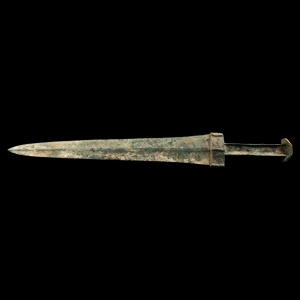
Luristan Bronze Dagger
2nd-1st millennium B.C.Estimate: £300 - 400 (+bp*)
Opening Bid: £160
Comprising a narrow double-edged blade, triangular in profile with raised midrib, rectangular guard with flanges, rectangular grip with lateral flanges to accept an organic grip, curved integral finial. 312 grams, 43 cm
Ex German collection, Cologne, 1980-1990s.
This weapon is typical of the cemeteries dating to the local Late Bronze Age (1300-1000 B.C.). The blade is still triangular but the crescentic pommel is reduced and flanged to be filled with organic material such as bone or wood. -
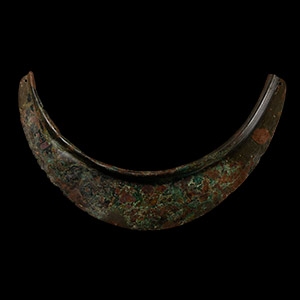
Greek Browband from Bronze Pseudo-Attic Helmet
3rd-2nd century B.C.Sold for (Inc. bp): £117
Semi-circular in shape, flat, the upper part raised, the lower one fitted with two fastening holes for the attachment to the upper bowl of the helmet; restored. 42 grams, 20.6 cm
Restored.
Private collection before 1937. Private collection, acquired February 1937, thence by descent. T.S. collection, UK, 1963.
The browband comes from a pseudo-Attic helmet of Thracian type (example from Brjastovec) or of a pseudo-Attic type with a high cap and fitted with a browband. These helmets, after prototypes already visible in the 5th century B.C., are typical of the Hellenistic era. The browband, if not fixed, was attached under the helmet's bowl, on the sides, by two rivets.
